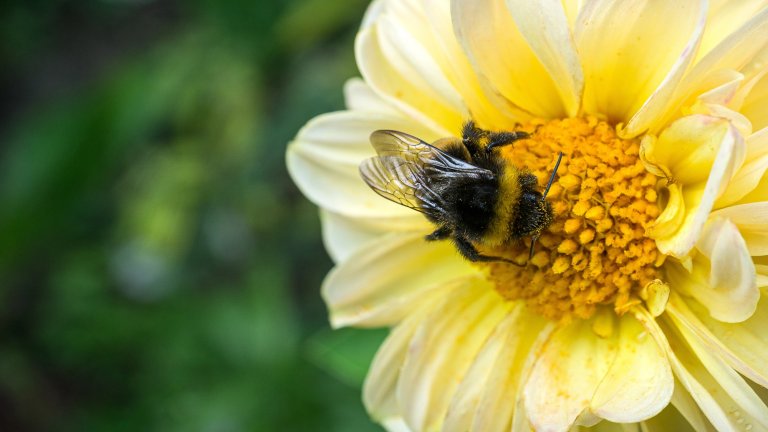
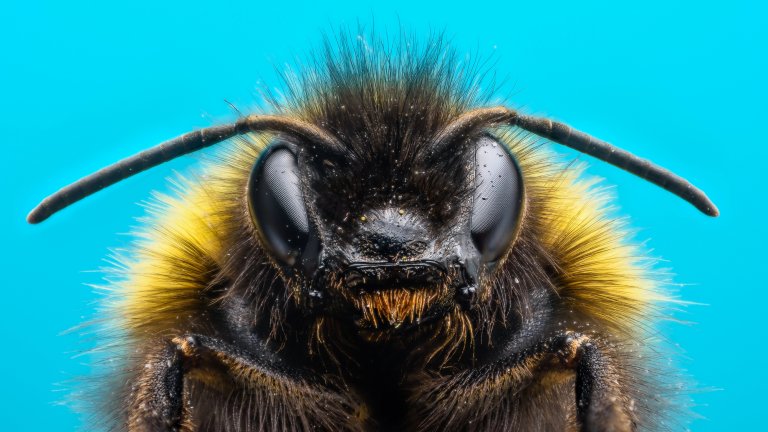
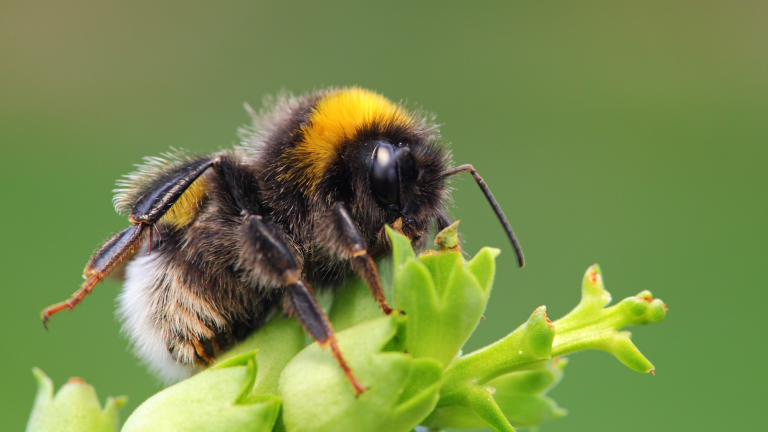
Bees need not recognize human faces when going about their pollination business. Yet scientists have now found that they can train bees to recognize the arrangement of human facial features, by rewarding the classy striped insects with sugar. That could inspire new facial recognition systems, given that bees manage this feat with brains the size of a microdot.
The bee ability to distinguish between human faces was first noticed by Adrian Dyer, a vision scientist from Monash University in Australia. But biologist Martin Giurfa from the Université de Toulouse in France wanted to better understand how bees managed to learn facial features, and so he teamed up with Dyer to carry out a more systematic test.
It turns out that bees don't consciously recognize individual people, so much as the relative pattern that makes up a face. Researchers tested this by first training the bees to recognize simple faces made of dots and slashes, and then seeing if the bees could distinguish between two different faces. The bees passed the test.Next, the research team gave the bees a choice between new faces and a random assort of dots and slashes. The bees still ended up homing in on the face-like patterns. Equally as impressive, the bees learned to recognize stick-and-dot faces against face-shaped photographs, and still identified the correct faces without the photo backgrounds.
Other insects have continued to prompt new research on full-color night vision for drivers. But face-recognition technology has a special place in the hearts of governments and security agencies, so we'd expect to hear some follow-up on this.
138 years of Popular Science at your fingertips.
Each issue has been completely reimagined for your iPad. See our amazing new vision for magazines that goes far beyond the printed page
Stay up to date on the latest news of the future of science and technology from your iPhone or Android phone with full articles, images and offline viewing
Featuring every article from the magazine and website, plus links from around the Web. Also see our PopSci DIY feed
The first issue of 2012 is a great one: we've got stories on how to make planes, tanks, subs, and soldiers invisible. Also, how the U.S. is reengineering homeland security at the southern border, inside the deepest mine in the world, and our predictions for the year to come.
Maybe I could train my own apiary of killer bees to recognize the faces of my enemies, and then send swarms of them to attack. It would all just look like freak incidents. The perfect crime...
OK, so now read the article on DARPA remote controlling moths with imbedded chips. So if bees can learn faces, maybe we can get them to sting terrorists.
oh wow! Amazing! they are so intelligent
I am constantly amazed by these creatures and the depth of their intelligence. I have to say that I am not surprised based on the fact that they mark flowers to let each other know which ones have been pollinated. They are just so amazing!
Well now that is crazy! We will be employing bees at the entrance gate of high security facilities, will we not? That is a very efficient solution because then fraudulent activity could be punished by bee bites right away! No need for prisons anymore nor security staff either! What a breakthrough!
Come and see Budapeste: www.hungriabonita.com/budapeste