In 2004, Matthew Teague traveled to Arthur C. Clarke's Sri Lankan home for a Popular Science profile. They candidly discussed Clarke's incredible legacy as well as his insatiable thirst—even at age 87—for the next Big Idea. Here we present again this feature in tribute to a man whose visions still continue to profoundly influence the world of science and technology today.
The gate to Arthur C. Clarke's compound stood tall, white and blast-proof. We ran our hands over its surface, poking around for some secret doorbell. "Hello? Can anybody hear us?"
I wasn't trespassing—I'd called ahead, and Clarke agreed to see me, apparently curious why an American would track him down to this doorstep in Sri Lanka, the tiny, troubled island nation off the coast of India. But the place spooked Thilac, my Sri Lankan driver. "Maybe wrong house," he said, looking around. "OK?"
Cinnamon Gardens is Sri Lanka's most lavish, powerful neighborhood. Clarke is the country's most famous resident. On an island where the caste system remains in force, taxi drivers don't go pawing at castle walls. When the gate mysteriously pulled back, triggered from inside, Thilac turned on his heel and walked back to his car. "You go," he mouthed from the driver's seat.
A mustached valet appeared and waved me in: "He is waiting." The main garden was barren but for the miniature headstones of pet dogs Clarke has owned during his almost five decades on the island. Dust blanketed every surface inside a glass atrium attached to the main house; sun-faded movie posters from 2001: A Space Odyssey decorated the walls. It appeared that only house staff lived in this stale place, until my guide threw open the door to Clarke's library and a gust of cool air rushed out. The library was full of light; rows of lovingly organized books covered the walls. In the room's center sat Clarke, 87 years old and wheelchair-bound from the effects of post-polio syndrome but still spry. "Look!" he said without preamble, spinning his chair to face a bank of computers. "You must see something!"
Monitors surrounded him. One displayed a paused DVD: Independence Day, Will Smith's mug frozen in goofy horror. Others blinked with e-mail alerts. "Look," Clarke said again, waving for me to look over his shoulder. On one screen he summoned recent photos transmitted from Mars. He cycled through shots of an orange landscape, a mountain, a canyon. Here we sat, in this wood-paneled study, on this remote island, and, as if by magic, stared out at a Martian sunset.
The world owes that sight, in part, to Clarke's own vision as a writer and thinker.
"Beautiful, isn't it?" he said.
Only a handful of science-fiction writers have reached beyond the bounds of their genre and grabbed the attention of the world: H.G. Wells, Isaac Asimov, Arthur C. Clarke. But it wasn't Clarke's lyrical prose that carried him there. His ideas did the job.
As a child in England, he explored in the way little boys often do: Dinosaurs. Chemistry sets. Science-fiction magazines. But his obsession with what lay ahead—the Big Idea—never subsided. When he was a soldier in World War II, he joined a military team attempting to harness the power of radar.
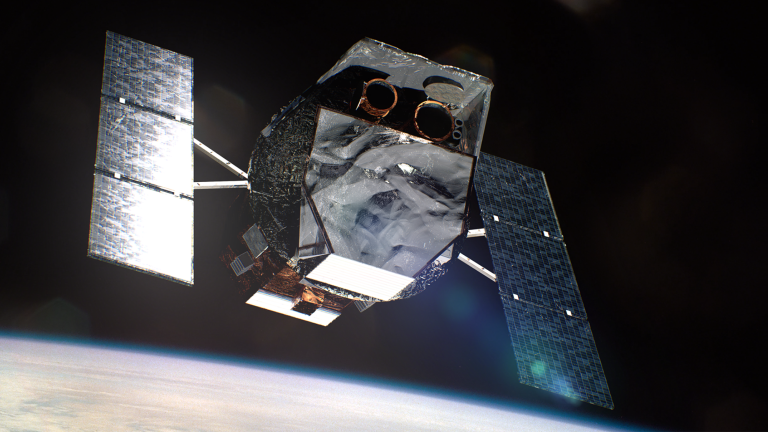
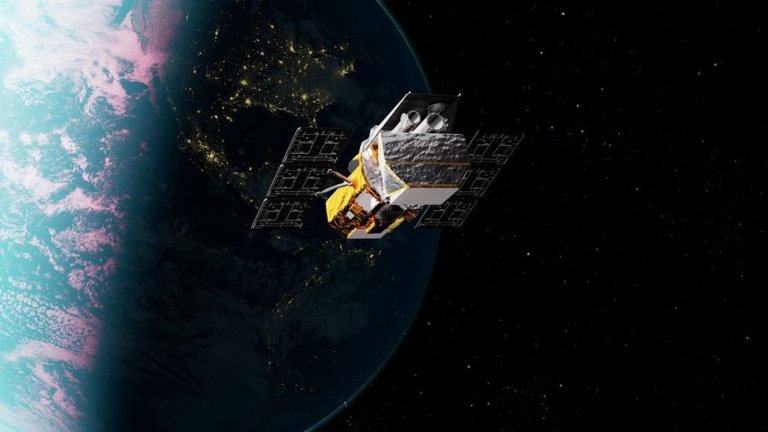
He was no scientist or inventor. But when he was 27, seemingly out of the blue, Clarke offered the world a remarkable vision: satellites. At the time—1945—there was an ongoing to-do about ways to create global communication. The reigning idea was to plant television towers across countrysides everywhere, an impossibly expensive and ugly notion. Then came Clarke's outrageous idea, in a paper called "Extra-terrestrial Relays." "Many," he wrote, "may consider the solution proposed in this discussion too far-fetched to be taken very seriously."
Rockets, he suggested, could carry into orbit lightweight units that could act as superhigh relay towers. Two decades later, when the world caught up, scientists named what we now call the geostationary orbit the Clarke Orbit.
Despite the Luxe surroundings—the mansion, the attendants, the reminders of his fame and influence—Clarke opened our conversation with a disarming nervousness. He fidgeted, toying with his eyeglasses, playing with my tape recorder. Time has claimed pieces of his memory, and he seemed aware of it. When I asked about his latest book, a collaboration with science-fiction writer Stephen Baxter, he looked down sheepishly and said, "Yes . . . Time's Eye. . . What was that about?"
For a while he wouldn't reply to my questions at all but instructed me to direct them to his Sri Lankan assistant. ("He can answer all these," Clarke said. "I can hardly talk.") Later, instead of speaking aloud, Clarke flipped through his older books for passages relevant to our conversation.
"Read this," he would say. "It's all in there." He could trust his words better, it seemed, when he could see them in black and white. "So," I ventured. "You've written every thought you've ever needed? No more need to speak?"
At this mild provocation he came alive. The question bumped our discussion out of the past—slippery terrain for a man in his late eighties—and into the future. He felt comfortable in the future, the home of Big Ideas.
"You've reminded me of something," he said. "How many books could ever be written?"
"Like . . . how many songs could ever be composed?"
He practically came out of his wheelchair. "Exactly! I think I worked it out one time, and it's some big number, like 10 to the power of 100 to the power of 10." I sat dumbfounded, feeling dense. He added for my benefit, "Since there are only a limited number of letters."
And so a pattern emerged in our talk, like a game. I asked a question, and he picked a random point elsewhere in the conversational universe and answered from there. Then, just when I thought he had blasted off into the void of senility, he would touch down neatly on our topic.

The picture was of a Chihuahua, whose name, he said, was Pepsi. "I'm going to get another one today," he said.
"Another Chihuahua?"
"Yes. Oh yes. The same one again."
Talking with Clarke was like spending time with a prophet. No answers came easily, and when they did come they often took the form of parables. Rather than entangle himself in a long argument over the ethics and viability of cloning, he simply handed over a picture of his beloved Chihuahua—a fine candidate, one might infer, for cloning.
single pageFive amazing, clean technologies that will set us free, in this month's energy-focused issue. Also: how to build a better bomb detector, the robotic toys that are raising your children, a human catapult, the world's smallest arcade, and much more.


Online Content Director: Suzanne LaBarre | Email
Senior Editor: Paul Adams | Email
Associate Editor: Dan Nosowitz | Email
Assistant Editor: Colin Lecher | Email
Assistant Editor: Rose Pastore | Email
Contributing Writers:
Rebecca Boyle | Email
Kelsey D. Atherton | Email
Francie Diep | Email
Shaunacy Ferro | Email
We have lost one the great intellects of the century. His mark is indelible and not only in literature but in hard science as well. I can't believe that no one else has yet commented on the reposted article.
Clarke was definitely a giant intellect, as well as a fabulous writer. It's sad when we discover a brilliant person's blind spots, however.
Clarke's blind spot was his own faith, though he claimed to be an opponent of faith. EVERYONE has faith in SOMETHING. If Clarke was an atheist, or at the very least an agnostic who practically lived as if atheism were true, then that was his faith. He placed faith in something he could not prove: the nonexistence of God.
And he talked about religion as being a very negative force in this world, totally heedless of the fact that some of the worst atrocities in history have been committed relatively recently by NONreligionists: Stalin, Hitler, and Mao Tse-tung. EVERYONE believes in something that drives their day-to-day actions, including power-grabs and the persecution of others.
And there is no conflict between science and religion, because science is ultimately founded on the nonscientific: a faith in the order and rationality of the universe, and our corresponding ability to interpret it. And our interpretations of nature's raw data are based on our precommitment to a certain worldview: if we have faith in naturalism - that nature is all there is and provides all the answers - then we will automatically interpret the data naturalistically. In such cases we haven't "proved" that a given phenomenon is strictly natural; we've just assumed that it is. A supernatural explanation may in some cases be equally logically possible.
(Note: I am NOT suggesting we opt for a supernatural explanation whenever a scientific investigation is stuck. I am simply pointing out the underlying assumptions that exist in our reasoning.)
Finally, while Clarke was good at predicting future technology, he was being quite ridiculous to hope for the eradication of religion. Man is an inherently and incurably religious creature. What's more, and this is very ironic, Clarke was an evolutionist, which means that by his own faith in naturalism he was forced to explain all human behaviours and character as the outcomes of the evolutionary process - which means, in turn, that religion in Clarke's view of the world must in fact be an outcome of evolution. If it is an outcome of evolution, then this must mean that it has been necessary for our survival, and apparently still is, since there are hardly any atheists on the planet.
If atheists believe that, by virtue of their atheism, they have "evolved" beyond any possible need for religion, what that means is that they view themselves as higher up the evolutionary chain than religionists - which, when you think about it, is a lot more arrogant than they consider religionists! Another irony is that such arrogance about one's supposed position on the evolutionary ladder is what undergirded one of the great evils of recent history, Nazism.
I like to think that Clarke ultimately found God before the end, but I have my doubts, sadly. In any case, he sure knows the truth now.
Dear previous poster:
Believe to be true what you want to be true! Other people will base their actions and perception of reality on EVIDENCE that can be reliably observed by anyone and on PROBABILITY rather than wishful thinking.
The ability of some people to twist everything until it fits into their (or any) religion is amazing. And while it is true that there are not as many atheist as there should be considering the evidence for a personal god or the miraculous workings of religion, by the same token you can say the same thing about people trusting in science. Considering how well the scientific method works, it is simply MIND BOGGLING how many people do not think that way.
Ultimately, the inability to seek, question until there are no more likely answers, and accept what really is going on (until further evidence surfaces) while happily accepting what is more convenient to accept without skepticism may be what brings us to an end. Maybe people are ultimately religious (aka believe what suits them best) but this is not reason for celebration. At least not if you want 6.5 billion people to continue to live on this planet.
The "faith" in religion is by no means the same than "trusting" in science! One is based on accepting without evidence the other is based on accepting as most likely after critical review of evidence by many. Science has proven to work far better to explain and even to predict phenomena. It does not mean it needs no scrutiny, or that scientists are infallible, or that there are no powerful interests that influence scientific data and scientists. It means that you will get more reliable results if you use it the way it should be used. Carl Sagan once wrote that you can inoculate against disease or you can pray. There are many many examples like this. It is a matter of reasoning. Some do it - too many don't.
You may not want to accept that evolution is more likely than any other idea currently on the market, however rejecting science and scientific thinking and retreating to religion (which one by the way?) may not send us back into the trees, but it will send us back into the dark ages. I don't know about you, but I from what I have heard about it, I don't want to be there. We have made progress, we need to continue. There is so much possible still, we have not discovered all by far. Still much work to be done. Stopping to search (or searching without restraint) is not going to help. If you want to criticize science you could question those who search without accepting responsibility for what they might find. Just because something can be done does not mean it should be done. Call feeling and being responsible for my actions my "religion" or "spiritualism" if you want.
BTW, whether you believe that there will be something after your death or not - you won't be disappointed! Probably not even surprised. :)
Karsten
--
http://www.polluteless.com
Practical Advice to Pollute Less
ad101867
Bad people are bad people, whether they are modern tyrants like Stalin, Hitler or Pol Pot.... Or the Medieval inquisition. Or the Spanish inquisition. Or the Portuguese inquisition. Or the Roman inquisition, which is the one that had Galileo recant his theories about Heliocentrism, now there's a blind spot for you... This is what religion is good at; stifling free speech and free inquiry.
As far as faith goes... It all depends on your definition of faith, doesn't it?
HOW dare you claim to know or perceive what another mans 'faith' is or even assume that you have an inkling as to his thoughts, regardless how you might be interpreting it? More accurately it seems, what you would consider it to be... Arrogant.
Man might be a religious creature, then again he may not, but we don't need to have religious types trying to tell the rest of us what to think about faith. In the religious sense, faith simply seems to be a divider, you know 'which of these these things is not like the other, which of these things doesn't belong'.
By the way, Hitler was raised Roman Catholic but preferred 'Positive Christianity'
Science is founded on the non-scientific??? If you wish to abdicate your reason to faith, be my guest, but please keep it to yourself.