Get the Popular Science daily newsletter💡
Breakthroughs, discoveries, and DIY tips sent six days a week.
By signing up, you confirm you are 16+, will receive newsletters and promotional content and agree to our Terms of Use and acknowledge the data practices in our Privacy Policy. You may unsubscribe at any time.
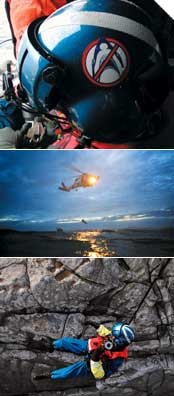
Playing a duck is not as easy as it sounds — not when a duck, in rescue swimmer lingo, is a practice victim, and the water, off the southern coast of Alaska, is too damned cold for anything without feathers. But here I am, dangling in a rescue basket 30 feet below the thundering hulk of a Coast Guard HH-60J Jayhawk helicopter with an elite squad of lifesaving commandos 20 feet underfoot. “Everything OK?” yells one after I’m dunked in the drink. “Hell yeah,” I shout back. It’s all I can muster between mouthfuls of 120-knot rotor blast.
Since its inception in 1984, the Coast Guard Rescue Swimmer program has grown to include nearly 300 swimmers at 25 air stations throughout the United States and Puerto Rico. More often than not, they’re the only intermediaries between life and death for shipwrecked mariners, and here in Sitka, Alaska, they take on the additional responsibilities of rescuing sick inhabitants from remote villages and plucking lost hunters from Alaska’s vast southeastern archipelago. It’s a daunting job, and proficiency training, such as the sea and cliff rescues that are on today’s menu, ensures they keep their edge.
Before ever saving a life at sea, rescue swimmers must pass a grueling four-month course at the Aviation Technical Training Center in Elizabeth City, North Carolina. Students simulate helo jumps, practice rescue techniques and learn to service and maintain everything from pyrotechnics to life rafts. Only 50 percent graduate, and those who do maintain their certification as aviation survival technicians (ASTs) through a monthly exam that includes 50 push-ups, 60 sit-ups, five pull-ups, five chin-ups, a 500-yard swim, four 25-yard underwater swims and a similar set of buddy tows. And in Alaska, they’re also required to have EMT 2 certification, which means they can intubate patients and administer IVs — handy skills at Air Station Sitka, where half of the 140 annual missions are bush medevacs in extreme weather with low ceilings, poor visibility, high winds and mountainous terrain.
“Usually, we get the call during harsh storms when commercial planes can’t fly,” explains AST Second Class Jason Schelin. “We have low-vis GPS routes that we fly low and slow, feeling our way blind if we have to.”
To put it mildly, things were different when I was a rescue swimmer in the mid-1980s aboard the USCGC Storis (a 61-year-old cutter now known as the Queen of the Fleet). We wore little more than a neoprene survival suit with a harness and a rope. Today’s dry suit is Mojave-like compared to the old leaky “gumby” one I wore, and the Trisar harness — which rescue swimmers use to attach themselves to the hoist cable — singlehandedly accomplishes what used to require two separate harnesses and a flotation device. Other modern amenities on their equipment list include a Uniden HH 940 waterproof radio, night vision goggles and a Benchmade switchblade that’s particularly useful for one-handed line cutting.
The art and science of cliff rescues is also far more evolved than when I was in the business. After several hours of open-water training, in which swimmers repeatedly jump out of the hovering helo and traverse 50 meters of ocean to “save” me, we fly to a nearby cliff to practice rescuing a stranded dummy known as Oscar. AST Third Class Michael Browning makes the first attempt, securing a hand and foot in the rock face before signaling us to fly forward, which pushes him snugly against the cliff. He then slowly advances toward Oscar — not so easy in full gear with the Jayhawk screaming overhead — eventually securing him in a dual harness. Both are hoisted aboard. Mission accomplished.
Browning makes it look easy, but most rescues in Sitka’s 300-mile mission radius are far more intricate and dangerous. Supporting the physical efforts of the helicopter crew — two pilots, a flight mechanic and the rescue swimmer — is a suite of high-tech gear that includes night-vision-compatible avionics for nighttime searching, a weather and surface radar, a forward-looking infrared sensor, GPS and inertial navigation systems, and an ultrapowerful Nightsun searchlight that must always point away from the helo lest it blister the paint. My hosts won’t even permit me to switch it on; instead, we rely on two small searchlights near the nose.
Then there’s the survival and rescue equipment packed in the rear of the helo, including rafts and a dewatering pump that can move 250 gallons per minute from a sinking boat. Most impressive is the medical kit, which features a backboard, collapsible litter, Super D oxygen bottle, backpack trauma kit with drugs, IVs and intubators, an advanced first-aid pack and a Lifepack multifunction monitor with automatic defibrillator — in short, anything you’d expect to find in a big city ambulance. “I’ve seen everything in the back of a helicopter that occurs in a hospital emergency room,” says Cmdr. Karl Baldessari, a Jayhawk pilot and operations officer at Sitka, “from fighting a combative survivor to rescue swimmers straddling a cardiac patient while performing CPR.”
One mission always stands out, and for Schelin it began with a mayday call from a mariner stranded in Chatham Strait, a notoriously nasty stretch of water. The man’s engine had quit en route to Funter Bay, and 40-knot winds and 8-foot swells were pushing him toward a jagged outcropping. Hovering directly over the boat, Schelin yanked the man to safety seconds before his skiff splintered.
Such scenarios drive home the very real possibility of a rescuer being left behind, with or without the rescued. Anytime you deploy a swimmer, explains Baldessari, you’re talking about at least three live hoists: deploying the swimmer, pulling up the survivor and recapturing the Coastie. Should things turn sour, the flight mechanic would throw the swimmer an inflatable raft, which comes complete with a survival suit, flashing light and emergency position indicator beacon. “It drives you crazy if you think about it too much, but we’re all trained to do whatever it takes to survive,” says Schelin. “I’d put on the suit, get in the raft and deal with it.”
Rescue swimmers have the right to refuse any mission they deem beyond their capabilities, but it’s tough to imagine one dire enough to fit the bill. “We’ve stopped counting the number of people we’ve saved,” explains Baldessari. “In that respect, the swimmers are definitely heroes.”
2025 PopSci Best of What’s New
The 50 most important innovations of the year