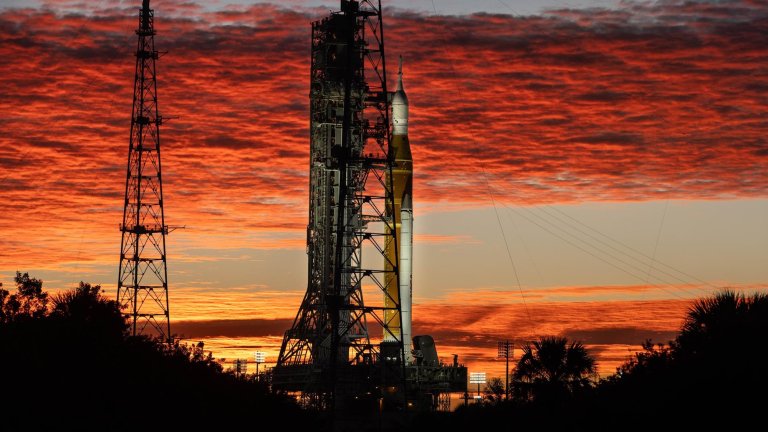
The Lightcraft's laser propulsion engine undergoes hypersonic shock tunnel tests in Brazil

Beam Me Up, Lightcraft No more boring commutes with the laser-propelled Lighcraft! Laser airspike experiments are currently taking place at Brazil's Henry T. Nagamatsu Laboratory of Hypersonics and Aerothermodynamics. A.C. Oliveira and I.I. Salvador; Courtesy of IEAv-CTA

Future business travelers may literally ride a laser to work. The U.S. and Brazilian Air Forces are experimenting with Lightcraft technology that could become part of your daily commute, using plain old air to fuel 45-minute transcontinental jaunts.

The design uses a ground-based laser to beam the Lightcraft skyward on a series of blast waves. A parabolic mirror on the back of the craft would capture and focus the pulsing laser beam so that it heats air to 5 times the sun's temperature, creating mini-explosions that propel human passengers or cargo to any point on the planet in under an hour, or into orbit.

If successful, a laser propulsion system could pave the way for cheaper launches for both NASA and the private space industry.

Riding a Beam of Light: Kick back and relax for your one-hour commute from New York City to Tokyo.  Media Fusion; Courtesy of NASA
Recent tests have taken place in a hypersonic shock tunnel with lasers that can reach the gigawatt range. The experiments involving laser-heated airspikes have been hosted by the Henry T. Nagamatsu Laboratory of Hypersonics and Aerothermodynamics in Sao Jose dos Campos, Brazil.

Such efforts represent the highest-powered laser propulsion experiments ever performed, according to an exclusive SPACE.com interview with Lightcraft founder Leik Myrabo.

Previous Lightcraft prototypes flew at White Sands Missile Range in New Mexico, and also claimed the world altitude record for laser-boosted vehicles in flight. Now Myrabo has funding from the United States Air Force Office of Scientific Research and the Brazilian Air Force, as well as access to the hypersonic shock tunnel that can simulate airstreams reaching Mach 25.

Hear those loud bangs? Sounds like the future -- not to mention 45-minute commutes halfway around the world.

[via SPACE.com]

Want to read more articles on the military, aviation, and space? Subscribe to Popular Science and enter to win $5,000!

22 Comments

This looks fantastic and a little futuristic let's recognize.
I don't believe in a way to travel based on lasers because they are unidirectional. If the laser ray is lost somehow, the trajectory and the vehicle is lost. It's not controllable.
I think that this could be a great idea for some other applications.
http://thecarpetsteamcleaner.com

Sounds like it could be used for the space elevator. After clearing the atmosphere, on-board propellent (water?) could be superheated to provide a rocket blast that exceeds the energy-to-weight ratio of standard boosters. Even traditional space flight could be done in this way. This would make is far less complicated and less dangerous.

It also gives new meaning to: "Beam me up, Scotty."

it can be certainly directional, the laser may be a straight line only perturbed by gravity, but the reflective focus of the receiving dish may only limited by the articulation built into it. Allowing it to point the reflection opposite of the direction of travel.

Sounds plausible to me.

it can be certainly directional, the laser may be a straight line only perturbed by gravity, but the reflective focus of the receiving dish may only limited by the articulation built into it. Allowing it to point the reflection opposite of the direction of travel.

Sounds plausible to me.

i hate when clicking once, you get a double post...sorry folks

one more time...

It certainly can be directional...the laser may be a straight beam only perturbed by gravity, but the reflective focus of the receiving dish may only be limited by the articulation built into it. Allowing it to point the reflected and focused beam in a direction opposite to the desired direction of travel.

p.s. i wish there were a way to erase typos after posting....

The trolling 'tard 1st poster spam artist clearly has no idea what they are talking about.

Obviously the laser propulsion is only good in a single initial direction for forward movement. i.e. out to space, trans continental flights, etc.

However there is no reason why a leap frogging system could not be in place to allow for different directions.
Imagine the possibility of having these systems and traveling at those immense speeds on earth.

Also secondary propulsion would most certainly have to be on board in case of a failure or if you were to lose your fuel source (going into space = no air to heat).

Incredible technology..now if we could only produce the necessary electricity for this laser on the cheap and with low/ no emissions.

--GTO--

@GTO: agreed :)

SWEEEEEEEETTTTT!!!!!!!! nuff said.
www.youtube.com/watch?v=hEUWrj7SyPk

Laser-Powered Lightcraft "At the Cusp of Commercial Reality"

Im sooo bored of reading for BIG rocket's and now multi-megawatt high powered laser driven craft's !

Maby we simply need a new "wheel" to cheat on that pesky gravity force...

I went back to my archive and pulled some past science data on the "Fly by Microwave" and found some articles from the past on it, one of them is from Science magazine dated September 1995 -- I remember it as though it was just yesterday. The major problem before with this technology was how to maintain a coherent beam, keep the laser beam from spreading, they may have solved that problem by now.

Using airspikes by superheating the atmosphere ahead of it therefore the spacecraft is pulled skywards by the extreme change in pressure is a great out of the box idea. Using a microwave frequency beam, that can go through the clouds or atmospheric disturbances without losing much energy will be another plus.

I suspect that a good combed beamed laser in the future will revolutionize the efficiency of the laser to make this idea more workable in the future. Combed lasers use more than one spectrum of light, it will revolutionize everything if perfected such as spaced based solar concentrator beamed energy without solar cells or Beamed wasted energy from earth to anywhere on the planet:

www.shineinnovations.com/6112.html

... and no chance of bird-strike, because the little buggers have been vaporised by the laser

30,000 degrees Celsius? Sounds toasty.

The Air Traffic Control system would need a serious upgrade if they were to eventually get this style of propulsion going mainstream.

What about sonic booms? They arent like a bump in the road. Would the acceleration be slow or fast? You can kill with enough G's you know. It has great potential, but you would have to design a craft that is comfortable and effecient. What does the laser give off as it burns the air ultra hot? Ozone or a plazma? All this needs to be taken in concderation.

With ideas and a little bit of mortar I can create anything you please.

Superheating air? Well, you might get ozone, and from that nitrogen oxides. Not so good, but it shouldn't exceed that from a lightning strike (based on naive guestimate, of course) so sure. Plus, if General Fusion gets going in a decade or so, you could power it cleanly at low cost. Everybody wins :) (well, except some people, but we don't talk about them)

When I read "heats air to 5 times the sun's temperature", I get to wondering how this can't have a huge negative impact on global warming (whether it be man-made or not).

Can anyone say "Global Warming"? (Children, you never know what they will put into their mouths).

Here is a video of how they claim it will work???

www.space.com/common/media/video/player.php?videoRef=SP_090729_LightCraf...

imagination = good
unrealistic = bad
This is a cool project, but I can list a whole bunch of "realistic problems" correct me if I'm wrong

- Power failure, no laser, no flying, even with back up fuel, it wouldn't last long
- The higher up you go, the less atmospheric pressure there is, less air? More energy is required to provide thrust for the ship
-Global warming as a result of manufacturing the ship, the station, heat from the craft.
- Where do you get the energy to power that laser!!!
-Laser hits a UFO a kills the life on board ( jk :))
- Strong wind can possibly send the craft off path and whewwwwww BAM into the ground/sea/ice
- How much weight can these things carry?(Not much of a problem, but useless if can only carry like one or two people per trip. it)

IF whatever company can eliminate these problem, then I'm with it.

I've been reading the stuff P.S. has written up, and what I've seen on the tube on this, and it looks like a great way to boost compressed gas for collection in orbit. Ya get the precious gas, and the metal. Or whatever. We will still be paying way too much in 10 years on boosting dumb mass, not to mention the obvious implication of a gyro stabilized platform guided by the laser to intercept a missile, for the govt not to explore this one further.

Of, course, then there is the plain old plasma cannon idea, where I would take the lightcraft and fill it with a more unstable compound and use this principle to accelerate my 'shell' which of course turns into a plasma ball with high charge.


Download Our iPhone App

Stay up to date on the latest news of the future of science and technology from your iPhone with full articles, images and offline viewing


Grab the Tech Buyer's Guide iPhone App

Carry everything you need to make a smart buy on HDTVs, cameras and 14 other product categories right in your pocket


Follow Us On Twitter

Featuring every article from the magazine and website, plus links from around the Web. Also see our PopSci DIY feed


Become a Fan On Facebook

Share links with friends, comment on stories and more


February 2010: Renovating America

Innovative fixes for five of the country's biggest infrastructure messes, plus a look the quest to read the human mind, the LCD screen that might finally kill paper dead, and the world's scariest science.

Read the issue here.

Popular Science Photo Pool


Share your photos in the Pop Sci pool at www.flickr.com!