Gray Matter
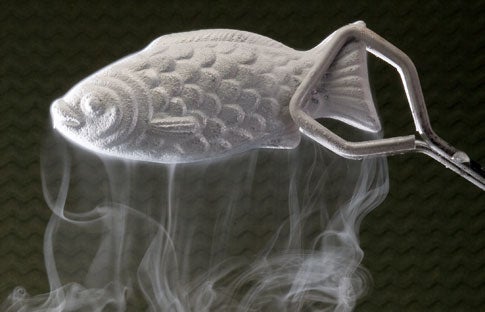
How to cast solid, if fleeting, shapes in mercury: Just keep it at 320 degrees below zero

Frozen Fish The frost crust forms when water condenses from the air Mike Walker

What you consider solid, liquid or gas depends entirely on where you live. For example, men from cold, cold Mars might build their houses out of ice. Women from Venus, where the average temperature is about 870°F, could bathe in liquid zinc.

We think mercury is a liquid metal, but it’s all relative. At one temperature, the mercury atoms arrange themselves into a solid crystal; at another, they flow freely around each other as a liquid. Children from Pluto (like mine, for example) could happily cast their toy soldiers out of mercury, because on that frigid planet it is a solid, malleable metal a lot like tin. Here on temperate Earth, you need a stove to cast tin, but a tank of liquid nitrogen to make mercury figurines.


At liquid-nitrogen temperature, about –320°F, mercury acts like any other metal: You can hammer it, file it, saw it. (It won't shatter like other liquid-nitrogen-frozen items because there's not enough moisture inside.) Watching it solidify is exactly like watching tin harden from a molten state. As the atoms go from liquid to solid crystal form, you see the surface pucker. And because mercury, like most metals, shrinks when it solidifies, you see the surface sink in areas, forming a patchwork characteristic of cast metal.
Pour to Scale: Room-temperature mercury poured into a cold cornbread mold  Mike Walker
Nice Casting: Adding liquid nitrogen freezes the metal  Mike Walker


The fun of making frozen mercury trinkets is another reason to lament the fact that this marvelous metal is also an insidious poison that must be handled carefully and never spilled. Schools have been evacuated because of one broken mercury thermometer, and mercury in the environment, particularly in fish, is a major public-health concern. Which is, of course, why I made this cute little mercury fish.

Melting Point: Above –38°F, the fish turns to liquid  Mike Walker

See much more of Theo Gray's mad science in his book: Theo Gray's Mad Science: Experiments You Can Do at Home but Probably Shouldn't.

13 Comments

cool! I would've liked to see the fish melt through the tongs though. that would've been sweet.

Watching the fish return to room temperature would be interesting.

archeology and anthropology taught us that igneous glass makes very sharp knifes ...
so what property does frozen mercury have that will make it unique ?
will it slice through water like tofu ???

Ceeson

doniv

from chennai , tamilnadu

"Schools have been evacuated because of one broken mercury thermometer"

Is it true ??
In our high school we use mercury from a plastic bottle with bare hands to do physics experiments . Forgot its name , still remember stealing some of the mercury hiding it in my ink pen case ...

that is sweeeeeeeeet!!

Wow thats pretty neat!

I accedentally put a mercury thermometer into a freezer and it did freez but when I opened it again it fell out and broke all over the floor!

What temperature would be needed for it to turn into a plasma?

http://rcrdlbl.com/users/suzyjenkins

Sheesh! While you're at it, why not just sculpt some fish and frogs out of radium?

Theo,

I love 'Gray Matter" ... Have an on-going scientific project. Call, left #'s at WRI. Very urgent.

Sharon

whats the real point of doing something like that...I mean,its pretty cool and all, but some what useless.

Sheesh! While you're at it, why not just sculpt some fish and frogs out of radium?
http://www.hedefnakliyat.com

We think mercury is a liquid metal, but it’s all relative. At one temperature, the mercury atoms arrange themselves into a solid crystal; at another, they flow freely around each other as a liquid.
------------------------------------
Ali EREN - www.playstationturk.net


Download Our iPhone App

Stay up to date on the latest news of the future of science and technology from your iPhone with full articles, images and offline viewing


Follow Us On Twitter

Featuring every article from the magazine and website, plus links from around the Web. Also see our PopSci DIY feed


Become a Fan On Facebook

Share links with friends, comment on stories and more


December 2009: Best of What's New

In our December issue, Popular Science names the 100 best innovations of the year: bombproof wallpaper, self-parking cars, the fastest helicopter, and 97 more. Plus inventor profiles and videos.

Check out the best of what's new here.

Popular Science Photo Pool


Share your photos in the Pop Sci pool at www.flickr.com!
tags_sprite.png
POP_embeddedForm_cover_May09.jpg