Laurie J. Schmidt

The Year's Coolest New Species

Darwin's hits just keep coming, from the smallest snake to the biggest bug

Scientists estimate the number of species on Earth to be close to 10 million -- and each year, the number of known species grows. The International Institute for Species Exploration at Arizona State University and an international committee of taxonomists recently released its "Top 10" list of new species described in 2008.

[ Read Full Story ]

Could Violent Asteroid Bombardment Give Rise to New Life?

A new theory offers promise for the existence of extreme microbial life on other planets

Nearly four billion years ago, the Earth was pummeled by asteroids -- some as large as the state of Kansas -- during an episode known as the "Late Heavy Bombardment." Now, scientists believe that bombardment phase may have jump-started early microbial life. The results also lend support to the possibility of extreme microbial life on other planets like Mars, and perhaps even on Earth-like planets in other solar systems that may have undergone similar bombardment phases.

[ Read Full Story ]

A Thoroughly Non-Mythical Dragon

Prying open the secrets of a giant lizard's poisonous bite

One look at this creature and you'll think you've stepped into a scene in Jurassic Park. But this jumbo reptile is alive and well and living in the Indonesian Islands. The Komodo dragon is the largest living lizard on Earth -- they can measure up to 10 feet long and weigh as much as 140 pounds. They also have about 60 serrated teeth and have been known to consume up to 80 percent of their body weight in a single meal. That's no garden gecko.

It's long been known that Komodo dragons pack a powerful bite, but a new study by a research team at the University of Melbourne, Australia, shows that the effectiveness of the Komodo's bite comes from a combination of venom and highly specialized serrated teeth. Using magnetic resonance imaging (MRI) techniques, the team found that the Komodo dragon has the most complex venom glands ever described for any reptile, and that its giant extinct relative Megalania (Varanus priscus) was the largest venomous animal to have ever lived.

[ Read Full Story ]

A Look Back at a Noble Mars Lander

On the first anniversary of the Phoenix Mars Lander's touchdown, we know a lot more about Mars than we did a year ago

One year ago, scientists at NASA's Jet Propulsion Laboratory, Lockheed Martin Space Systems, and the University of Arizona held their breath as the Phoenix Mars Lander hurtled toward its final descent and touchdown in the northern arctic plains of Mars. It was the first spacecraft landing on Mars without airbags since Viking 2 landed in 1976.

At 4:53:44 PM Pacific time on May 25, 2008, radio signals confirmed that Phoenix had survived its final descent and had landed safely on the Martian surface. The tricky and precise maneuvers involved with the spacecraft's entry, descent, and landing were executed in a manner described as "textbook perfect," leaving Phoenix poised almost perfectly level on the Martian surface. And the crowd at Mission Control went wild.

[ Read Full Story ]

PharmaSat to Test Drugs in Space

Ever wonder whether antibiotics work in orbit? NASA has

It's miserable enough to be under the weather in the comfort of your home, but imagine coming down with a bad cold when you're stuck inside a small crew module 200,000 miles from Earth. You're coughing on your fellow astronauts and that space food you ate half an hour ago is now floating around your zero-gravity spacecraft.

Luckily, mission control packed some antibiotics into your survival pack... but will they work in space?

[ Read Full Story ]

Life Thrives Below Antarctic Glacier

If microbes can survive without sunlight and oxygen on Earth, what does it mean for the possibility of life elsewhere in the universe?

The McMurdo Dry Valleys of Antarctica are one of the last places on Earth you would expect to find a new living organism. With bitter cold temperatures and only about four inches of annual snowfall, scientists consider these valleys to be one of Earth's most extreme and harsh environments.

The region was believed to be devoid of complex animal and plant life, but a new study has revealed that an unusual microbial life form lives under the Taylor Glacier -- an outlet glacier that drains part of the East Antarctic Ice Sheet and terminates in the Dry Valleys.

[ Read Full Story ]

Giant Antarctic Ice Bridge Collapses

Two weeks ago, it was a 25-mile-long span of solid ice; now it's a massive flotilla of icebergs

A 25-mile-long ice bridge that linked the Wilkins Ice Shelf to Charcot Island on the Antarctic Peninsula has collapsed. NASA satellite imagery shows that the bridge's disintegration occurred sometime between March 31 and April 6. Scientists had been keeping a close eye on the bridge since last March, anticipating its collapse following dramatic changes that have taken place on the Wilkins Shelf in recent years.

[ Read Full Story ]

NASA Study Shows Thinning Arctic Sea Ice

The latest satellite data on Arctic ice thickness show continued melting

If you've been following the status of Arctic sea ice for the past few years, hearing scientists herald the potential coming of an ice-free Arctic summer may sound like old news. But according to researchers at NASA and the National Snow and Ice Data Center (NSIDC) in Boulder, Colo., this year, sea ice at the top of the globe may be even more vulnerable to melting than in the past.

[ Read Full Story ]

An East Antarctic Odyssey: The Final Segment

The team returns to the land of minus-50 temperatures and hurricane-force winds

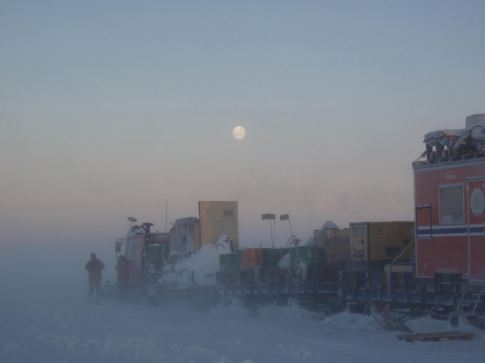
Think you've done the ultimate road trip? Think again. That tour de force can only be rightfully claimed by a team of scientists who spent this winter driving 2,000 miles across East Antarctica -- at a top speed of about 9 miles per hour.

In late December, twelve American and Norwegian scientists set out to complete the second segment of a two-season overland traverse of East Antarctica. This year's expedition began with the team traveling in two groups, with one heading first to 'Camp Winter' to repair the vehicles that were damaged during Season 1 and then driving to the South Pole, and the second group testing equipment at McMurdo Station before meeting up with group one at the South Pole. The entire team then headed to Troll Station, a Norwegian research station located about 150 miles from the East Antarctic coast, stopping at various points along the way to fly unmanned aerial vehicle (UAV) missions and drill for ice core samples.

[ Read Full Story ]

The Top Five Space Illusions

Seeing things in outer space that aren't necessarily there

Martian Irrigation Canals

As bizarre as it may seem now, in the late 19th and early 20th centuries it was commonly believed that there were artificial canals on Mars. The rumor started in 1877 when Italian astronomer Giovanni Schiaparelli observed long, linear features on Martian surface through his telescope. He named the features "canali," which translates to "channels" or "canals" in Italian. Schiaparelli did not intend for the term to be interpreted as "artificial" canals; he actually meant simply "narrow waterways." But the coined phrase took on a life of its own, and some people even believed that Martian intelligent life had constructed a canal system to bring water from the polar regions to its cities.

[ Read Full Story ]
READ MORE ABOUT > , , , ,
Page 1 of 3 123next ›last »


Download Our iPhone App

Stay up to date on the latest news of the future of science and technology from your iPhone with full articles, images and offline viewing


Follow Us On Twitter

Featuring every article from the magazine and website, plus links from around the Web. Also see our PopSci DIY feed


Become a Fan On Facebook

Share links with friends, comment on stories and more


December 2009: Best of What's New

In our December issue, Popular Science names the 100 best innovations of the year: bombproof wallpaper, self-parking cars, the fastest helicopter, and 97 more. Plus inventor profiles and videos.

Check out the best of what's new here.

Popular Science Photo Pool


Share your photos in the Pop Sci pool at www.flickr.com!
tags_sprite.png
POP_embeddedForm_cover_May09.jpg