Probably the most sought-after surfing experience is the tube ride (a.k.a. "getting barreled"). A tube ride occurs when the top of the wave pitches over the surfer so that he or she is completely enclosed in an oval space behind the curtain of falling water. Inside the "green room," you are hurtling through a tunnel of water and the only way out (without wiping out) is straight through the opening in front of you. Hollow waves are foot-for-foot the most powerful variety of breaking wave, and good tube riding is really difficult. It requires timing, experience, and skill. The video shows us some world-class surfers making it look easy!
But why do some waves break as hollow grinding tubes while others crumble more gently and forgivingly? Let's examine a little wave dynamics in order to assess the situation. Ocean waves are created by wind blowing over the ocean surface, as the kinetic energy of the air is converted into potential and kinetic energy of the water. The biggest and most powerful waves are created in massive storms. As the swells generated by these storms travel over the open ocean, the originally chaotic "victory at sea"-type wave motion is gradually organized into cleaner lines. As with all waves, it is not the actual material (water in this case) that travels any distance through the medium -- it is the energy of the wave. As the wave energy passes through a point in the ocean, the water molecules rise and fall in a circular pattern but remain in the vicinity as the disturbance passes by.
While waves are in deep water, you can't surf them because they don't break. In order for a wave to break, there must be less than a 120-degree angle between the front and back face, and the wave doesn't get steep enough until it approaches shallower water. What happens in shallow water is this: the motion of the bottom of the wave is impeded by friction with the ocean floor while the top section of the wave continues to move, relatively unimpeded. It therefore "outruns" the lower part of the wave, forcing the front face to steepen until the top layers cascade over the edge. Waves generally break when the ocean depth falls below about 1.3 times the wave-face's height.
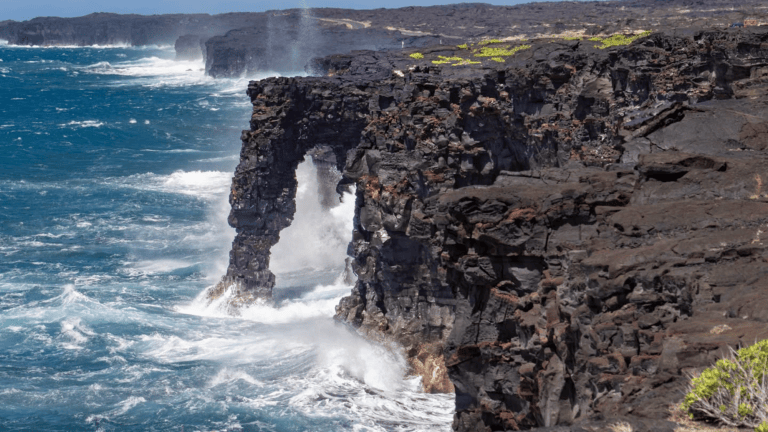
However, in order to get hollow tubing waves, you need energetic swells that travel abruptly from deep to shallow water. Tropical reefs (such as those fringing the north shore of Oahu) often produce some of the best tubing waves, not only because they're in the direct path of powerful swells originating in the North Pacific, but also because the ocean depth decreases from several dozen meters to a few feet over a very short distance as you move shoreward over the reefs. Offshore winds blowing into the wave faces also help steepen them and hollow them out.
Adam Weiner is the author of Don't Try This at Home! The Physics of Hollywood Movies.
138 years of Popular Science at your fingertips.
Each issue has been completely reimagined for your iPad. See our amazing new vision for magazines that goes far beyond the printed page
Stay up to date on the latest news of the future of science and technology from your iPhone or Android phone with full articles, images and offline viewing
Featuring every article from the magazine and website, plus links from around the Web. Also see our PopSci DIY feed
Science is reinventing play, from extreme sports to gamification to ridiculous roller coasters to the playgrounds of tomorrow, and this issue is chock full of fun. Also, on a less fun note: Did global warming destroy my hometown?
from Sao Paulo, SP
Very well written. Great stuff.
Great surfing video. That's some awesome surfing skills - http://hintcafe.com/find-singles/surfing
really interesting article, i tried surfing earlier on this year for the first time and I have to say its one of the few forms of exercise that I really enjoy. Superb Video too
www.sanzsurfwear.co.uk