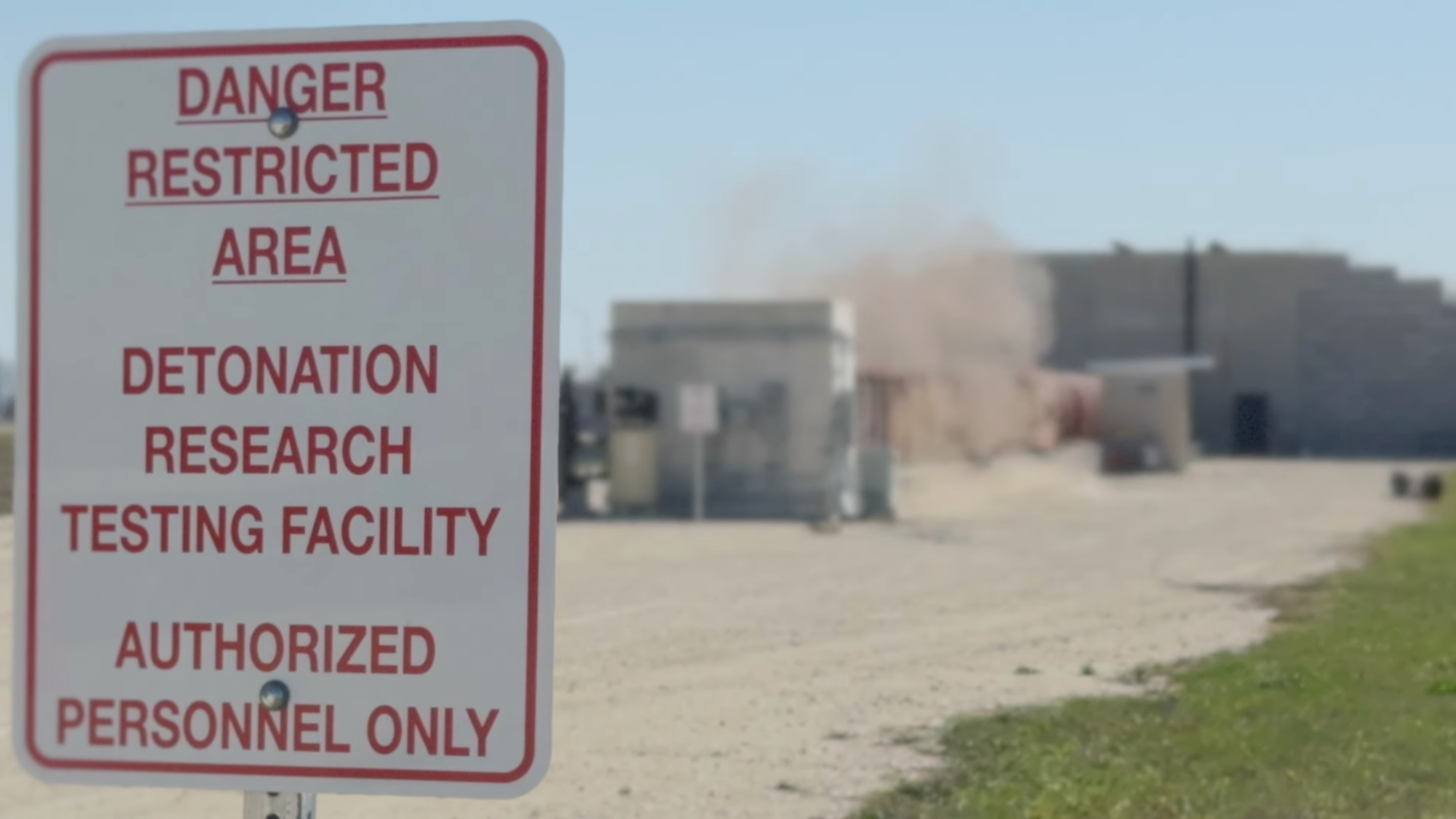
Everything is bigger in Texas, and that includes its controlled detonations. Texas A&M University recently revealed what they say is the world’s largest controlled explosion lab, where researchers can fill a nearly 500-foot metal tube with gas and ignite it in the name of science. They are calling it The Detonation Research Test Facility (DRTF). By precisely measuring what it takes to turn a simple flame into a massive, deadly detonation, researchers hope to make discoveries that could better prepare engineers to prevent gas leaks, and potentially inform ways to build explosion-resistant infrastructure. And all of that will require lots and lots of yeehaw inducing bangs.
Located in Southeast Central Texas, the detonation tunnel is about six feet in diameter and stretches nearly the length of two football fields. Its metal exterior consists of three-quarter-inch steel walls and is covered in earth to muffle the sound—or try to, at least. Inside, the tube holds various sensors that can measure the explosion as it intensifies. By containing all the power within the facility, researchers can study explosions strong enough to level entire buildings. The shockwaves that form in the tunnel can apparently reach speeds of Mach 5—or roughly 3,800 miles per hour.
“The facility enables us to observe, measure and understand one of nature’s most extreme forces in ways that haven’t been scaled before, or even been possible until now,” Texas A&M Engineering professor Dr. Elaine Oran said in a statement.

Engineering Explosions | Texas A&M Engineering
Measuring a detonation, from flame to boom
The idea for the massive detonation tunnel began as an inquiry from the coal mining industry. Industry leaders sought to scientifically determine whether natural gas trapped in a coal mine could explode and detonate. The short answer is yes. It quickly became clear, however, that a facility capable of measuring that would prove useful for a number of other explosion-related questions as well.
To measure an explosion, researchers start by sending an electrical current through a long wire leading into the chamber. Eventually, the current leads to a spark, which creates a flame, not unlike a gunslinger in a Western striking a match and watching a flame trickle its way to a stick of dynamite.
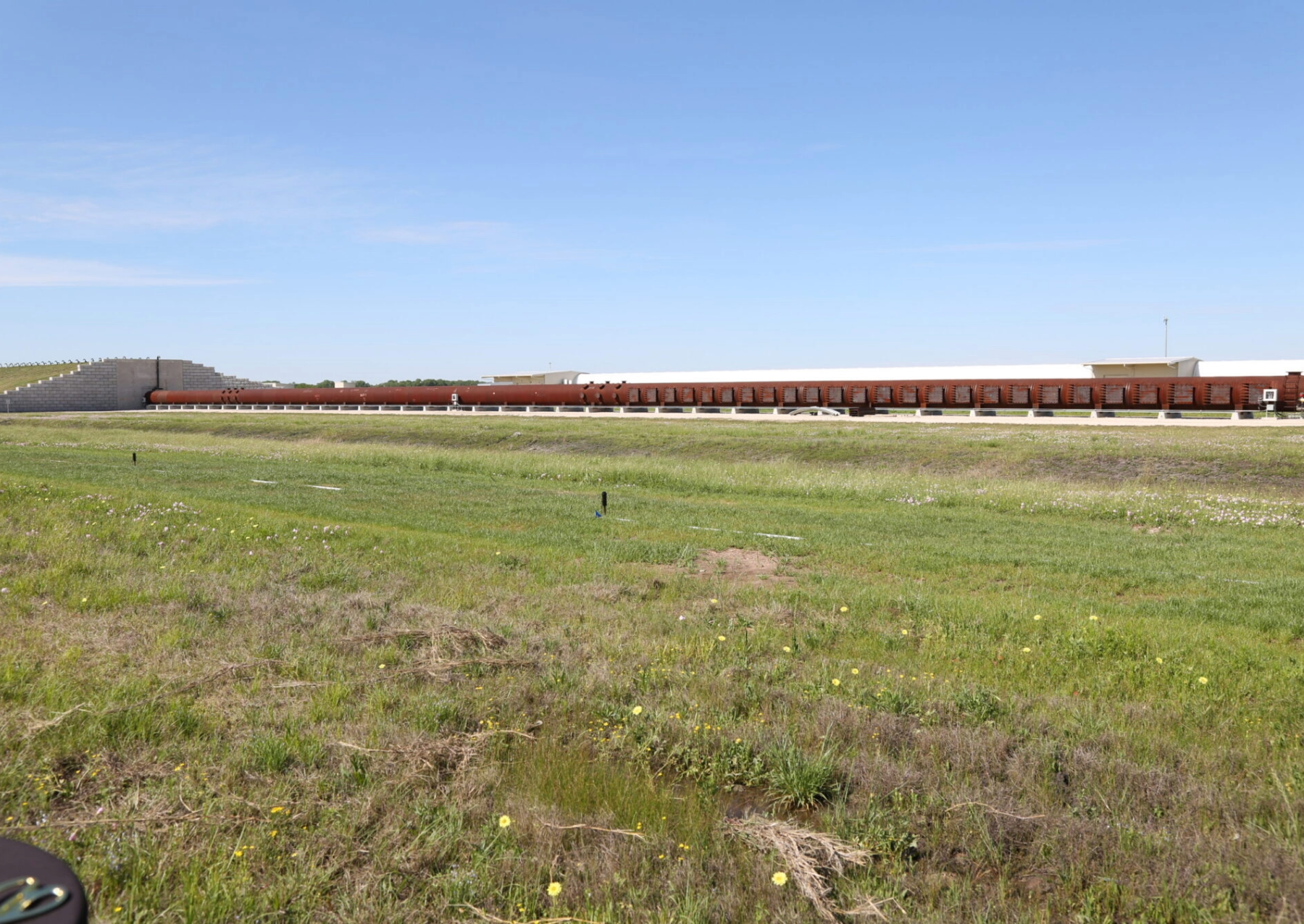
When the flame enters the chamber, it begins a violent journey. The chamber is lined with what researchers refer to as an “obstacle course” of metal beams that generate turbulence. As the flame travels, more surface area is created, which in turn causes it to burn faster and stronger.
Eventually, all of that power creates a shockwave in front of the flame. Once the shockwave is strong enough, it pushes forward and creates a second, much larger explosion. That second, earth-shaking boom is the detonation.
Video footage of the process occurring in real time is dramatic, to say the least. Everything is quiet except for a voice in the control room counting down three, two, one. That’s followed by what sounds like a muffled gunshot as the flame enters the tube’s first segment. Visually, the tunnel’s thick metal exterior quivers and soil shakes off it as each succeeding segment ignites. That all leads up to the detonation, which is a significantly larger boom that shakes the entire facility and sends earth soaring into the air. Seconds later, amid smoky air, the soil can be heard raining back down, like an artillery scene from a war film.
And even though the facility is designed to withstand massive explosion level forces safety, it still leads some to check their heart rates.
“There’s a lot of nervousness, [and] jitters,” Texas A&M Aerospace engineering student Zachary Wideman said in a video. “Because something on this scale with this type of energy, you can’t help but be nervous.”
Though the facility’s controlled explosions will likely prove most useful for industrial safety initially, engineers involved believe its scientific findings could have broader appeal. The shockwaves it creates could prove important for future testing of hypersonic plane and space shuttle propulsion. On the more conceptual side, scientists interested in the history of the cosmos could use the tube’s controlled explosions to help build models of supernovas, which undergo a similar physical process, albeit on a much, much larger scale.