
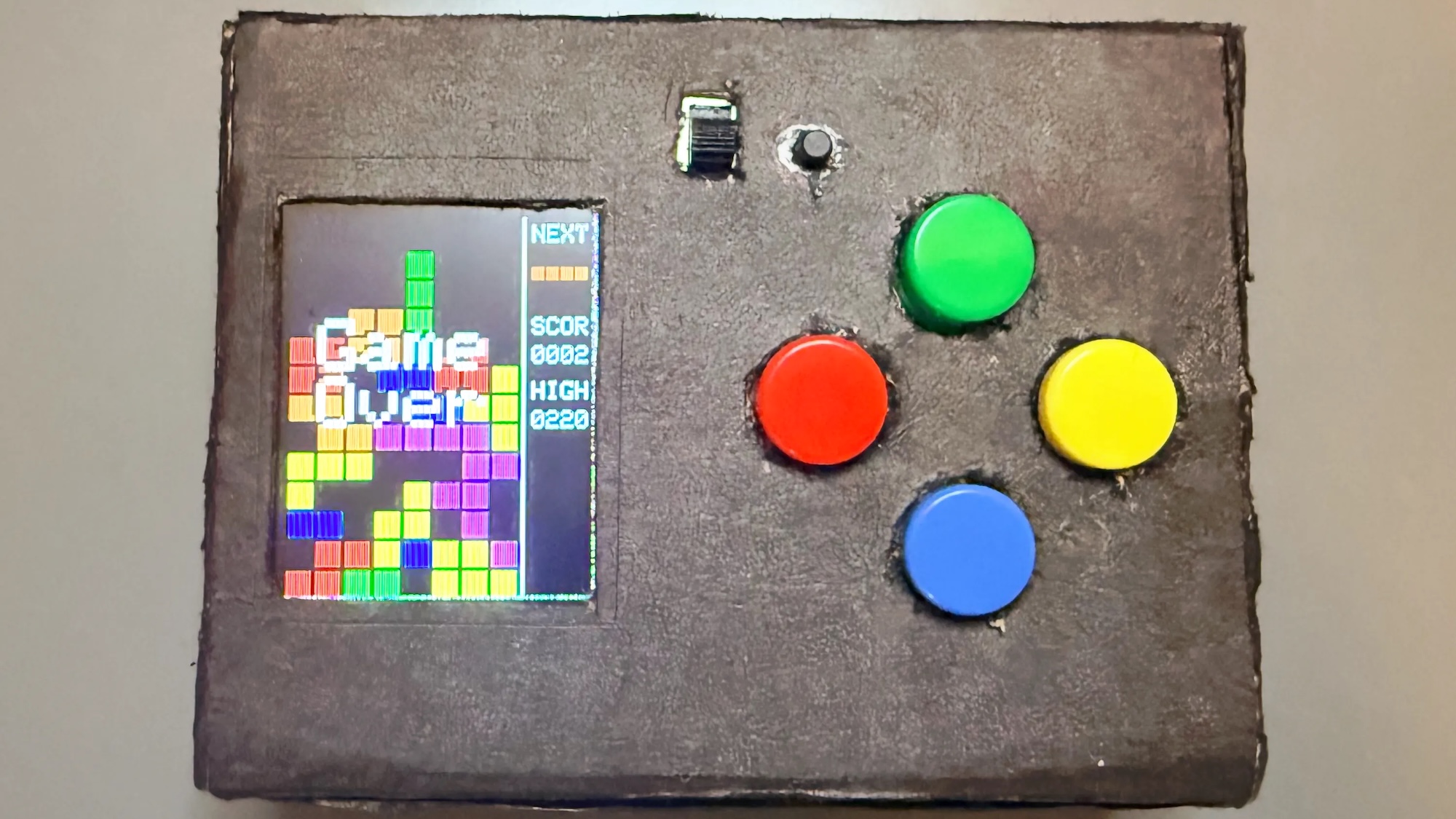
There was a time when you had to travel to your nearest arcade or beg your parents for a Game Boy if you wanted to play Tetris. Today, the iconic, addictive puzzler is available online for free and in countless forms across nearly every gaming platform imaginable—even a PDF.
Part of the inherent appeal for many people is the game’s mounting difficulty, but more crafty fans can take things up a notch by building their own Tetris-playing machine. And as software writer and hobbyist William Gaspar recently proved, you don’t need a plastic case to protect it. A tiny cardboard box will do just fine.
Gaspar’s creation looks endearingly wonky, but manages to play Tetris (not to mention Snake) as well as any premium device. All of the code information and construction steps are available for free on GitHub, too. The key to its size and affordability is an Arduino computer paired with an ATmega328P single-chip microcontroller, as well as a 1.8-inch color LCD screen. Combined, the electronics can all run off only a trio of AAA batteries. As Hackaday notes, this is thanks in part to Gaspar’s decision to run the microcontroller at 8 MHz instead of the standard 16 MHz. That meant the board only needed 3.3 V to run rather than 5 V, meaning the LCD display can also run on the same power supply.
Cardboard enclosures are an increasingly popular trend among DIY hobbyists, especially for projects that are essentially works-in-progress or casual tinkering endeavors. In this case, Gaspar swears he did not opt for a popular soda brand box for his choice of casing.
“And I know you would argue: I can see it says zero calories in the lower right corner!” he wrote on his website. “You think you got me, but the answer is very simple: That’s just how many calories are in the box.”
