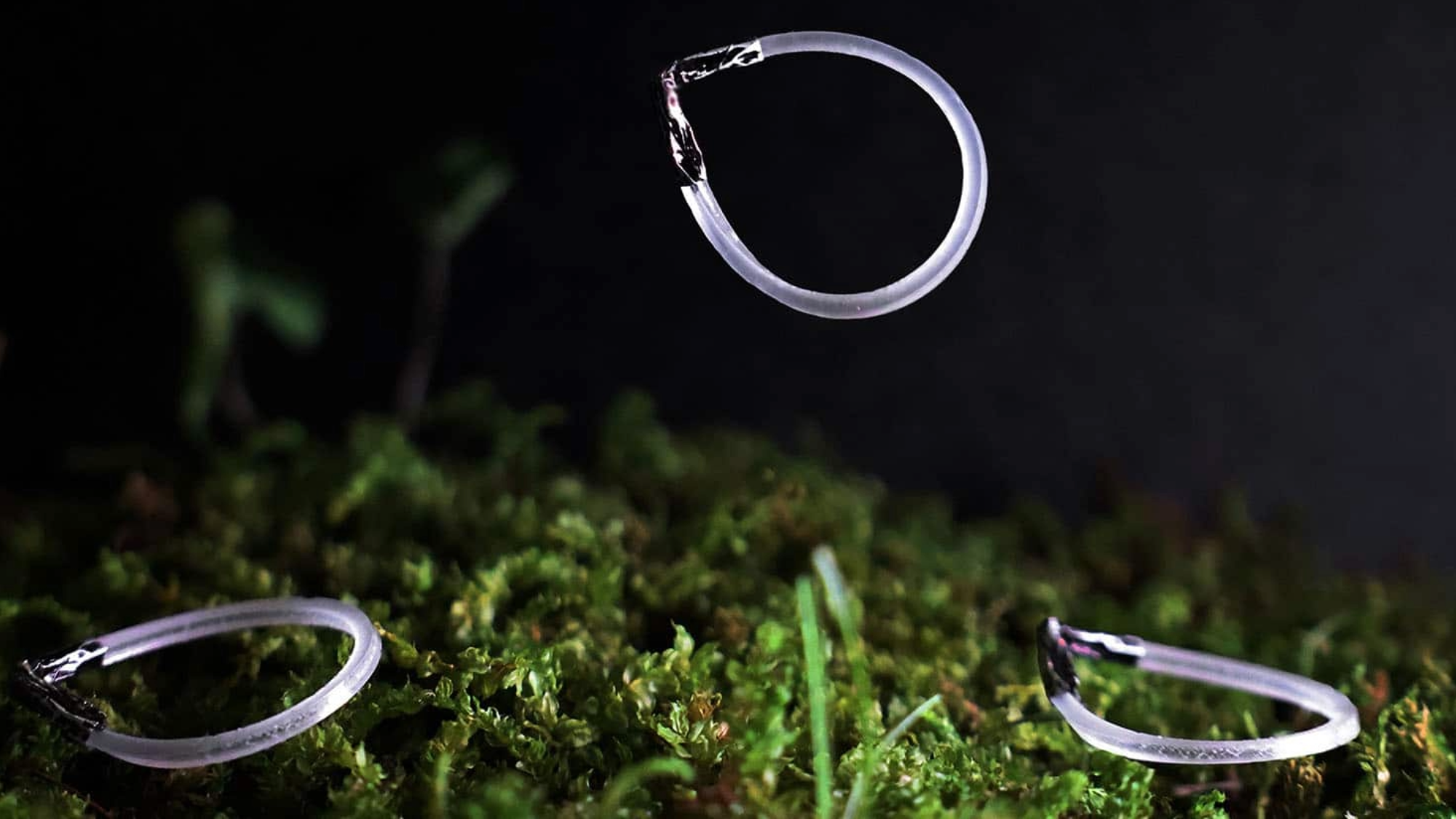
Much like the earworm “The Song That Doesn’t End” from Shari Lewis’ Lamb Chops’ Play-Along, a new soft robot does not stop…curling up and jumping. A team of mechanical engineers from North Carolina State University say that they’ve created the bracelet-shaped bot that moves indefinitely when it’s exposed to infrared light.
Called a Ring Leaper, the teardrop-shaped machine is made of a liquid crystal elastomer ring with a more rigid aluminum V-shaped tail at the end. The ribbony-soft part contracts and tightens when exposed to the light. It keeps curling in, getting tighter and tighter (and building up more energy) until it reaches a “critical threshold” and folds onto the metal part. At that point, the V-shaped aluminum aggressively snaps downward, smacking the ground and launching the robot forward or into the air.
But Ring Leaper doesn’t quit after that. As soon as the bottom part snaps down, the ribbon part of the body will start tightening around itself all over again. This team of researchers at North Carolina State University says this results in a new kind of robot system that “autonomously stores, releases, and recycles elastic energy.”
Their mechanical jumping bean can leap either straight up or forward, depending on the angle of the V-shaped bottom part. And it has some hops. The tiny Ring Leaper can achieve a vertical leap exceeding 80 times its own body height. That would be the equivalent of LeBron James (six foot nine inches) leaping 540 feet into the air. That’s taller than a 50-story building. The team recently published their findings in the journal PNAS.

A Self-Resetting Soft Robot That Leaps Forever Under Constant Light
Ring Leaper can hop over hurdles and swim like a frog
Ring Leaper wasn’t limited to a sterile lab environment. It can tackle small obstacles like grass, rocks, and mulch. It can even swim… sort of. One of the tests involved placing Ring Leaper into a shallow tub of water before shining infrared light on it. On cue, it started its curling-and-jumping routine, but this time it would slightly pop out of the water and gradually wade forward like a frog. Ring Leaper was also able to clear a pair of tiny hurdles, even after slightly tumbling over the first one. When tasked with jumping headfirst into a tall wall, the robot dutifully complies, then whips backward and continues jumping back in the direction it came from, in a kind of mirroring effect. None of this, it’s worth saying, is really programmed or coded instruction. Ring Leaper just jumps.
Controlling Ring Leaper’s mode of movement is also pretty low-tech. The team can dictate whether it jumps straight up, propels itself forward, or goes somewhere in between by adjusting the angle of the V-shaped aluminum tube at its base. A V-shaped angle wider than 120 degrees will result in a crawling motion. Reduce that angle to 90 degrees, and it will leap forward like a frog. A narrower opening below 50 degrees results in a dramatic vertical jump. Each of those movements is also determined in part by the strength of the infrared light shining at it. More light equals more power.
“We could also improve the robot’s jumping distance by adding a small amount of weight to the rounded end of the teardrop,” Fangjie Qi, a North Carolina State postdoctoral researcher and study co-author said in a statement. “This changes the robot’s center of mass and leads to a more powerful and stable forward motion – much like a swimmer leaning forward as they dive off the starting block.”
So what’s this forever jumping robot actually useful for? Well, for now, nothing. Like a great deal of important scientific research conducted over many decades, the team essentially made it because they could, with no obvious commercial or practical application. That still doesn’t mean it’s completely useless. The proof-of-concept robot marks an advancement in self-resetting jumping, which could help other engineering teams who are looking to integrate these findings into future robotic navigation methods.