
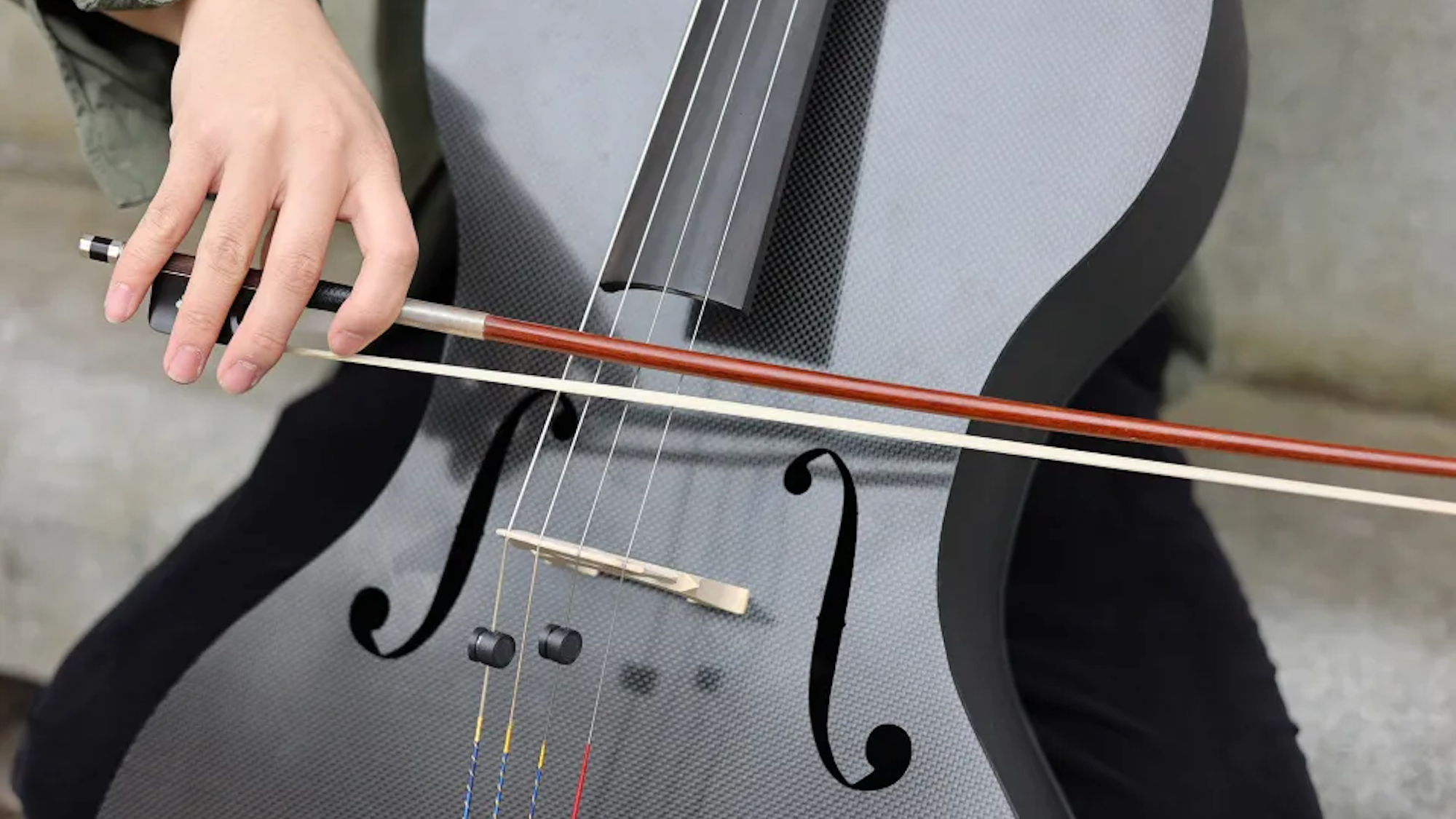
3D printing is long past the days of simple plastic models. Today, the technology is used to manufacture everything from entire homes and rocket parts, to microscopes and even food. After more than six years of experimentation and refining, a former Yale University student recently showcased yet another application: concert-worthy cellos and other stringed orchestral instruments 3D-printed using carbon fiber.
The cello, which dates back to the 16th century, is an engineering marvel. Its instantly recognizable, sonorous melodies are only possible through a complex interplay of wood types, geometry, acoustics, and the player’s own physicality. Even its exterior varnish is more than an aesthetic choice—the thin layer is used to both dampen the instrument’s sound without sacrificing its overall tone.
These factors also make cellos a serious financial investment. A decent, entry-level instrument can easily cost over $600, while concert-grade examples routinely set musicians back at least $15,000. Then there’s the upkeep and maintenance to consider. Without regular care, no amount of money can salvage a cracked frame or warped neck. Taken altogether, the logistical and financial barriers exclude many would-be musicians from ever taking up the art form.

Schumann Cello Concerto – Samuel Cao
Elijah Lee, a cello player and Yale University biomedical engineering graduate, Forte3D wants to offer a novel solution. His new company is dedicated to crafting tailored, customizable, and durable stringed instruments from 3D-printed carbon fiber and polymer.
Lee first began tinkering with merging engineering and music while in high school. After learning of his fondness for 3D printing projects, his high school orchestra director suggested he try designing a cello using the same strategies.
“It was gradual, but when we assembled the first fully realized cello, I thought, ‘Okay, wow, we really have something here.’ That moment made it all worth it,” Lee said in a university profile.
Forte3D’s cello isn’t simply a clone of the classic instrument. Instead, Lee and his colleagues redesigned the overall form and shape to take advantage of their materials’ unique properties. While a wooden cello body usually features a rounded top and back, Forte3D’s iteration relies on flat, concave carbon fiber panels with a neck and ribs constructed from 3D-printed polymer. At the same time, vital components like the bridge, sound post, and fingerboard all remain crafted from wood to ensure a familiar tone and acoustic presence. Thanks to the flexibility of rendering with CAD files, each individual instrument can be further customized based on thickness, shape, and material.
“Because we’re using our own designs…we can really dial in the acoustics,” explained Lee.

Forte3D Violin | Méditation from Thaïs – Valerie Vuolo
After a successful sales pitch on the show Shark Tank, Lee is now moving forward with scaling the company to reach a wider audience while also introducing a wider array of instruments. Forte3D already offers a 3D-printed violin, and there are plans to add the viola and double bass to their lineup. Ultimately, Lee wants to expand the instruments’ accessibility and durability.
“Music shouldn’t be confined by price or fragile wood,” he said. “A student in a rural school, a touring professional, or a budding musician anywhere in the world could hold one [of these cellos] and feel the same richness, the same resonance, the same possibility.”
At the moment, Forte3D’s prices certainly aren’t the cheapest. Their 3D-printed cello alone costs nearly $3,000 while the violin is priced at almost $1,500. That’s better than many classic options, however. With increased institutional support, it’s easy also to envision the instruments one day making their way into schools and community music programs. Until then, the combination of arts and engineering alone is worth a standing ovation.
