
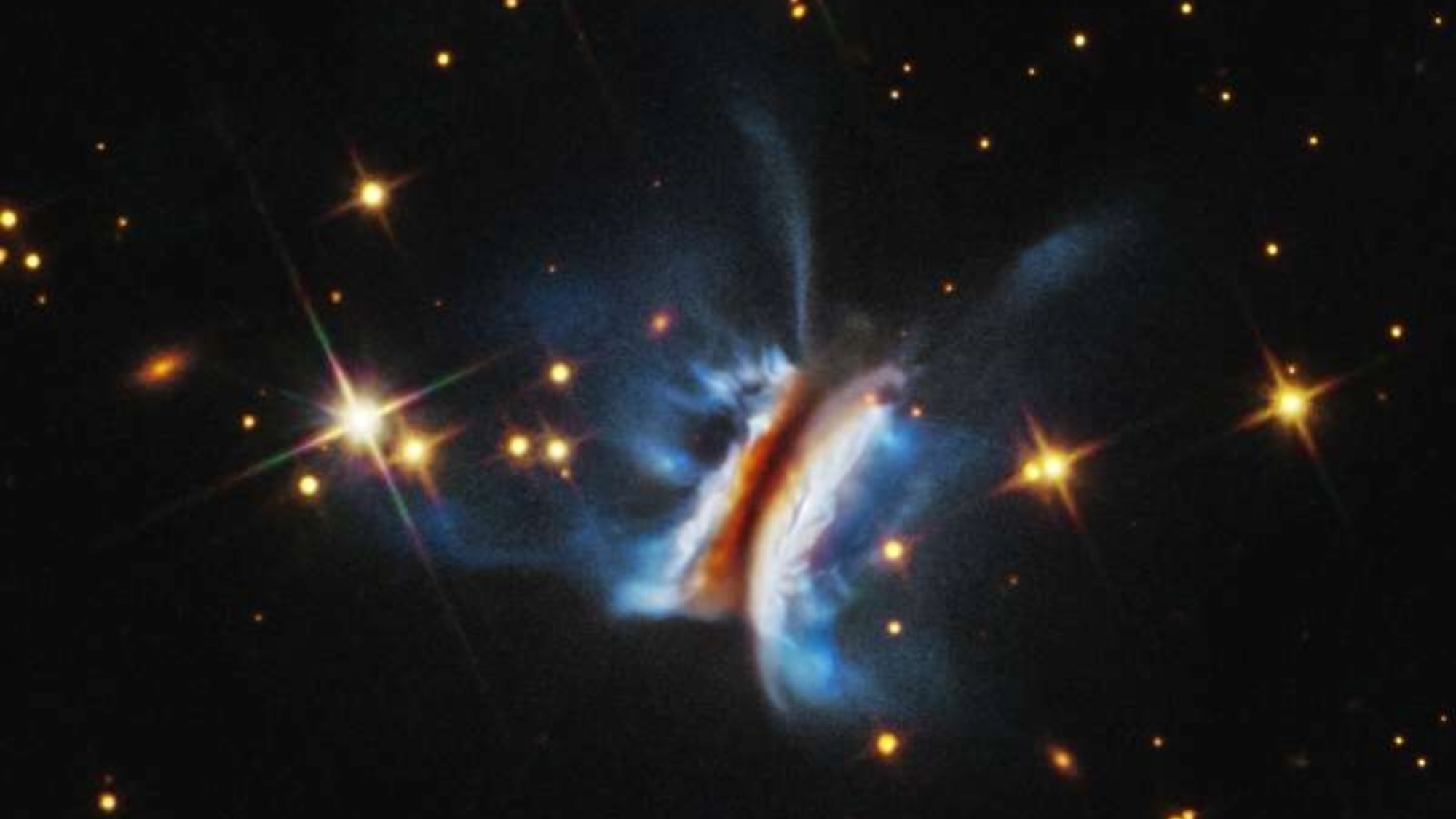
Scientists are leaving space fans with one more tasty treat before the year comes to a close. Using the Hubble Space Telescope, astronomers captured a stunning image of the largest protoplanetary disk ever observed, which just happens to be shaped like a giant celestial sandwich. The massive formation of dust and gas, which astronomers call Dracula’s Chivito, resides about 1,000 light-years from Earth and spans roughly 400 billion miles. To put that in perspective, NASA estimates this disk is about 40 times the diameter of our own solar system.
But aside from making stomachs rumble, astronomers say more research into the vampire disk could provide new insights into the early formation of other planetary systems, possibly even our own. Researchers go on to suggest this unusually volatile disk might, “represent a scaled-up version of our early solar system.” The astronomers’ new findings were published this week in The Astrophysical Journal.

Hubble Spots Giant Vampire Sandwich?
Vampire Disk offer glimpses into dramatic planetary past
Planetary disks, sometimes called planet nurseries, are the building blocks of solar systems. All planetary systems initially form disks of gas and dust around young stars. Eventually, planets form as material in the disk coalesces and accumulates. This particular disk, officially designated IRAS 23077+6707, has an estimated mass that’s 10 to 30 times greater than that of Jupiter, the largest planet in our solar system. Astronomers note it’s both the largest and one of the most unusual disks observed, with filament-like features appearing on only one of its two sides, suggesting it is being shaped by dynamic processes such as recent infalls of dust and gas. This results in a composition that is “unexpectedly chaotic and turbulent.”
“These new Hubble images show that planet nurseries can be much more active and chaotic than we expected,” Kristina Monsch, a study co-author and a postdoctoral researcher at the Center for Astrophysics, a collaboration between Stanford University and the Smithsonian, said in a statement.
Meanwhile, the spooky nickname is a nod to the home regions of the astronomers involved. One is from Transylvania, (hence Dracula) and the other is from Uruguay, whose national dish is a sandwich called “chivito.” The researchers say the image of the flattened disk resembles a hamburger, though an argument could easily be made that it looks more like a hot dog.
Related: [Hubble Space Telescope caught a second glimpse of comet 3I/ATLAS.]
Don’t count out the Hubble just yet
The Hubble Telescope (launched back in 1990) might not have the most powerful onboard tech compared to the more recently launched James Webb Space Telescope, but it’s still regularly making major scientific contributions. Just this year, Hubble has caught a rare glimpse of large space rocks colliding, showed a white dwarf eating an object that resembled Pluto, and created the largest photomosaic of the relatively nearby Andromeda galaxy to date.
“Hubble has given us a front row seat to the chaotic processes that are shaping disks as they build new planets—processes that we don’t yet fully understand but can now study in a whole new way,” study co-investigator and Center for Astrophysics Joshua Bennett added.
