
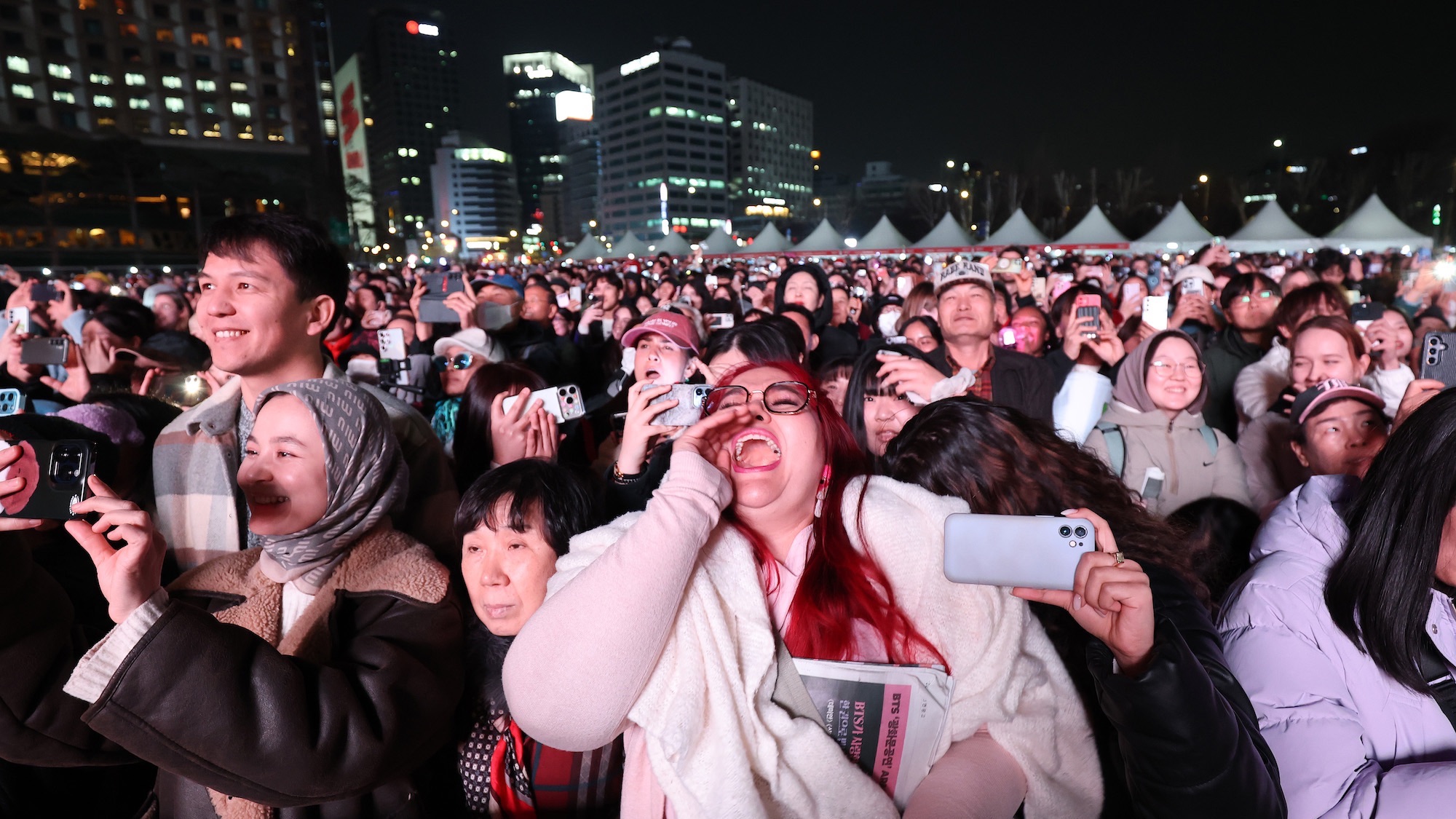
Concert venues are supposed to measure a star’s reach. BTS skipped the measurement entirely. On March 21, 2026, they played a free concert at Gwanghwamun—their first performance as a complete group in six years—and in doing so, commandeered the entire city of Seoul as their stage.
The decision was unusual. Most acts choose enclosed arenas and stadiums because they’re easier to manage: the sound stays in, the crowd stays put. An open-air concert in the middle of a capital city inverts all of that. Sound becomes harder to control and project. Crowd management and traffic flow have to be handled simultaneously, across city blocks rather than corridors. But by picking Gwanghwamun—a site loaded with national symbolism, the broad avenue that runs from Seoul’s old main gate to its modern government buildings—BTS signaled that they wanted the performance to mean something beyond the music, even if it meant accepting serious technical headaches.
The open-air format also broke up the usual audience structure. Ticket holders filled designated zones near the stage, but ordinary residents showed up too—some intentionally, some just passing through. The fandom-driven bubble that typically seals a concert from the outside world didn’t form. Instead, the crowd was porous. Anyone who wanted to be part of it already was.
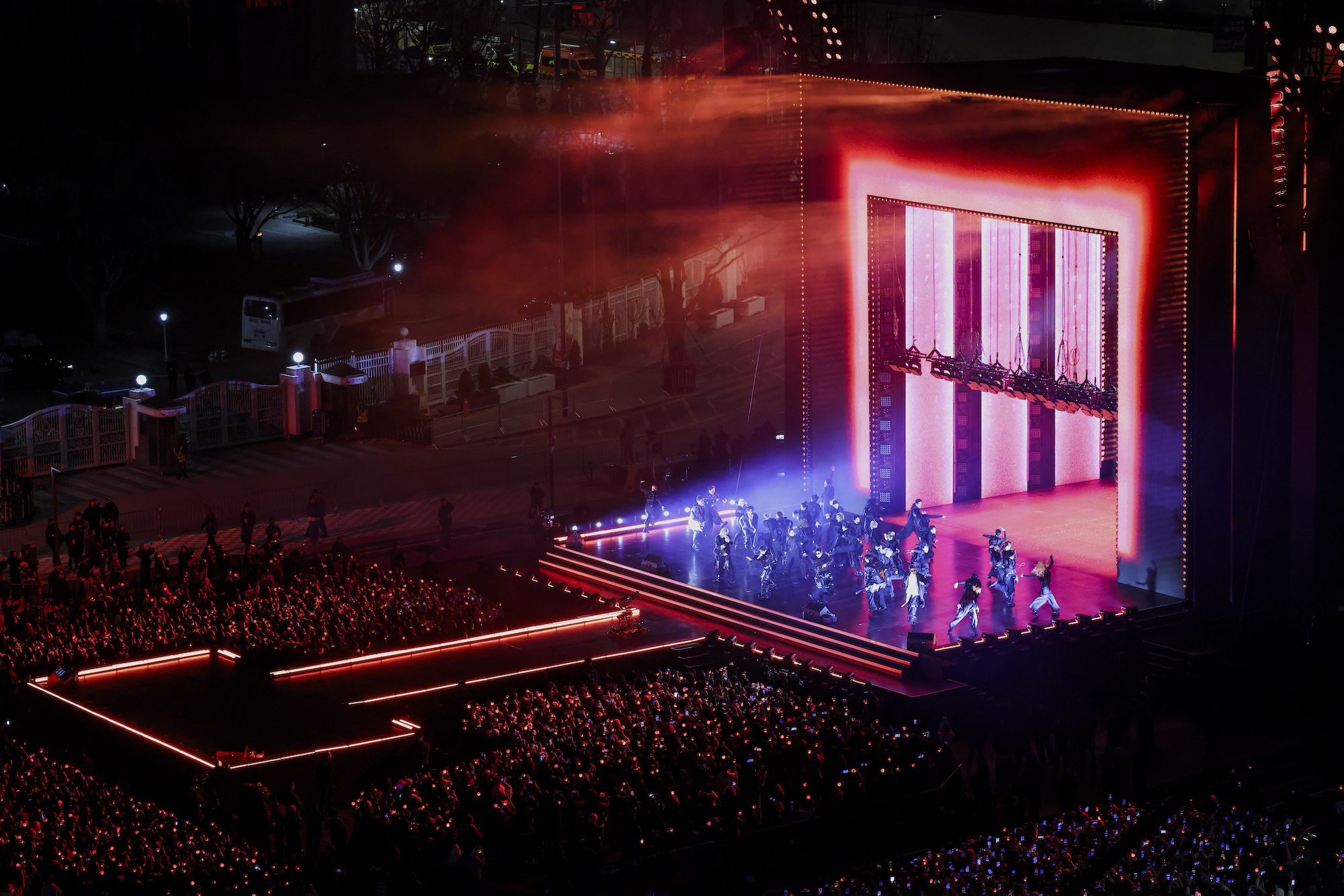
And then something less predictable happened. The acoustics of the city and the behavior of the crowd started feeding off each other. Low-frequency sound rolled through the corridors between buildings, spreading across blocks through reflection and diffraction. People hearing the same music at the same time began to move in sync—not because anyone told them to, but because the shared sound pulled them into a common rhythm.
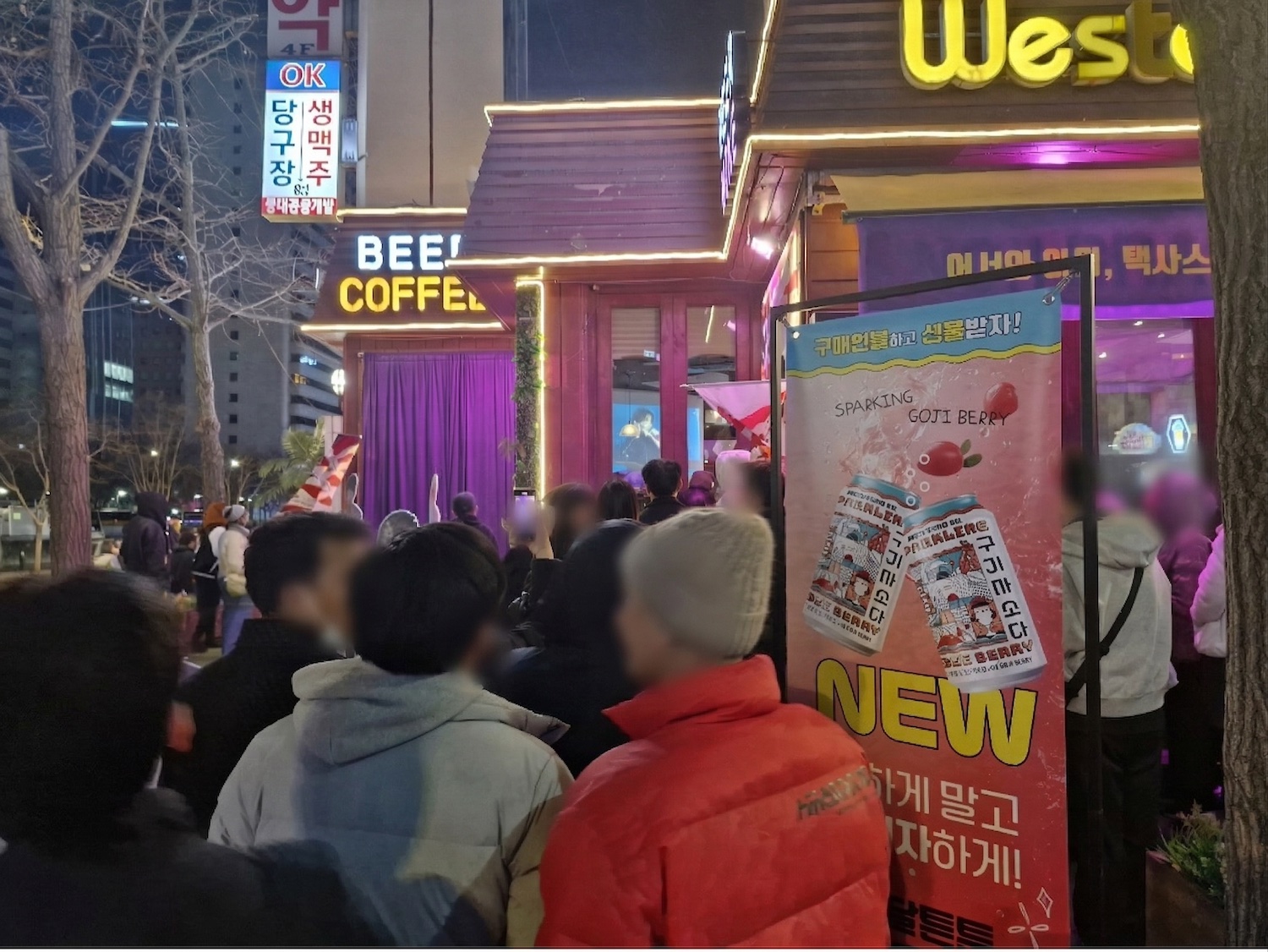
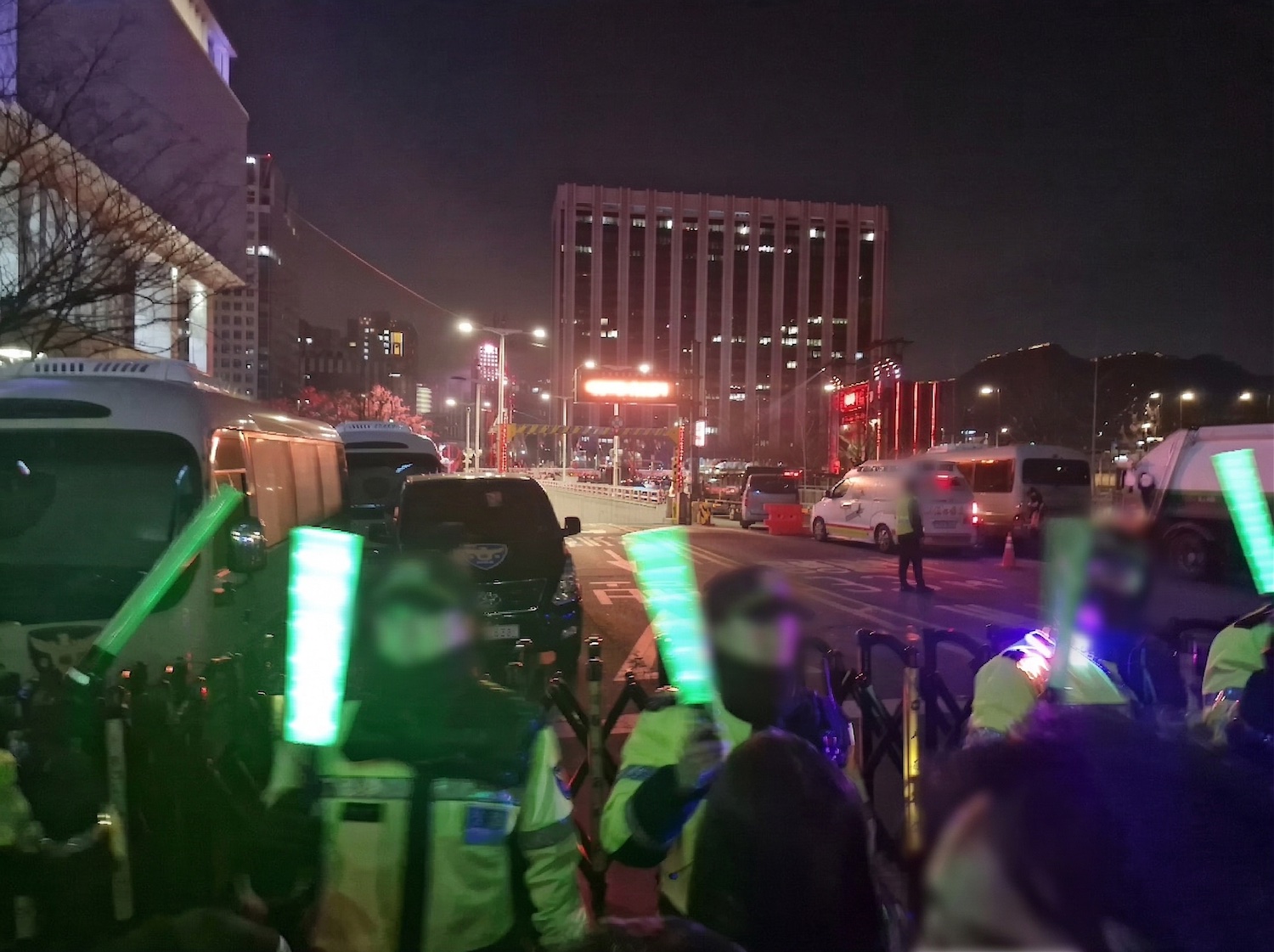
This was most visible away from the stage itself. Citizens clustered around metal barricades, along the Cheonggyecheon stream, in front of shops and bars—watching on screens or phones while the live sound from the venue washed over them. It merged with whatever they were watching, stitching the visual feed to the physical acoustics of the city. Their visual access was indirect, but they shared the same auditory and temporal experience as the people with tickets. They weren’t outside the concert. They were inside another layer of it.
By the end of the night, the Gwanghwamun concert had done something that stadium shows, by design, cannot do. It dissolved the boundary between venue and city, and let the urban landscape itself—its buildings, its streets, its acoustic quirks—carry the performance to people who never bought a ticket.
Music Carried for Blocks Through a Maze of Buildings
The sound of the concert didn’t die neatly with distance. Popular Science Korea took field measurements that day and found that sound pressure exceeded 100 decibels near the venue, which is roughly the volume of a chainsaw. Several hundred meters away, at the Cheonggyecheon stream, levels still hovered between 70 and 80 decibels—the intensity of a busy street or a vacuum cleaner. Melodies remained discernible as far as Myeongdong. Lyrics blurred first; rhythm was the last thing to go.
Some of this follows from basic physics. When sound travels through open air, higher frequencies get absorbed by the atmosphere faster than lower ones. The mid- and high-frequency components that carry vocal detail fade first, while the bass—with its longer wavelengths and greater energy—keeps traveling. That’s why, at a distance, you could still feel the beat of a BTS song even when the words had become unintelligible. It’s a well-known effect called atmospheric attenuation, but hearing it play out across an entire city district gave it a different quality.
Distance and frequency, though, only explain part of the picture. The crowd itself was reshaping the sound. La Roda Mauro and colleagues at the Polytechnic University of Valencia showed in 2024 that a densely packed audience acts almost like a physical medium—shifting the phase and intensity of low-frequency waves so that perceived volume can vary wildly even among listeners standing the same distance from the source. The mass of people packed into Gwanghwamun Plaza that day was exactly the kind of condition their research describes: dense enough to warp how sound behaved in ways that no acoustic model of an empty plaza would predict.
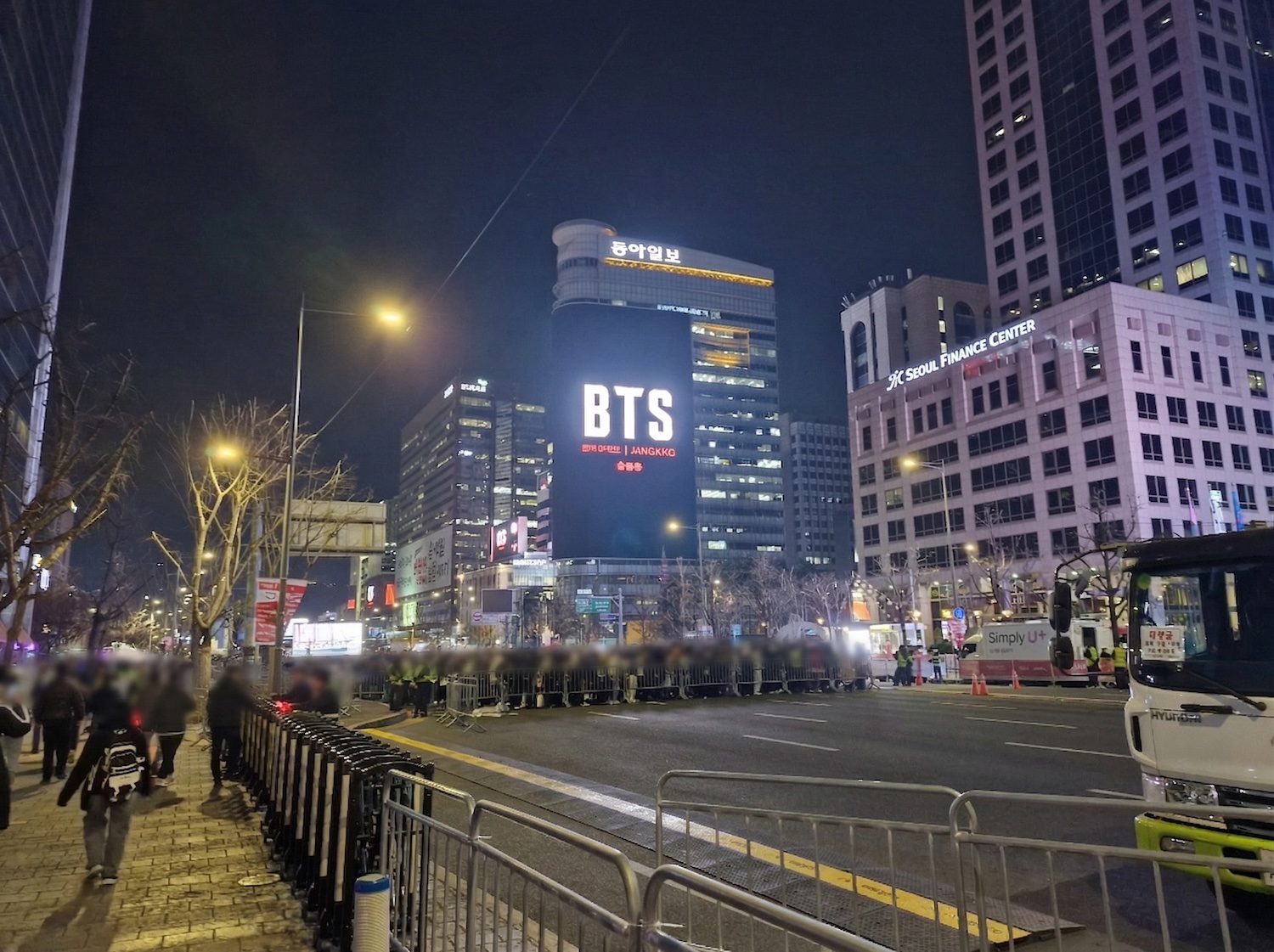
Then there was the city itself. A distributed speaker system had been installed across the Gwanghwamun area, and the surrounding high-rises created what acousticians call a multipath environment—sound bouncing off hard surfaces, arriving at any given point from multiple directions. At the Sejongdaero intersection, some distance from the stage, readings hit 90 decibels. That number can’t be explained by the stage speakers alone; it reflects the combined output of nearby distributed speakers and reflections ricocheting off building facades. Sofia Giulia Feriani’s 2025 research at the Technical University of Denmark documented exactly this effect—building facades acting as acoustic mirrors, amplifying sound at certain spots. A reading of 96 decibels near the Starbucks by the Leema Building, an area that should have been relatively quiet given the police road closures, tells the same story: sound was bouncing off nearby walls and reinforcing itself.
That same urban canyon effect made lyrics even harder to catch. Sound waves ricocheting between buildings stretched out reverberation times and created an uneven acoustic field. The high-frequency detail that was already fading from atmospheric absorption got smeared further. Low frequencies, which bend around obstacles more easily, held up.
Put it all together and the sound distribution at the Gwanghwamun concert was the product of atmospheric attenuation, architectural reflection, scattering off building surfaces, and the deliberate placement of distributed speakers. The fact that BTS melodies reached the Cheonggyecheon stream and Myeongdong—both of which sit off the main Sejongdaero axis—shows that sound wasn’t radiating outward in clean lines. It was being redirected, reflected, and funneled through street corridors and between buildings, effectively redrawn across the map of central Seoul.
When People Moved as One
If the sound had just been audible in the distance, most people would have ignored it—filed it under city noise and moved on. That isn’t what happened. People received the sound as a performance, something worth stopping for and paying attention to. The difference was the crowd. The physical sensation of moving together, of being carried along in the same direction as thousands of strangers, turned background noise into shared experience. From the streaming site in front of City Hall to the main venue at Gwanghwamun, the crowds fed off one another, becoming a single body stretched across the city.
All day, waves of people surged through the Gwanghwamun area, all headed roughly the same way. Police stationed throughout the zone directed foot traffic along designated routes and controlled the number of spectators flowing into each section. Announcements played on loop, urging people to keep moving, warning that stopping was dangerous. The crowd complied. It maintained a steady flow, never quite coming to a halt.
Because the flow held, the crowd never broke apart. People didn’t scatter into isolated pockets; they stayed absorbed in the collective movement. This is a pattern that crowd dynamics research has been studying closely. Oscar Dufour’s 2025 analysis of crowd data from concert venues found that pedestrian interference kicks in at around 1.5 to 2 people per square meter. At four per square meter, physical contact becomes constant. Beyond that threshold, the question that matters isn’t how many people are present—it’s whether the flow is still moving. That’s what determines whether a crowd stays stable or tips toward danger.
You could see this playing out in real time. Even when spacing tightened, as long as people kept moving, the crowd held its direction and maintained something close to equilibrium. But when movement stalled—when congestion set in—the dynamics changed fast. People kept arriving from behind, and with nowhere for the front to go, density and compression climbed together toward a threshold that crowd safety researchers consider dangerous.
The Gwanghwamun and City Hall area came close to this at several points. At hotspots where crowds converged—particularly the stretch from the Dong-A Ilbo building to the nearby restaurant district—temporary congestion built up. Each time, police intervened, directing people forward until the flow recovered. A few hundred meters away, closer to Gwanghwamun Plaza, movement stayed relatively smooth. The crowd wasn’t evenly distributed, but on the whole it followed the designated routes and kept moving.
What emerged was something that behaved less like a collection of individuals and more like a fluid. Congestion at one point, openness at another, the pattern repeating unevenly throughout—yet the crowd never fell apart. Sustained movement and constant on-the-ground guidance kept it connected, so that even people separated by blocks were still, in a meaningful sense, part of the same physical system.
You Didn’t Need a Ticket to Belong
Can someone watching a livestream on a phone, standing on a sidewalk a kilometer from the stage, really be called part of the audience? The images on their screen lag a few seconds behind reality. They can’t see the stage. And yet: the moment a bass line reverberating between buildings merged with the cheers of a stranger next to them, the distinction stopped mattering. They were inside the same sensory event.
Watching a concert alone and watching it in a crowd are fundamentally different experiences. In a crowd, you’re not just receiving the performance—you’re receiving other people’s reactions to it, and those reactions feed back into your own. Across the Gwanghwamun and City Hall area, clusters of different sizes formed, each taking in the same concert through a different lens.
Near the stage, ticketed spectators had a direct sightline and the full force of the live sound. Around City Hall Station and Seoul Plaza, large screens drew dense crowds into a collective viewing experience—people watching the same feed, reacting together. Along the Cheonggyecheon stream and in nearby cafés, the experience was more fragmented: smaller groups following the concert on phones or shop screens, with the live sound diffusing through the urban landscape filling in what the tiny speakers couldn’t. The same concert, reconstructed differently at each point across the city.
What held these scattered audiences together was shared attention. At Gwanghwamun and City Hall Station, people watching the same screen naturally became aware of one another and started exchanging reactions—glances, cheers, the small involuntary responses that turn a crowd into a social body. Even along the Cheonggyecheon, where people watched on individual phones, the shared sound and the visible reactions of nearby strangers served as a bridge. Psychologist Victor Chung and his research team found in 2024 that shared attention on the same object strengthens social cohesion even when people’s gazes are physically scattered. That’s a precise description of what was happening across central Seoul.
The sense of connection ran deeper than shared attention, though. It also depended on shared time. There was an inevitable delay between the live sound at the venue and the images arriving through screens—everyone in the area was, technically, watching a slightly different version of the same moment. But it didn’t feel that way. Media scholar Philip Auslander has argued that liveness, in the contemporary sense, doesn’t require perfect temporal alignment. It requires the emotional conviction that you’re participating in the same event, at the same time, with other people. Technology mediates that conviction; it doesn’t destroy it. At Gwanghwamun, the live sound echoing through the streets, the real-time broadcast on screens, and the immediate reactions of the people around you all converged to place everyone—regardless of location—on a single psychological timeline.
Music tightened that bond further. Tschacher and colleagues showed in 2024 that music can align listeners’ physiological responses and attention patterns—and that even when people aren’t feeling exactly the same emotion, the synchronicity of their reactions alone strengthens the sense of shared experience. On the day of the concert, the rhythm spread outward from the stage at Gwanghwamun, past the streaming screens at City Hall, and into the streets near the Cheonggyecheon and Myeongdong. It carried the feeling of togetherness with it.
Christian Kronsted’s 2025 work on collective effervescence—a concept Durkheim first described to explain the emotional charge people feel when they come together—helps make sense of what was unfolding. Kronsted studied the mechanism by which large audiences start moving in unison with a rhythm, and argued that human emotion isn’t manufactured independently inside the brain. It’s shaped through physical interaction with the people around us. Other people’s reactions bleed into your own experience; the boundary between self and crowd loosens. At Gwanghwamun, a massive concentration of people at the center coexisted with smaller clusters scattered across the city, and all of them—connected by the same time and the same rhythm—were folded into the same event. Even those physically outside the venue were, psychologically, inside the performance.
Prof. Kim Jung-seob of Sungshin Women’s University described it as a case in which the entire city functioned as a single performance space. “Indoor concerts offer high intensity but limited space,” he said. “In an open setting like Gwanghwamun, audiences participate in many different ways, and the event expands into something more like a festival.”
The story was produced in partnership with our colleagues at Popular Science Korea.
