
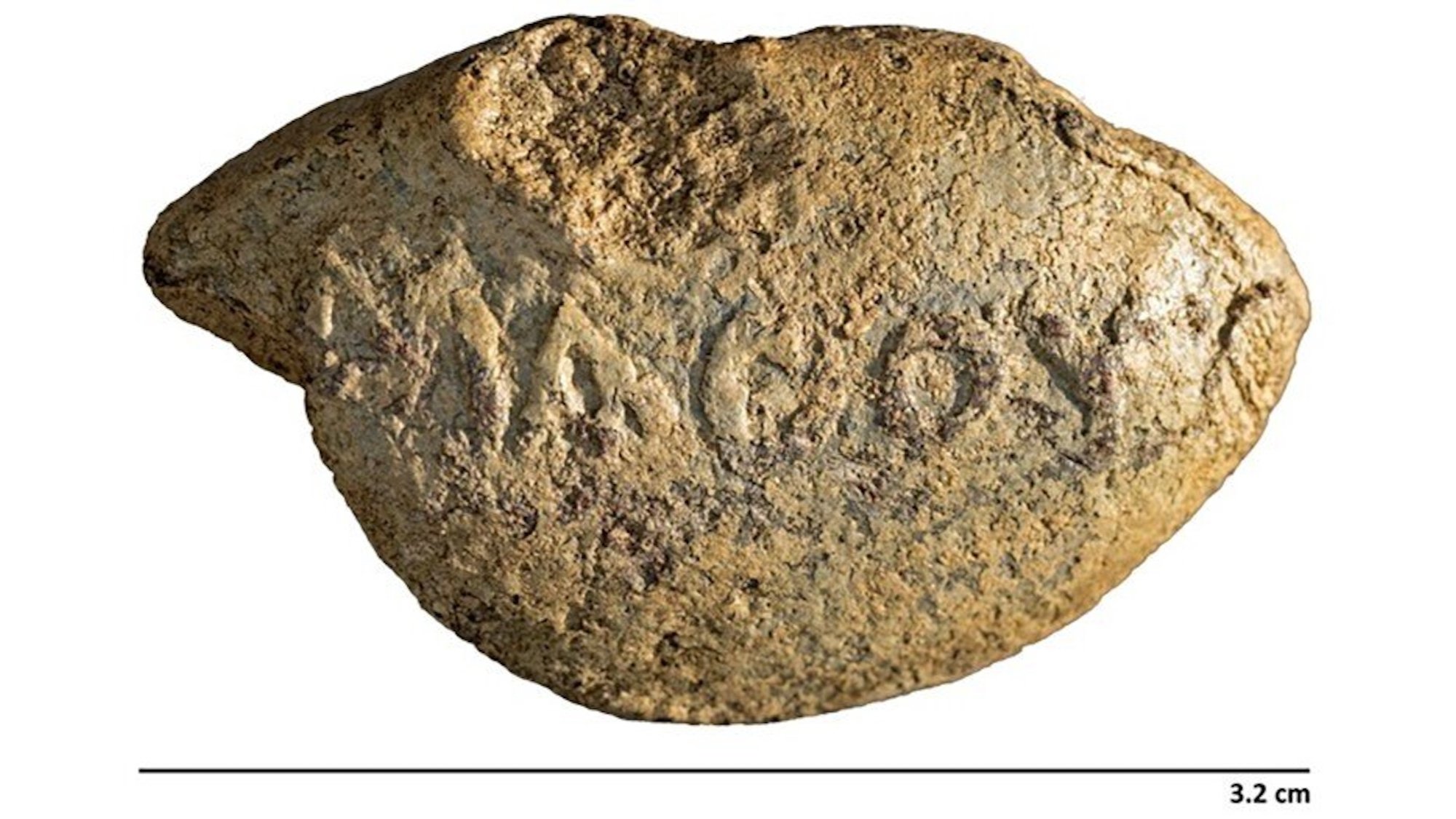
No one wants to get pelted by a rock, much less one inscribed with an infuriating taunt. Nevertheless, the unwanted projectiles have brained unfortunate targets for thousands of years. And near the ancient city of Antiochia Hippos in present-day Golan Heights, archaeologists recently discovered a projectile featuring the first known message of its kind. As they describe in a study recently published in the journal Palestine Exploration Quarterly, it’s very likely a soldier laying siege to the Roman fortification about 2,100 years ago got smacked with a lead bullet featuring the Greek letters “ΜΑΘΟΥ.”
The translation? “Learn your lesson!”
Researchers located the projectile in 2025 while surveying a riverbed near Hippos using metal detectors. While it’s only one of around 70 similar munitions catalogued during the field work, most of the other examples are either bare, or feature illustrations of scorpions and thunderbolts. These were widely employed by hurling them in slings.
“Sling bullets were a cheap munition, a hand-thrown projectile, used for millennia,” archaeologist and study co-author Michael Eisenberg told Phys.org. “Its throwing power is based on swirling a long sling made of rope while the bullet rests in a leather pouch.”
The ΜΑΘΟΥ bullet may be unique, but the city’s use of slings was not. Hippos saw its fair share of combat over the centuries. The Greco-Roman settlement was one of 10 locales that made up the Roman Decapolis.These communities located around the Southern Levant were more closely associated with Greek society than local Semitic populations. It was founded following the Battle of Paneion around 199 BCE, and resisted conquest by the Judean king Alexander Janneus around 101 BCE. However, the Roman general Pompey ultimately incorporated Hippos into Provincial Syria in 64 BCE.
It’s unclear when the ΜΑΘΟΥ bullet exactly took flight, but the study’s authors believe it likely dates to the 2nd century BCE. The team also explained it’s a classic example of an almond-shaped lead sling bullet from the era—about 1.25 by 0.76 inches in size and weighing around 1.3 ounces. According to Eisenberg, sling bullets were extremely effective at hitting individual targets as far as 328 feet away, but were also effective at longer distances when thrown at groups of enemies.
Historical examples of sling bullets include inscriptions such as the names of gods, military units, or even the name of the wielder. In some instances, the ammunition featured taunts translating to phrases like “receive this” and “take a taste,” but ΜΑΘΟΥ is especially notable. Archaeologists believe the Hippos bullet likely read as μαθοῦ, which would emphasize the message’s mockery.
“It is the only instance in which such a word appears on a bullet and its imperative [is] in the middle voice, which could make the case even more sarcastic,” he explained.
It likely will never be known if ΜΑΘΟΥ struck its intended target to add insult to injury. But based on where archaeologists found the bullet, it was almost certainly thrown by a defender of Hippos and not an attacker. Whether or not the message was received, the defense ultimately worked.Hippos continued to exist in various forms until it was finally abandoned following a devastating earthquake in 749 CE.
