

This article was originally featured on Knowable Magazine.
How about a cuppa?
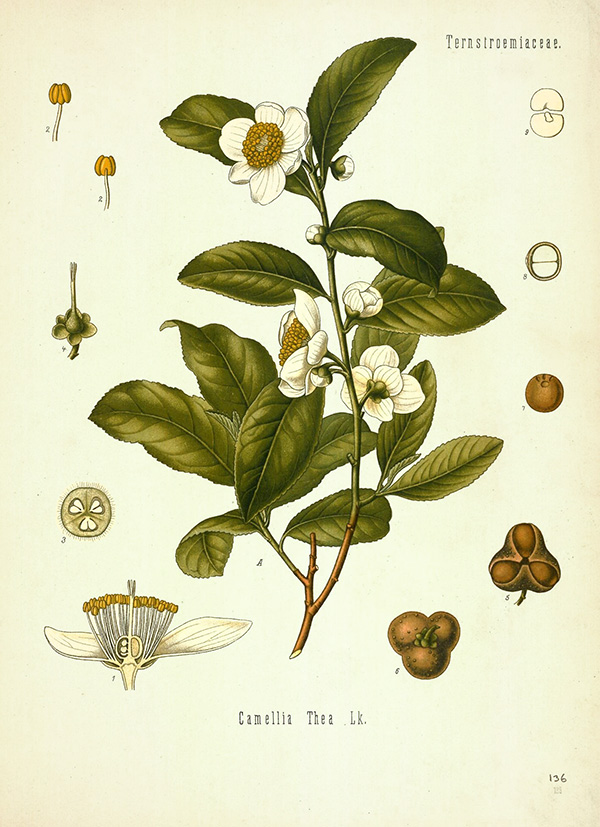
Tea is the world’s most popular drink, except for plain old water. Whether we’re talking matcha, Earl Grey or oolong, it’s all made from the leaves of one species of plant, Camellia sinensis. (Any other tea-like brew is technically a tisane or herbal tea.)
That one tea plant yields teas in an astonishing rainbow of varieties: green and black, yellow and white, and other types and subtypes. The leaves contain hundreds to thousands of different molecules that contribute to the beverage’s aroma, flavor and potential health benefits, says Young-Shick Hong, a metabolomics specialist at Chonnam National University in Gwangju, South Korea.
Until recently, knowledge about such tea molecules was limited, and sometimes incorrect, says Kelly Miller, product development and innovation manager at the tea retailer DavidsTea in Mont-Royal, Quebec. Now, thanks to advanced scientific methods, scientists are getting a closer look at the molecules in tea leaves.
“We can get into the details, which is cool,” says Miller.
These investigations are revealing that, much like wine, the molecular profile of each tea variety, or even batch, is influenced by every phase of production, from the soil the bush grows in to the way the leaves are dried, rolled or heated in preparation for consumption. And these molecular patterns correspond to features that tea drinkers care about. Hong, for example, enjoys a brand made with young leaves picked from the first spring harvest of tea grown on South Korea’s Jeju Island.
5,000 years of tea variety
The tea plant is an evergreen shrub that was domesticated about 5,000 years ago, probably in China. It’s now grown in dozens of countries and has been bred into an array of varieties. Farmers may grow the sweet sinensis variant or the bold assamica version, and there are more specific cultivars and hybrids within those varieties.
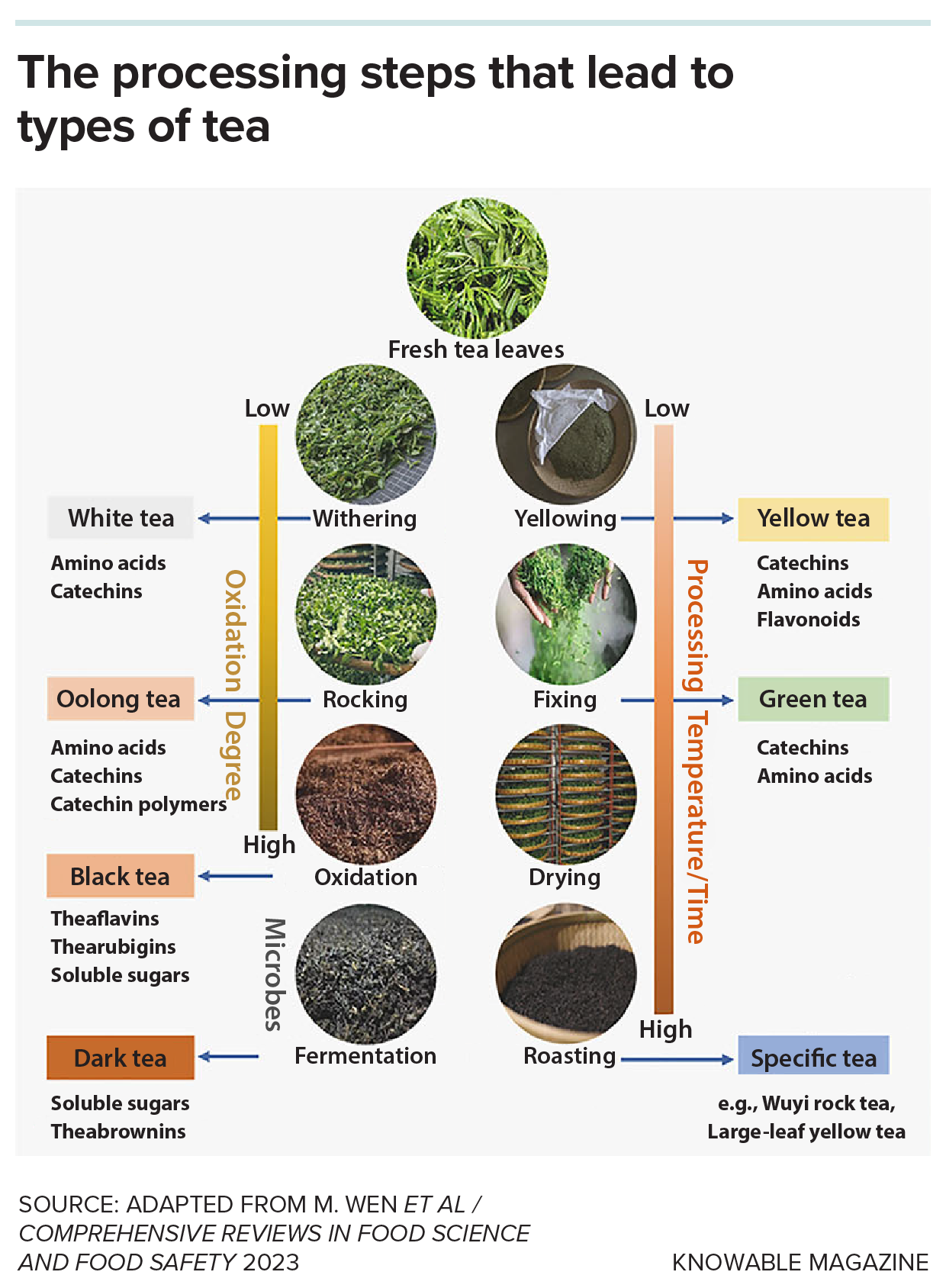
Growers can further influence the final product by cultivating their crop in sun or shade and by picking the newest buds or older leaves. Processing involves further options: drying, rolling, grinding or even fermenting the leaves with microbes (see infographic). “There’s this really, really amazingly large tapestry of choices, and everything has a ripple effect,” says Miller.
To fully understand how factors from weather to processing influence tea compounds, scientists turn to metabolomics: profiling all the metabolites — sugars, amino acids, organic acids and other compounds — that they can measure in an organism’s cells or tissues. A variety of technologies can now detect these various molecules in tea, allowing scientists to compare tea from different regions, seasons and preparation methods.
Geography, for example, influences tea, just like terroir influences wine: “It’s as unique as a fingerprint,” says Miller. In one study, Hong and colleagues measured metabolites in 281 green tea samples from China, Japan and South Korea. First, they ground up the leaves and mixed them with water to extract key molecules. Then they analyzed the solutions via nuclear magnetic resonance spectroscopy, which can identify molecular structures based on how the atoms’ central components respond to magnetic fields.
Taking all the metabolites into account, the team found that the profiles of teas from each nation were different, likely due to factors like cultivars and climate. For example, Korean tea had more caffeine and sugars than Chinese tea, but Korean samples had less theanine, an amino acid that’s important to tea flavor. Miller calls theanine’s taste “sweet-savory” and compares it to a fresh garden tomato. It tends to balance the bitter flavor of catechins, another prominent set of tea molecules.
The histories of tea plants were also written in their metabolomes. In South Korea, some farmers grow some tea variants that originated in China; others cultivate teas that arrived by way of Japan. The scientists found that there were molecular similarities between these Korean transplants and their Japanese or Chinese forebears.
Even teas from neighboring regions showed variation in metabolite profiles, the group found. For example, teas grown about 10 miles apart, in Hangzhou and Yuhang, China, had different metabolomes.
Altitude matters, too. Another team of scientists analyzed teas from different elevations in China’s Yunnan Province via mass spectrometry, which converts molecules to charged particles, then measures their masses to reveal their identities. Lowlands tea contained bitter compounds, like catechins and caffeine, and produced a grassy aroma. Higher-elevation teas were sweeter.
High-altitude flavors result from a combination of environmental factors, Miller says, including cooler temperatures and slower growth rates as well as fewer insects munching on the leaves. Bitter compounds like caffeine are part of the plant’s anti-pest system, she explains. If there are fewer bugs at altitude, the tea plant doesn’t need to make as much caffeine. That’s why teas like delicate Darjeeling, grown at up to 7,000 feet above sea level in the Eastern Himalayas, offer floral and fruity notes without much bitterness.
Levels of sun versus shade also influence flavor. Matcha, for example, is produced from teas that are shaded for weeks before harvest, leading to lower levels of bitter catechins but more bright-green chlorophyll. And shading also results in more theanine in the final product, because theanine is normally converted to other metabolites by sunlight.
Shade is also linked to higher levels of amino acids in general, but lower amounts of the sugar glucose, according to a metabolomics study led by Hong. This seems to be because light-starved plants can’t perform as much photosynthesis, so they don’t convert as much light energy into sugar. In response to shade, the plants break down the proteins in their chloroplasts, giving rise to amino acids. Of those, theanine, as well as glutamic acid, will have the greatest impact on taste, resulting in a savory, refreshing flavor, says Liang Zhang, a chemist at Anhui Agricultural University’s School of Tea and Food Science and Technology in Hefei, China.
Many paths for tea processing
The processing phase, which begins with harvesting the leaves, can dramatically influence a tea’s molecular profile and taste. Depending on how they’re treated, the leaves can become grassy green teas, bold black teas or other varieties.
“Every step in processing tea leads to changes in the tea metabolome and, consequently, flavor,” says Hong, who detailed tea metabolomics in the 2025 Annual Review of Food Science and Technology.
The first step is usually to dry, or “wither,” the tea leaves. For such a simple process, withering has big effects. It initiates interactions between tea components and oxygen, cuts chlorophyll, boosts caffeine, and leads to production of fragrant molecules.
Following withering, further processing choices determine tea types. Green teas, for example, come from leaves that are quickly heated to stop their molecules from reacting with oxygen. Black teas, in contrast, result from leaves that are rolled or bruised, breaking down their cell walls and allowing oxygen to alter the molecules within. This step also makes their caffeine more accessible during steeping, notes Miller, who enjoys black tea for this stimulating bonus.
In one study, researchers profiled the tea metabolome at various stages of black tea production. They found the biggest differences before and after rolling and withering the tea leaves, with changes to more than 100 different compounds. In newly withered tea leaves, for example, levels of certain sugars and catechins dropped, but the amounts of amino acids rose.
They also uncovered some very specific metabolite changes following processing from fresh leaves to steep-ready black tea. Quantities of several amino acids continued to rise. The amounts of aromatic molecules, which create honey and rose fragrance in the tea cultivar that was being studied, increased, and eight new ones were produced. At the same time, 19 grassy-smelling molecules dropped in concentration.
Probing tea’s health benefits
Tea is not only aromatic and tasty; it’s also widely believed to have health benefits. For example, drinking tea has been linked to lower risk for conditions including cardiovascular disease and dementia, as well as a longer lifespan. Yet such studies are typically based on work with lab animals or on observations of large populations of people, where scientists don’t necessarily know exactly what their subjects were drinking, nor other dietary or lifestyle habits that might also influence health.
Metabolomics might enhance this kind of research by providing clues on specific molecules behind health effects, suggests Marilyn Cornelis, a nutritional scientist at the Feinberg School of Medicine of Northwestern University in Chicago. “These metabolomic studies are very cool because they identify compounds in tea that we might not have even known about, or that are produced during the processing,” she says.
For example, it’s already known that bitter catechins are antioxidants that fight inflammation. And theanine, Cornelis notes, appears to reduce stress and anxiety. That could explain why many people find a cup of tea to be calming, even though tea, like coffee, contains caffeine.
Theanine, caffeine and catechins are just a few of the many metabolites in tea. And many tea compounds remain unknown, notes Zhang. But now, thanks to metabolomics, the C. sinensis bush is spilling its molecular secrets. Drink up.
This article originally appeared in Knowable Magazine, an independent journalistic endeavor from Annual Reviews. Sign up for the newsletter.
