
Sciatica afflicts millions of people each year—though not as many people as think they have it. A growing catchall term among the undiagnosed for all manner of back problems, sciatica is a specific lower-back nerve condition that requires specific action to address.
“Early detection matters,” John Gallucci Jr. MS, ATC, PT, DPT, the CEO of JAG Physical Therapy, tells Popular Science. “If you start feeling sciatica pain, do not wait to get it treated. Prolonging the pain will only make it worse.”
So, anyone seeking sciatica stretches and exercises should be certain they’ve received the right diagnosis for what they’re suffering before embarking on a concerted effort to relieve it. Once they do, however, they’ll find that sciatica can be improved fairly simply.
We asked Dr. Gallucci about the physical therapy exercises for sciatica he recommends, and he bent over backwards—don’t worry, it’s forward movement that triggers sciatica—to help. Learn about each below along with the symptoms, provocations, and prevention methods of sciatica.
What is sciatica?
Sciatica refers to pain or tingling caused by irritation of the sciatic nerve, which governs much of your lower body function. It’s the body’s largest nerve, running from several roots in the lower spine, through the glutes, then down the back of the thigh and into the lower leg and foot.
“When any portion of this nerve becomes compressed or inflamed, the result can be pain or altered sensation anywhere along its long pathway,” Gallucci says.
A common misconception among amateur orthopedists mischaracterizes any lower back pain as sciatica, but that label applies strictly to pain originating from the sciatic nerve. Notably, a condition called piriformis syndrome can mimic sciatica symptoms due to the proximity to the sciatic nerve of the piriformis muscles that connect the spine and femur. Sciatica and piriformis syndrome stem from different causes and call for different remedies.
6 signs of sciatica
Sciatic pain is characterized by a sharp, shooting sensation that radiates from the low back into the buttock and leg, typically following along a discernible line. Besides pain, there are several other indicators of sciatica to watch for, according to Dr. Gallucci.
- Numbness or tingling in the buttock, thigh, calf, and/or foot.
- Leg or foot weakness such as difficulty lifting the toes or pushing off when walking.
- Muscle spasms in the low back or glutes, often triggered by transitions like standing up from sitting or rolling in bed.
- Worsened symptoms after prolonged sitting or long car rides. Many patients report “burning” or a “deep ache” after 20 to 40 minutes of sitting.
- Pain that eases with gentle walking.
In the vast majority of cases, sciatica only affects one side of the body at a time.
When to see a doctor
If you experience these more serious symptoms, seek immediate medical care:
- Leg weakness that causes stumbling
- Numbness in the groin or “saddle” area
- Change in bowel or bladder control
What causes or worsens sciatica?
The most common cause of sciatica is a herniated or bulging lumbar disc, something only an MRI or CT scan can confirm. There are a number of factors that can contribute to both.
- Age: Sciatica appears to peak among people in their forties.
- Prolonged sitting: especially when combined with poor posture or deep, couch-style seats.
- Job: Incidence of sciatica has shown to be higher for certain occupations, including machine operators, truck drivers and workers placed in awkward positions (see below).
- Lifting with poor mechanics. Failing to use proper form when picking up even moderately heavy objects can overload the lumbar spine both acutely and chronically.
- Smoking: Cigarette use causes blood vessels to constrict, reducing an already limited nutrient supply to spinal discs, which may degrade faster with prolonged smoking.
- Tight hip flexors or hamstrings, which increase lumbar stress.
- Weak core and glutes, which can increase nerve strain and decrease stabilization.
Sciatica is generally inflamed by movements involving repetitive lumbar spine flexion (think: crunching), twisting of the trunk, frequent elevation of arms above shoulder height, even coughing. Prolonged sitting while driving or working at a desk can exacerbate this by increasing load on the intervertebral discs in your lower back, which can further irritate a herniated disc.
One thing that doesn’t appear to have an impact on sciatica is gender; no greater predisposition has been shown among men or women, though men are two to three times likelier to experience sciatica owing to their greater incidence of physically demanding work.
Most cases of sciatica resolve in four to six weeks with no long-term complications, even absent medical treatment. More severe cases may be accompanied by a longer recovery time.
7 Stretches and Exercises to Help Relieve Sciatica
The answer to your back pain is likely some form of movement. This selection of glides, stretches and exercises recommended by Dr. Gallucci provides seated, standing and lying options to decompress the lumbar spine and reduce pressure on the sciatic nerve.
1. Sciatic nerve glide (or “flossing”)
So called because it’s not quite a stretch, rather this movement gently mobilizes the nerve—rather than lengthening the muscle—to decrease sensitivity and improve circulation.
- Sit upright on the edge of a chair with both feet flat on the floor.
- Slowly straighten your right knee while pulling your right toes upward.
- Return to the starting position by returning your right foot to the floor while simultaneously bringing your chin toward your chest.
- Repeat by straightening your knee and bringing your head back up to neutral.
Reps: 10 to 15 per leg, 1 to 2 times per day
Tip: This movement should feel smooth, so avoid any sharp pulling.

2. Figure-4 piriformis stretch
This more conventional seated stretch reduces tension in the piriformis, a common compression point.
- Sit upright on the edge of a chair with both feet flat on the floor.
- Cross the ankle of your right leg over your left thigh, just above your knee.
- Keeping your spine straight, gently lean forward until you feel a stretch and hold for 20 to 30 seconds.
Reps: Perform 2 to 3 rounds per leg.
Tip: Pull your knee toward the opposite shoulder for a deeper stretch.

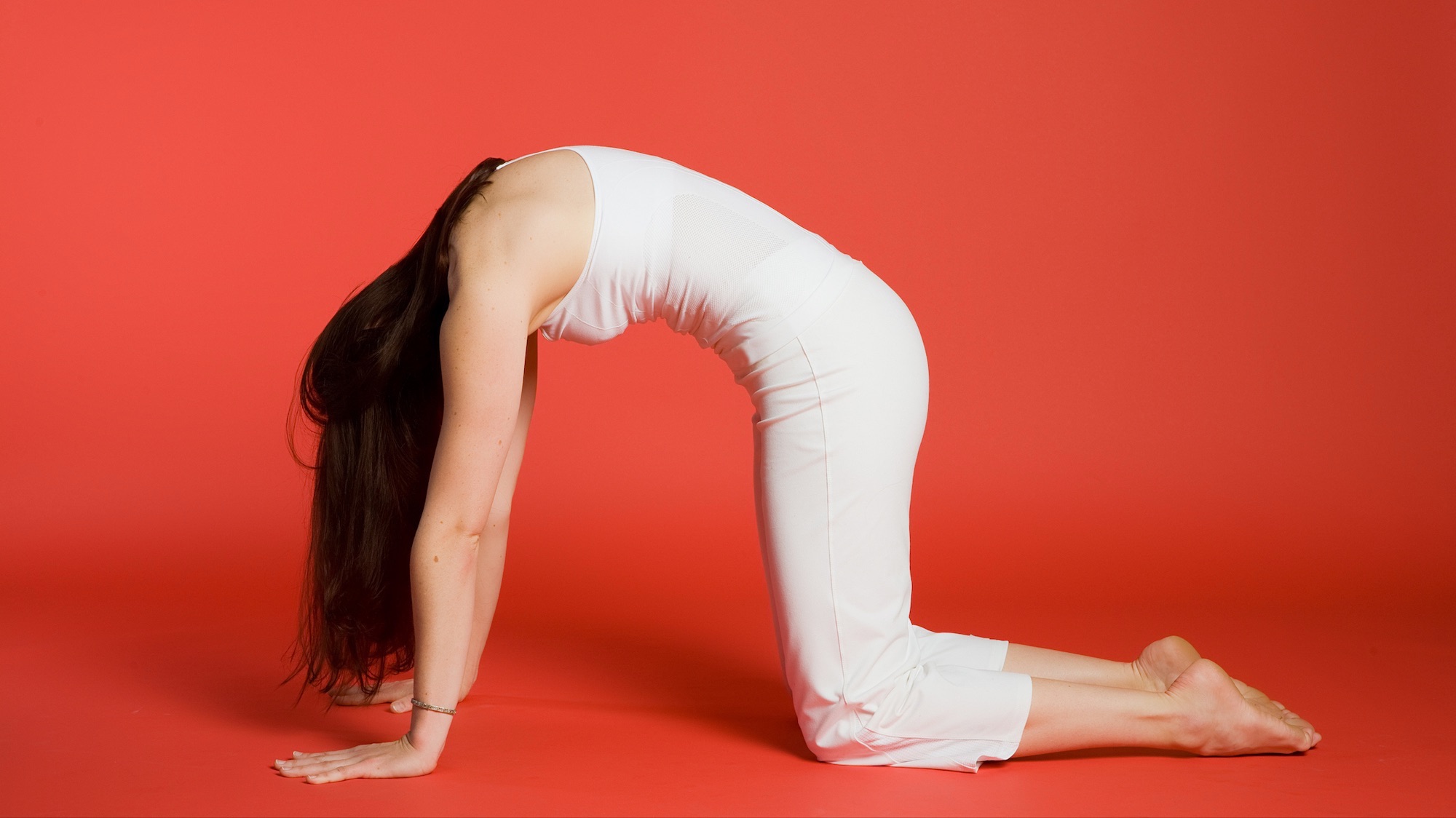
3. Cat-cow spinal mobility
This classic yoga sequence improves spinal mobility and decreases stiffness around irritated segments.
- Get down on the floor in tabletop position, with your hands directly under your shoulders and your knees directly under your hips.
- Round your spine up toward the ceiling while simultaneously tucking your chin toward your chest and drawing your belly button inward.
- Reverse the move, slowly arching your back, while lifting your chest and tailbone upward, allowing your abdomen to relax.
Reps: Perform 10 to 15 cat-cows in a slow and controlled manner.
Tip: Focus on smooth lumbar movement rather than forcing large ranges of motion.

4. Child’s pose
Another yoga-inspired stretch that gently lengthens the spine and reduces lower-back pressure.
- Get down on the floor in tabletop position, with your hands directly under your shoulders and your knees directly under your hips.
- Sit your hips back toward your heels, and extend your arms forward on the floor.
- Allow your forehead to rest on the floor and hold for 30 to 45 seconds
Tip: If your knees bother you, widen them or rest on a pillow.

5. Standing hamstring stretch
The lone standing movement on the list helps loosen hamstrings and relieve stress on your lumbar spine.
- Stand tall with your feet hip-width apart.
- Plant your right heel on the floor slightly in front of you with your knee straight and your toes pointing upward.
- Keeping your back flat, gently hinge forward at your hips until you feel a stretch in the back of your thigh.
- Hold for 20 to 30 seconds and repeat on the other leg.
Tip: Lengthen through your spine, hinging at your hips rather than rounding your back.

6. Glute bridge
This lying hip extension exercise strengthens glutes and the posterior chain, reducing load on your lumbar spine.
- Lie on your back with your arms at your sides and your feet flat on the floor.
- Engaging your core, drive through your heels and lift your hips toward the ceiling until your body forms a straight line from your knees to your shoulders.
- Slowly lower your hips back to the floor.
Reps: Perform 12 to 15 bridges per set, completing 2 to 3 sets.
Tip: Avoid arching your lower back.

7. Side-lying clamshell
Reduce load on your lumbar spine by strengthening your hip abductors, piriformis muscles, and glutes with this abduction exercise.
- Lie on your right side with your hips stacked and your knees bent 90 degrees. Rest your head on your right arm if it feels comfortable.
- Draw your knees in toward your body until your feet are in line with your glutes.
- Without allowing your hips to rotate, raise your top knee as far as you can and return it to the starting position.
Reps: Perform 20 to 30 clamshells per set, completing 2 to 3 sets per side.
Finally, it’s important to note that this article is intended for informational purposes only and does not constitute medical advice. You should always consult a healthcare professional before beginning a new exercise or treatment regimen.

