
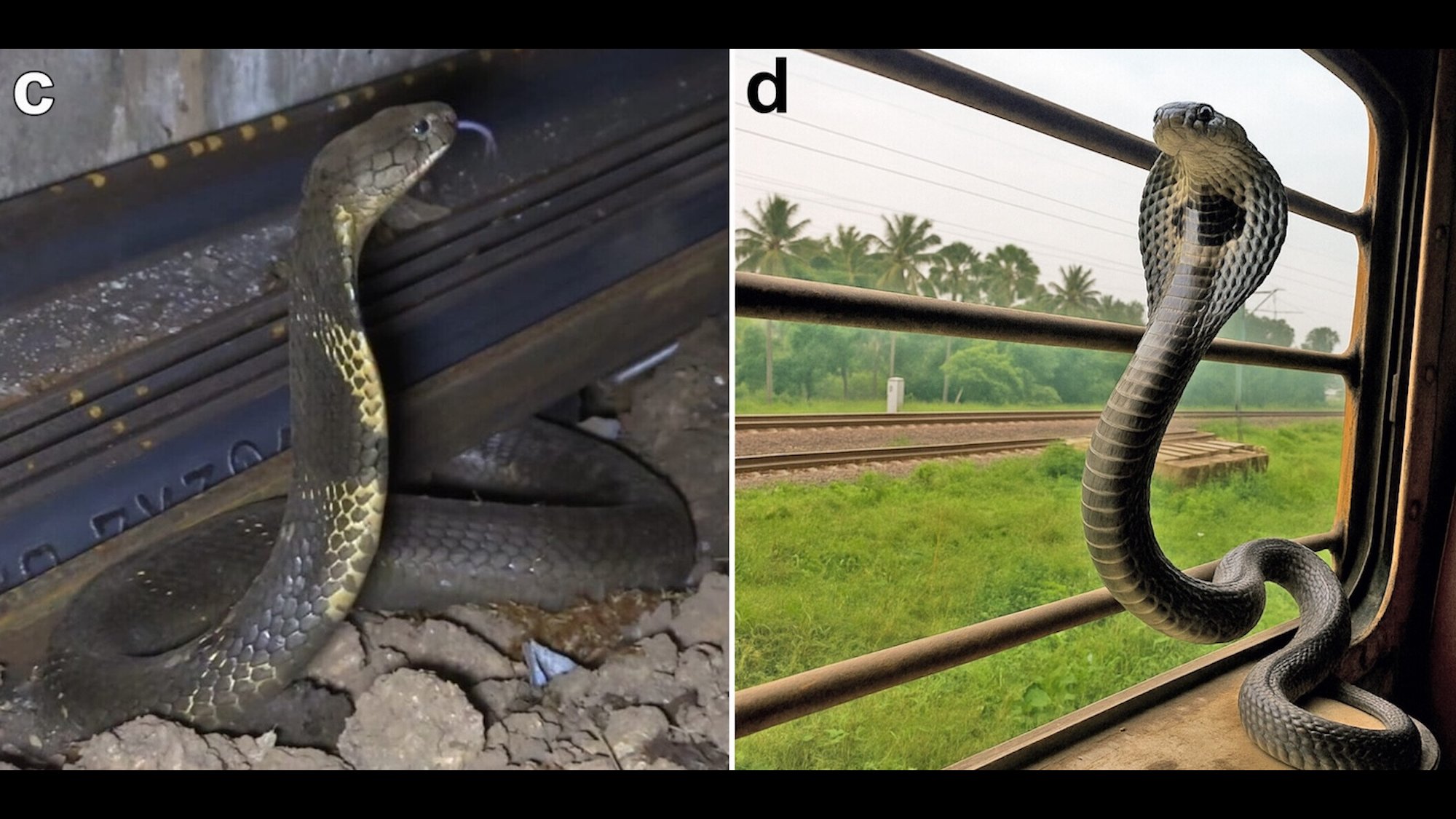
The king cobra (Ophiophagus hannah) isn’t a difficult snake to spot. A fully grown adult easily reaches over 13 feet long, making them the largest venomous snakes in the world. But despite their size and iconic appearance, at least one vulnerable species in India is sneaking aboard trains and accidentally arriving into new and dangerous habitats.
In a study recently published in the journal Biotropica, researchers from Museum Liebnitz in Bonn, Germany, analyzed available verified local cobra reports and rescue records made between 2002 and 2024 in the Goa region of southwestern India. In all, they identified 47 encounters with the Western Ghats king cobra (Ophiophagus kaalinga) over 22 years. Beyond the danger of such meetings, there was a larger problem: the Western Ghats isn’t endemic to Goa.
Herpetologist and firsthand volunteer king cobra rescuer Dikansh Parmar can personally attest to the issue. His 2017 encounter is one of his own study’s five separate snake sightings located on or near trains. Following additional interviews with local residents revealed the serpents were also spotted in villages and neighboring forests, but nowhere in the surrounding farmland.
“With the increased global availability of low-cost smartphones and social media in recent years, the number of reports of snakes on and around trains in India has increased, with three incidents recorded in a 30-day period, and many more emerging on social media,” Parmar and his co-authors wrote.

Based on these and other reports, the team developed a theory: Western Ghats cobras are hitching rides on trains to new locales. They suspect that the snakes are likely attracted to railway cars for a mixture of reasons, including prey like rodents and the lure of safe, secure shelters.
Their final destinations around Goa aren’t ideal, however. After conducting a species distribution model that integrated factors like human activity, vegetation, and climate, Parmar then compared hypothetically suitable habitats to the actual cobra rescue locations. His team discovered the snakes have the best chances for survival in Goa’s interior, away from the coast but close to rivers and streams in forests. More often, however, reports placed the snakes near railway sites that are drier, more exposed, and house fewer prey options. Instead of climate shifts forcing their migration, Parmar explained another factor is now at play.
“Our findings suggest a different, more passive mechanism: railways may act not just as corridors for active movement, but as high-speed conduits,” he wrote “This contrasts with the typically negative impact of roads, which often function as barriers or significant mortality sinks for snakes.”
Parmar’s team argued it’s very plausible that train migration routes are a vastly underreported method of travel—not only for king cobras, but other vulnerable species, as well. Only by better studying and understanding these situations can conservationists protect the animals, as well as any surprised commuters.
