
Mushrooms are social butterflies. Seemingly small communities of fungi separated by hundreds of feet are frequently connected via vast underground webs known as mycelial networks. While these allow the fungi to share vital information about their surroundings and environmental conditions, researchers still know very little about how these networks truly function.
A team of mycologists in Japan recently highlighted one fungi group’s remarkable, highly dynamic communications. Their particularly unique type of mushroom chatter that can be easily influenced by one thing that all animals release—urine. Their findings are published in the journal Scientific Reports.
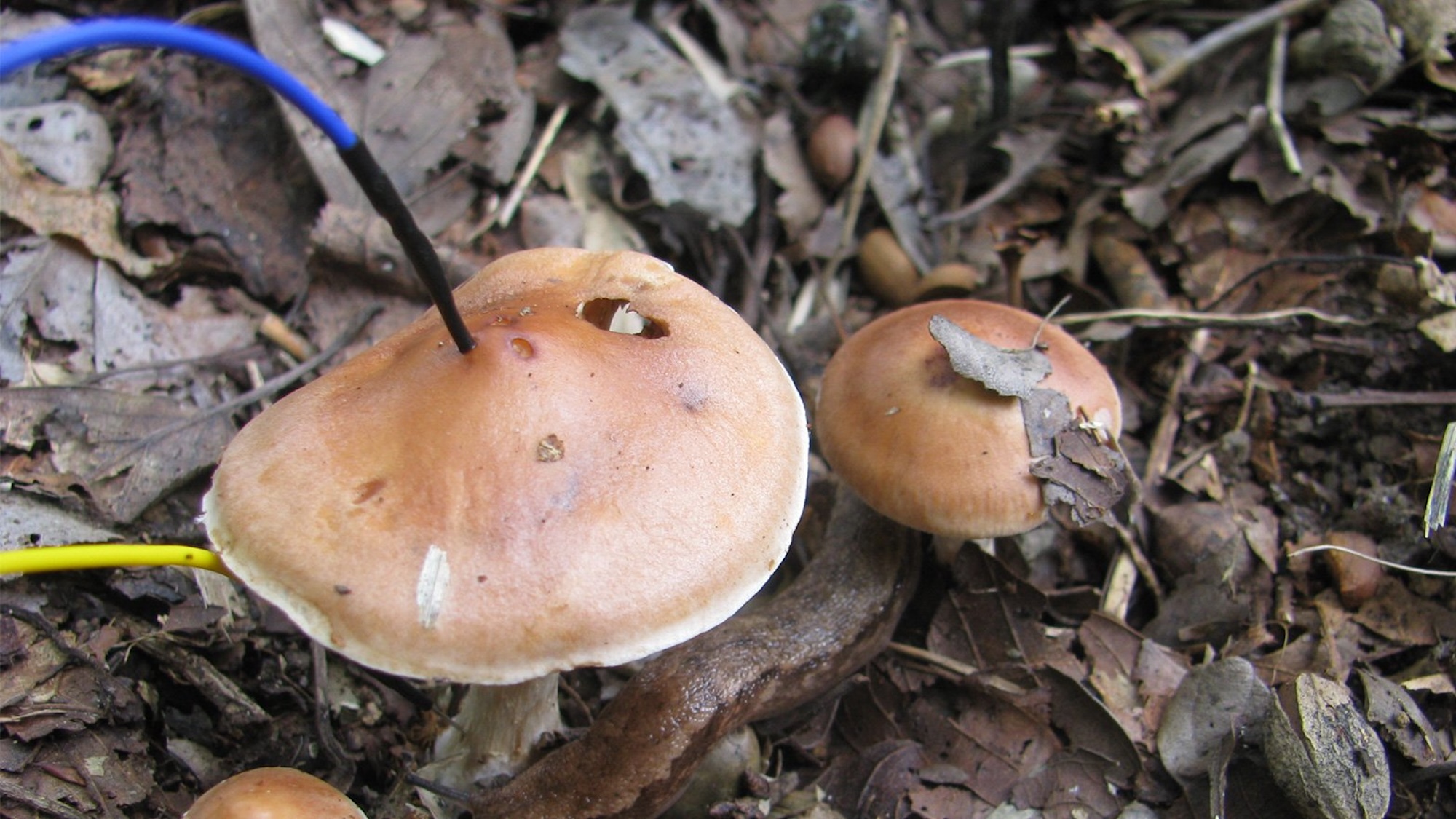
Ectomycorrhizal fungi belong to a larger group known as ammonia fungi. As their name implies, they heavily depend on soil ammonia levels to grow and spread. Urine contains large amounts of urea, a chemical predecessor to ammonia. With this in mind, researchers led by Yu Fukasawa at Tohoku University in Sendai attached electrodes to 37 ectomycorrhizal mushrooms growing on the floor of an oak forest. Next, they exposed the fungi to different amounts of water and urine under multiple conditions, then measured electrical communication levels every second for 3.5 days.
The results illustrated a wide spectrum of mushroom chatter. When water was added to a single mushroom, information activity boosted in response. However, when water was applied to more mushrooms, the electrical flow decreased.
“It’s fascinating to think about why the mushrooms communicate the way they do,” Fukasawa said in a statement. “For example, applying water to all the mushrooms may mean that there’s no need to share information since the whole network already knows what’s going on, which could be why the flow of information decreased in this situation.”
Interestingly, exposure to urine also decreased communication among the fungi. Although the reason for this remains unclear, the experiments offer a detailed look at the ways some mushrooms alter electrical information flows depending on the world around them. With further study, Fukasawa’s team hopes to match specific electric signals to corresponding activity within mushroom whisper networks.
