
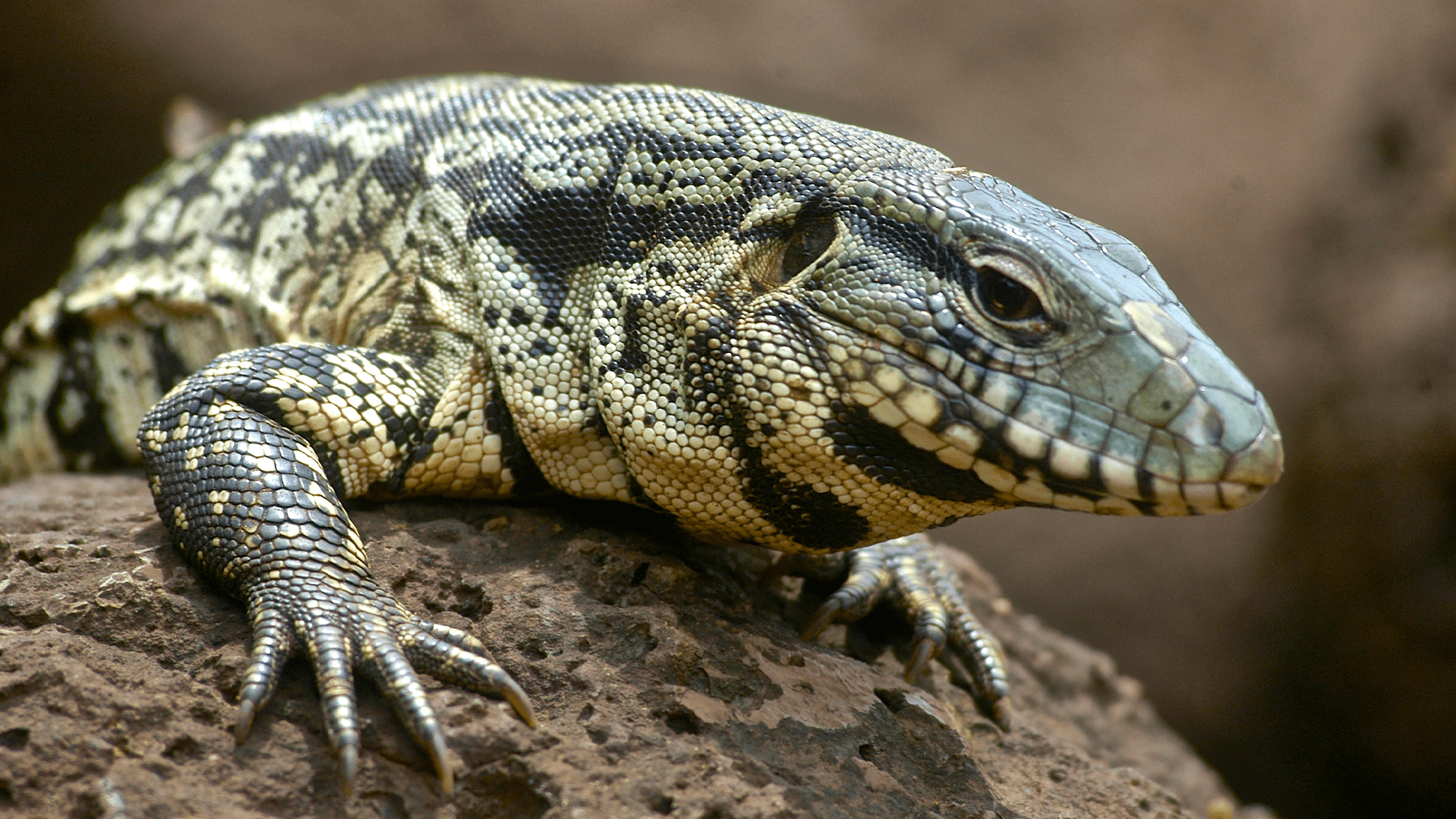
If last year was brat summer, this year may be remembered as escaped lizard summer. Since June, at least three large pet lizards in the United States have escaped their owners’ homes, surprising neighbors by appearing in places that aren’t used to hosting these large dinosaur-looking reptiles.
In June, hikers came across an Argentine black and white tegu (Salvator merianae) in Joseph D. Grant County Park in Santa Clara County, California. These large, omnivorous lizards can grow up to almost five feet long and are native to regions in South America. They mostly eat eggs, fruits, insects, and small animals, meaning they’re (probably) not going to go after your six-year-old.
[ Related: Gila monster spit inspired a new way to detect rare pancreatic tumors. ]
“These lizards are not native to the area and tend to eat bird eggs, small birds, small lizards, and various small mammals and invertebrates. They are docile so they won’t harm people, but they do not belong in county parks,” reads a social media post by Santa Clara County.It’s unclear whether the lizard escaped from its owner or was abandoned—either way, it was safely captured later that month.
On the opposite coast, another lizard had quite the adventure in July.
“Folks in Webster, be on the lookout for an unusual escapee: a 5-foot water monitor lizard that may be channeling its inner explorer,” the Massachusetts Environmental Police wrote on social media. “Not aggressive but best admired from a safe distance — those teeth mean business. Despite its chill demeanor, this is not your average pet.”
Water monitors (Varanus salvator) are large, carnivorous lizards native to South and Southeast Asia. As the name suggests, they are exceptional swimmers. Owners need a permit to possess a monitor lizard in Massachusetts, and according to Webster Animal Control, this reptile(named Goose) was owned illegally. Thankfully, Goose was apprehended earlier this month after several days on the lam and relocated to a nonprofit animal sanctuary.

Most recently, residents further north in New England were also alarmed to spot a giant reptile in the city of Old Town, Maine.
“We originally thought it was a Monitor lizard, although after hearing from many of you, we believe it’s a Tegu. Tegus have sharp teeth and claws, and strong jaws. While not inherently aggressive, they can lash out if they feel threatened,” the Old Town police department wrote on a social media post.
According to the non-profit organization Pet Advocacy Network, reptiles are escape artists. Enclosures should be completely secured “with hinges, a latch, or a locking device that secures all sides. Placing weights on top of a screen cover is not sufficient.” There are also specially designed enclosures for larger lizard species, such as monitors.
The tegu in Maine is still at large. But if Louie the otter taught us anything back in June, it’s that sometimes animals decide to take their destinies into their own hands.
