
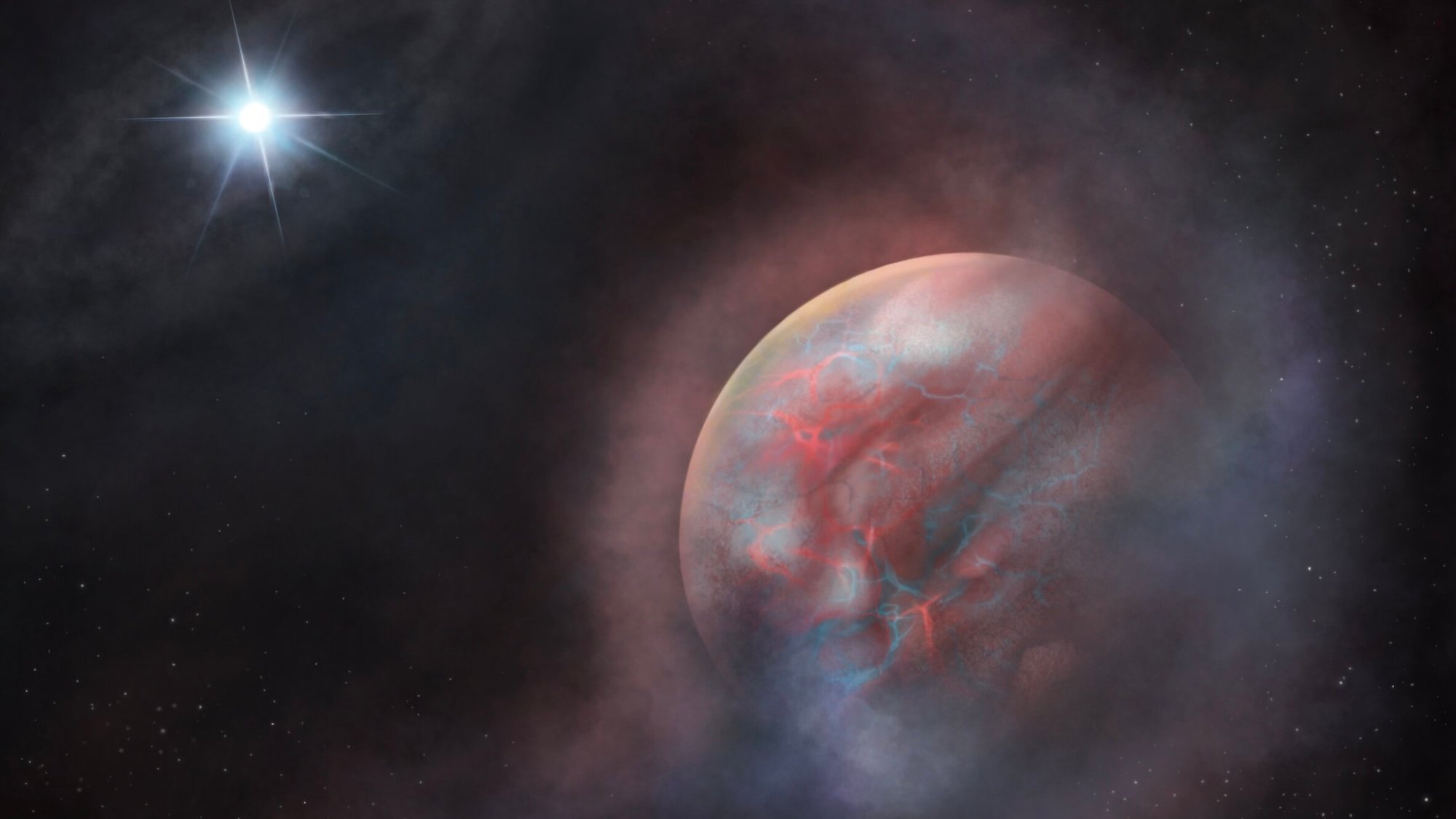
A star’s explosive death is often apocalyptic for its closest planets. In our solar system, the sun’s expansion into a red giant about five billion years from now will spell doom for Mercury, Venus, and possibly even Earth. But a dead star isn’t only capable of destruction. Astronomers suspect that gravity from highly magnetized, fast-spinning neutron stars known as pulsars can sometimes assemble enough material to form second-generation planets. But for the first time, scientists have detected a potential planet birthed from a white dwarf—and it may only be the first of more to come
“[Secondary planets] are incredibly rare, and finding one around a white dwarf was completely unexpected,” said University of Warwick astronomer Jamie Williams, co-author of a study recently published in the journal Nature Astronomy that focuses on the white dwarf HS 0209+083.
When a star collapses into a white dwarf, its gravitational pull often draws in elements from existing planets that are already orbiting the star. These elements then serve as small chemical signatures for common rock-generating ingredients like iron and silicon. But while examining HS 0209+083, Williams and his colleagues noticed a very different atmosphere laden with heavier elements like copper, zinc, and niobium. In the latter component’s case, the white dwarf possessed more than 1,000 times the amount seen in the sun. These elements are all seen during a star’s death, but it’s the first time niobium was found in a white dwarf.
“It’s a chemical signature no ordinary, ‘first-generation’ planet should carry, which told us that this new planet was something different,” added University of Wisconsin-Madison astronomer and study co-author Nicholas Stone.
Additional data collected by NASA’s Transiting Exoplanet Survey Satellite (TESS) indicates a faint brightness signal that repeats every 4.4 days. This aligns with a gas giant about the size of Jupiter in a tight, tidally locked orbit with the dead star. Its proximity implies the planet’s atmosphere is disintegrating from a bombardment of radiation, and that material eventually makes it to the white dwarf. Researchers now suspect HS 0209+083 is consuming material from the gigantic planet whose existence is entirely owed to the white dwarf.
“What’s remarkable about the planet around HS 0209+0832 is that this isn’t a planet from somewhere else, or a survivor from the system’s birth,” said study co-author and University of Warwick astrophysicist Boris Gänsicke. “In a sense, this system has given birth to a new world using the foundations of the old one.”
However, this scenario only makes sense in very specific situations. A single, dying star typically largely ejects its mass symmetrically when it dies. To form a new planet, HS 0209+0832 probably required a companion star that reeled this material back into orbit before it could scatter into space. But if proven true, astronomers will have a new method to scan for additional second-generation planets orbiting dead stars.
“It’s a bit like finding a planet that has risen from the ashes of the very star it once orbited,” said Williams.
