
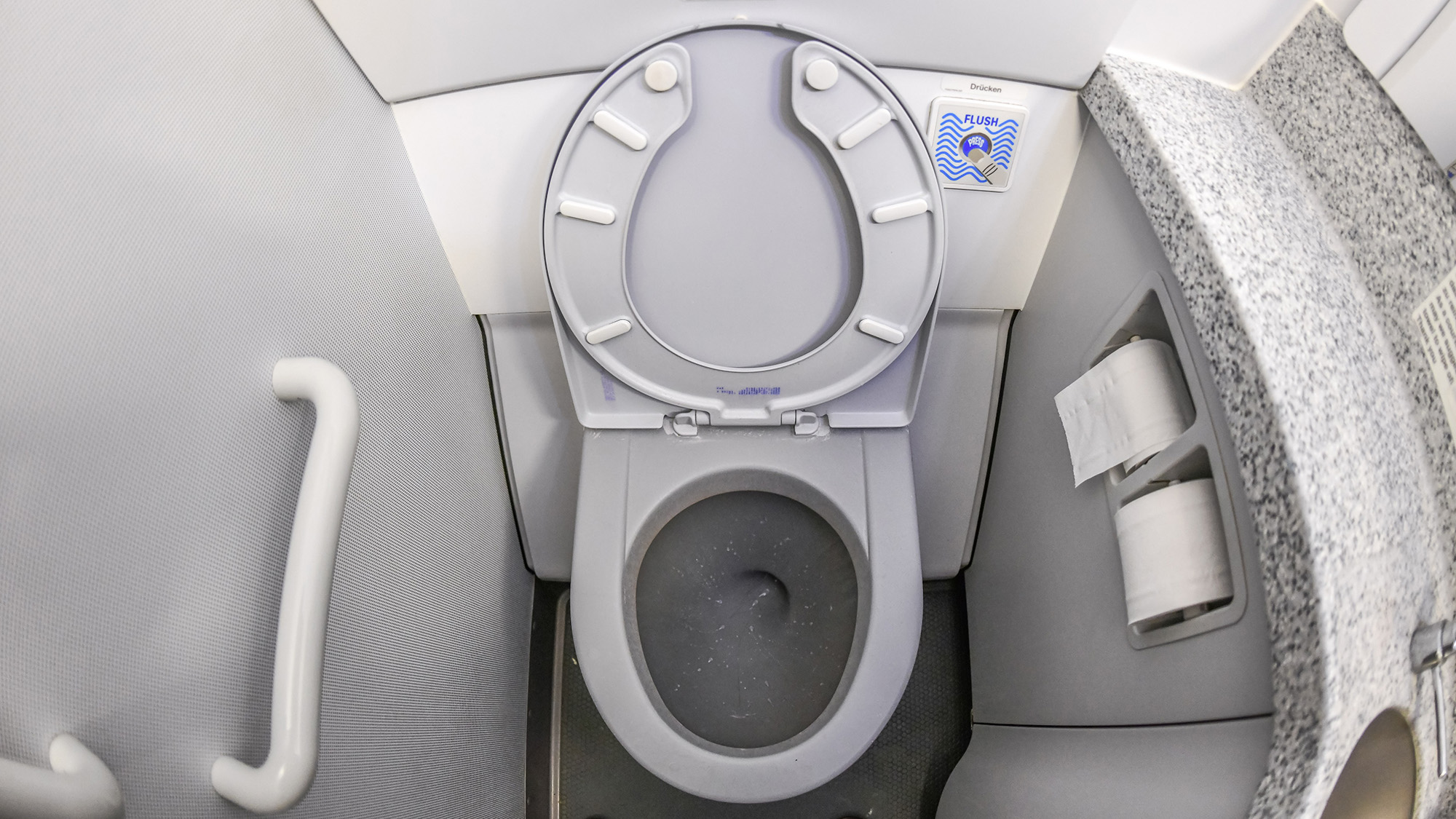
There’s nothing quite like the sound of an airplane toilet flushing. But that incredibly loud sucking sound is actually something of an engineering marvel. These toilets flush, with no water, while zooming along at 500 miles per hour.
In this episode of Ask Us Anything by Popular Science, we get into all the smelly details of how airplane toilets actually work.
Ask Us Anything answers your most outlandish, mind-burning questions—from the everyday things you’ve always wondered to the bizarre things you never thought to ask. So, yes, there’s a reason we can’t remember being babies and no, not all cats hate water. If you have a question for us, send us a note. Nothing is too outlandish or too ordinary.
This episode is based on the Popular Science article “How do airplane toilets work?”
Subscribe to Ask Us Anything
Listen and follow Ask Us Anything on your favorite podcast platform:
Spotify | Apple Podcasts | YouTube | Or wherever you get your podcasts.
Full Episode Transcript
Sarah Durn: You’re six years old, wedged into a middle seat on your very first flight.
Your ears are popping. The engine sounds impossibly loud. Somewhere a baby is crying. And after nervously sipping one too many ginger ales, you realize there’s something else you need to do.
So you make the LONG walk down the NARROW aisle to the airplane bathroom.
You open the weird sliding door, and this lavatory is tiny. And, after doing your business, you hesitantly hit the flush button.
For one horrifying second, you’re convinced the toilet might actually suck you into the sky.
But what exactly is happening here? How do airplane toilets work?
Turns out, the answer involves physics, pressure differentials, and one surprisingly clever engineering trick.
Welcome to Ask Us Anything from the editors of Popular Science, where we answer your questions about our weird world, from “why do parrots talk like people” to “what’s the coldest temperature humans can survive?” No question is too ordinary or too outlandish.
I’m Sarah Durn, an editor at PopSci.
Laura Baisas: And hello, I’m news editor Laura Baisis.
SD: Here at Popular Science, we can’t stop thinking about all the world’s strangest questions, and this week, we’re wondering how the heck airplane toilets actually work, something Laura actually edited a story on.
So Laura, what’s going on here? What happens when we use the bathroom at 35,000 feet?
LB: First of all, you can relax. The toilet is not strong enough to suck you out of the plane.
SD: Ah, thank God. Childhood fear officially resolved.
LB: But that terrifying slurp sound, very real. And it turns out that airplane toilets use a surprisingly clever system that takes advantage of something that planes already have at high altitude, the enormous pressure difference between the cabin and the outside of the plane.
SD: So every time we flush on a plane, physics is essentially doing the dirty work?
LB: Pretty much. We love physics.
SD: Oh, we do.
LB: And once you learn how the system actually works, from vacuum toilets to something called blue ice, I’m pretty sure you’ll never hear that sound the same way again.
SD: All right. I’m in. Tell me all the airplane bathroom facts.
LB: I’d be happy to. But before we dive into the science of sky-high plumbing, we want to hear from you. What questions are swirling around your brain? Submit your question by clicking the “Ask Us” link at popsci.com/ask. Again, that’s popsci.com/ask, and click the “Ask Us” link.
SD: We’ll be right back with more about airplane toilets after this quick break.
SD: Welcome back! Okay, Laura, before we get into all the smelly details, I think we need to talk about the history of airplane toilets because early flying was kind of a nightmare.
LB: Oh, absolutely. I mean, that glamorous golden age of air travel, a lot less glamorous if you needed to pee.
SD: Right. So in the very earliest days of aviation, planes just, you know, straight up no bathrooms at all.
LB: Which makes sense if you remember early flights were a lot shorter and planes flew so much closer to the ground.
SD: Yeah, exactly. Pilots were basically flying by sight, and it’s said that early pilots actually peed into their shoes and then would just toss it into the air.
LB: I still can’t believe that’s real.
SD: Me neither. Or they’d make a hole in the cockpit floor…and just go ahead and, you know, pee through that.
LB: Correct. This is all so, so bad. So bad.
SD: But it does get better. I mean, kind of. As passenger air travel became more common in the later 1920s, airlines were like, “Okay, we should probably do something about the bathroom sitch.”
So early passenger planes basically had buckets. Just, you know, a bucket in the back of the plane.
LB: Ah, truly a luxury travel experience.
SD: Very chic, very elegant. Then in the late 1930s, the first enclosed plane lavatory debuted on the DC-4 passenger plane. But even those were pretty primitive. The toilet had a removable bowl that crews had to take out and dump after landing.
LB: Yeah, not sure I’d want that job.
SD: Yeah, same. Eventually planes, though, started using chemical toilets, you know, kind of like a fancy porta potty situation. Waste would sit in these tanks full of bright blue disinfectant liquid.
LB: Ah, yes, we come to the origin of one of aviation’s most disgusting phrases: blue ice.
SD: It doesn’t sound disgusting, which is what throws me.
LB: It’s kind of a misnomer.
SD: I know. It sounds like something a superhero would use. But anyways, explain it to us. What is blue ice?
LB: So blue ice forms when waste leaks from a plane at a really high altitude. Since it’s so cold outside, the waste instantly freezes onto the aircraft.
SD: Okay, which is already kinda gross.
LB: Yeah, and then sometimes, I’m gonna emphasize this, very, very rarely it can break off as the plane descends.
SD: Wait, meaning frozen airplane toilet waste can theoretically fall from the sky? That’s what blue ice is? Frozen human waste raining from above?
LB: Again, gross, but very, very rare, but yes, it can.
SD: Okay. Awful. New fear unlocked. Hate that. Really bad.
LB: But the good news is that modern airplane toilets are much, much more sophisticated. Most commercial planes today use vacuum toilet systems, which are lighter, cleaner, and honestly kind of ingenious.
SD: Okay, so let’s get into it. What’s actually happening when we flush while up in the sky?
LB: Okay, so the key thing to understand here is pressure. Airplanes fly at very high altitudes, usually between 31,000 and 42,000 feet up. There, the air pressure outside of the plane is way lower than inside of the cabin.
SD: Because the cabin is pressurized so all of us, you know, can breathe.
LB: Exactly. Breathing equals important. Right.
SD: Right.
LB: So engineers realized they could use that pressure difference to their advantage. So when you hit the flush button in an airplane bathroom, a valve opens between the toilet bowl and a waste tank. So because the air pressure is lower on the tank side, everything gets sucked downward incredibly fast.
SD: Which explains the very loud sucking sound.
LB: Exactly. And one reason engineers love this system is because it saves a ton of weight. Traditional toilets need a lot of water, but on airplanes water is heavy and heavier planes burn more fuel.
SD: So instead of gallons and gallons of water, plane toilets mostly use air pressure.
LB: Right, which is why the flush is so dramatic and loud and fast.
SD: Okay, and, you know, silly question, but can you actually get sucked into an airplane toilet?
LB: No. Despite what every child, and honestly some adults, might believe, the vacuum is nowhere near powerful enough to suck a human into the plumbing.
SD: Oh, thank goodness.
LB: Although aviation experts do say that you should close the lid before flushing because the suction can splash some gross things around more than you’d maybe like.
SD: Ooh, yikes. Noted forever.
LB: And that’s… Come on, that’s just good general toilet flushing behavior anywhere. You know, flush with that lid down.
SD: Yeah, I’m a strict lid down girl.
LB: Yep, same. Same.
And, you know, airplane toilet systems are also designed with a lot of safety features. There are pressure valves, sealed tanks, all kinds of redundancies to make sure the cabin stays pressurized and everything works safely.
SD: Right, ’cause you don’t wanna mess with the air pressure on a plane.
LB: Absolutely not.
SD: Okay, so when you flush an airplane toilet, where does everything actually go?
LB: So all the waste gets sucked through pipes into holding tanks elsewhere in the aircraft, and contrary to a very persistent myth, planes do not just simply dump sewage while flying. The waste stays on board until the plane lands.
SD: Unless it’s blue ice.
LB: Unless it’s blue ice. But remember, very rare and not that often anymore. Planes are more sophisticated with their waste.
SD: I’m gonna be so aware of anything falling from the sky.
LB: I know.
SD: Watch out. We’re really helping, you know, just assuage a lot of childhood fears on this episode.
LB: You know, we aim to please here.
SD: And okay, so then after the plane lands comes the very misleadingly named honey truck.
LB: The honey truck. Uh, yeah, unfortunately the honey truck is a lot grosser than it sounds. After landing, airport ground crews bring over these specialized service trucks that connect to the aircraft and pump all of that waste out of the holding tanks.
SD: The fact that they’re called honey trucks feels like a crime. Like, who is naming things—blue ice, honey trucks—what the heck is going on?
LB: But, at major airports this happens constantly. Honey trucks are always roving around, pumping waste from planes into their holding tanks for disposal.
Kinda cute, sort of like a poop version of WALL-E happening all along the tarmac without us even knowing.
SD: Is it cute? Do we think that’s cute?
LB: I kind… You know what? I kind of do. It’s important. It’s important, so I think it’s cute.
SD: Fair. Yeah, I can’t imagine being the person assigned to the airplane poop truck.
LB: And apparently, as I said, those very important crews also deal with people flushing things they absolutely should not flush.
SD: Oh, no.
LB: According to one aircraft engineer, mechanics have found diapers, silverware, soda cans.
SD: Soda cans?
LB: Soda cans. And airplane toilet pipes are tiny, so clogs are a huge deal, not to mention they can cause major delays.
SD: Yeah, you do not wanna be the person responsible for grounding a plane because you flushed your ginger ale can.
LB: There are already enough reasons you could get delayed. Do not delay a flight because you decided to flush that can, exactly.
SD: People are crazy.
LB: A clog can even take a plane out of service for days while mechanics fix the plumbing.
SD: It’s honestly incredible that these toilets don’t have more issues. I mean, they’re really clever little pieces of technology.
LB: And the engineering behind all of this is fascinating. These systems have to work safely, reliably, and hygienically while flying hundreds of people through the sky at 500 miles per hour. It’s amazing.
SD: Airplane toilets are one of those weird engineering marvels most of us never think about unless we’re hearing the very loud slurp sound.
LB: And yep, never gonna hear that sound the same way again.
SD: Yeah, same.
LB: Or think of blue ice and honey the same way again, if I’m being honest. And with that image in mind, we’ll be right back after this quick break.
SD: Welcome back. Since this episode is all about flying toilets, we have to talk about the fact that while we were making this episode, NASA sent four astronauts into space, headed to the dark side of the Moon for the first time, and then their toilet basically immediately broke.
LB: Immediately. I mean, that poor crew.
SD: I know. Yeah, Artemis II embarks on this historic mission around the Moon, and then just a few hours into the mission, NASA’s like, “Ooh, guys, quick update, the space toilet fan broke.”
LB: Guessing that’s a sentence that probably caused, you know, some stress at Mission Control.
SD: Yeah, just, you know, a little bit, especially because there was only one toilet on board for four astronauts on a 10-day mission.
LB: Yeah, that toilet had a lot riding on it.
SD: Yeah. And unlike airplane toilets, space toilets can’t really rely on gravity because, you know, space.
LB: Space. In microgravity, nothing naturally goes down, which means space toilets use fans to pull waste in the correct direction, and in this case, the fan stopped doing that, which would have meant urine floating around the cabin. Ew.
SD: Yeah. The good news is NASA fixed it pretty quickly. Astronaut Christina Koch worked with Mission Control to get the system back online within a few hours.
LB: And apparently the astronauts had backup emergency urine bags, just in case.
SD: Which, fun fact, is basically how Apollo astronauts handled this back in the 1960s. No luxury Moon bathroom, just Neil Armstrong peeing and pooping in a bag.
LB: What an image.
SD: I mean …
LB: I know, right? Humanity can build giant rockets, fly hundreds of thousands of miles through space, and still end up improvising bathroom solutions.
SD: Honestly, it all feels very, very human.
LB: It does. And on that note…
SD: May all of your toilets, earthly or cosmic, function correctly.
LB: And that’s it for this episode, but don’t worry, we’ve got more episodes of Ask Us Anything live in our feed right now. Follow or subscribe to Ask Us Anything by Popular Science wherever you enjoy your podcasts, and if you like our show, leave us a rating and review.
SD: Our producer is Alan Haburchak, and this week’s episode was based on an article written for Popular Science by Tom Hawking, with a link in the show notes if you wanna learn more about airplane bathrooms.
LB: Thank you, team. Thank you, toilets, and thanks everyone for listening.
SD: And one more time, if you want something you’ve always wondered about explained on a future episode, go to popsci.com/ask and click the “Ask Us” link. Until next time, keep the questions coming and close those toilet lids.
LB: And watch out for the blue ice…
