
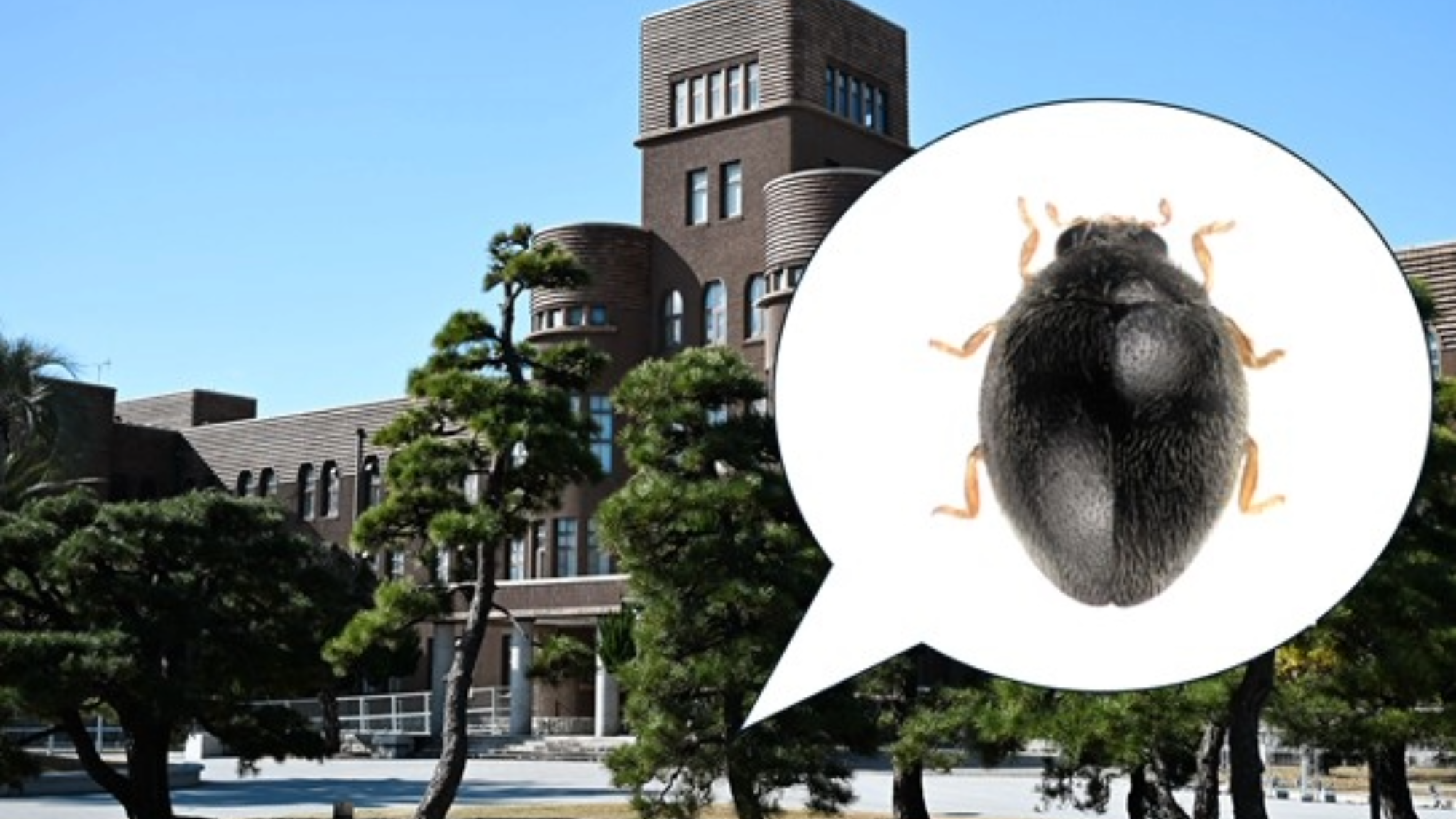
Ladybugs are famously harbingers of good luck, and the trait proved consistent at a university in Japan when researchers found a new species of the iconic insect directly on the campus.
Ladybugs, also known as ladybird beetles or lady beetles, consist of the family Coccinellidae within the order of beetles (Coleoptera). The newly identified member is a black Parastethorus pinicola, and researchers discovered it on a pine tree at Kyushu University’s Hakozaki Satellite. In fact, its species name means “pine dweller.”
The identification of the tiny species—barely more than 0.039 inches (or one millimeter) long—occured within the context of a broader study. In a study recently published in Acta Entomologica Musei Nationalis Pragae, two Kyushu University researchers updated the categorization of a group of ladybirds called Stethorini in Japan . Stethorini ladybugs are small and eat spider mites.
“I knew that this group of ladybirds often inhabits pine trees. Since there are Japanese black pines growing at the Hakozaki Satellite, I decided to look there, and that is where I found the new species,” said Ryōta Seki, the paper’s first author and a graduate student at the Graduate School of Bioresource and Bioenvironment Sciences’ Entomological Laboratory. “Normally, insect collectors do not pay much attention to pine trees, which is perhaps why scientists have overlooked this species for so long.”
We can forgive researchers for not identifying P. pinicola sooner. The pine dweller and other tiny black ladybirds are so hard to identify, so they haven’t received significant research attention, Seki explained. The only way to distinguish them is by cutting them open, not to mention the fact that they’re just a bit bigger than a single grain of sand.. It’s thus unsurprising that previous documentations have a significant number of wrong classifications.
As such, the duo studied around 1,700 ladybugs, and also concluded that two species—Stethorus japonicus and Stethorus siphonulus—are one and the same. Another previously unidentified species also came to light, which they called Stethorus takakoae after Seki’s grandmother, Takako Ōtsuki, and her support of his interest in insects.
“Standardizing these names is important because it allows us to share data and research with other countries in Asia,” Seki said. “It clarifies that this is a widespread species found from the tropics to temperate Japan.”
“People rarely notice such small insects. But as our study showed, even in a city or on a university campus, there are unknown species living right beside us,” Kyushu University Museum’s Munetoshi Maruyama, the other co-author, pointed out. “These ‘minor’ insects support our ecosystems. I hope this discovery makes people interested in the diverse and fascinating world that exists unnoticed at our feet.”
