
A standard ballpoint pen will not write in space. Without gravity, the ink refuses to flow. This simple failure illustrates a profound headache in space exploration: tools designed for terrestrial use often become useless in a microgravity environment. Robots, for all their technological sophistication, are no exception.
Autonomous free-flying robots aboard the International Space Station (ISS) frequently lose their bearings. Without gravity to distinguish up from down, even precision sensors suffer from accumulating errors, causing the machines to drift. Until recently, astronauts sometimes had to intervene manually, interrupting their tightly scheduled work.
The National Aeronautics and Space Administration (NASA) has found a solution to this persistent problem through a collaboration with Professor Pyojin Kim and his team at the Gwangju Institute of Science and Technology (GIST). An expert in navigation technology, the science of enabling robots to determine their 3D position and orientation, Professor Kim has proposed an algorithm to significantly suppress these errors. By reducing the ’absolute rotation error’ to within about 1–2 degrees on average, the team has enabled robots to perform long-term missions without requiring human intervention.
We spoke with Professor Kim to discuss how he adapted technology for the cosmos and the breakthrough that keeps NASA’s robots on track.
Saving space robots with digital twin navigation
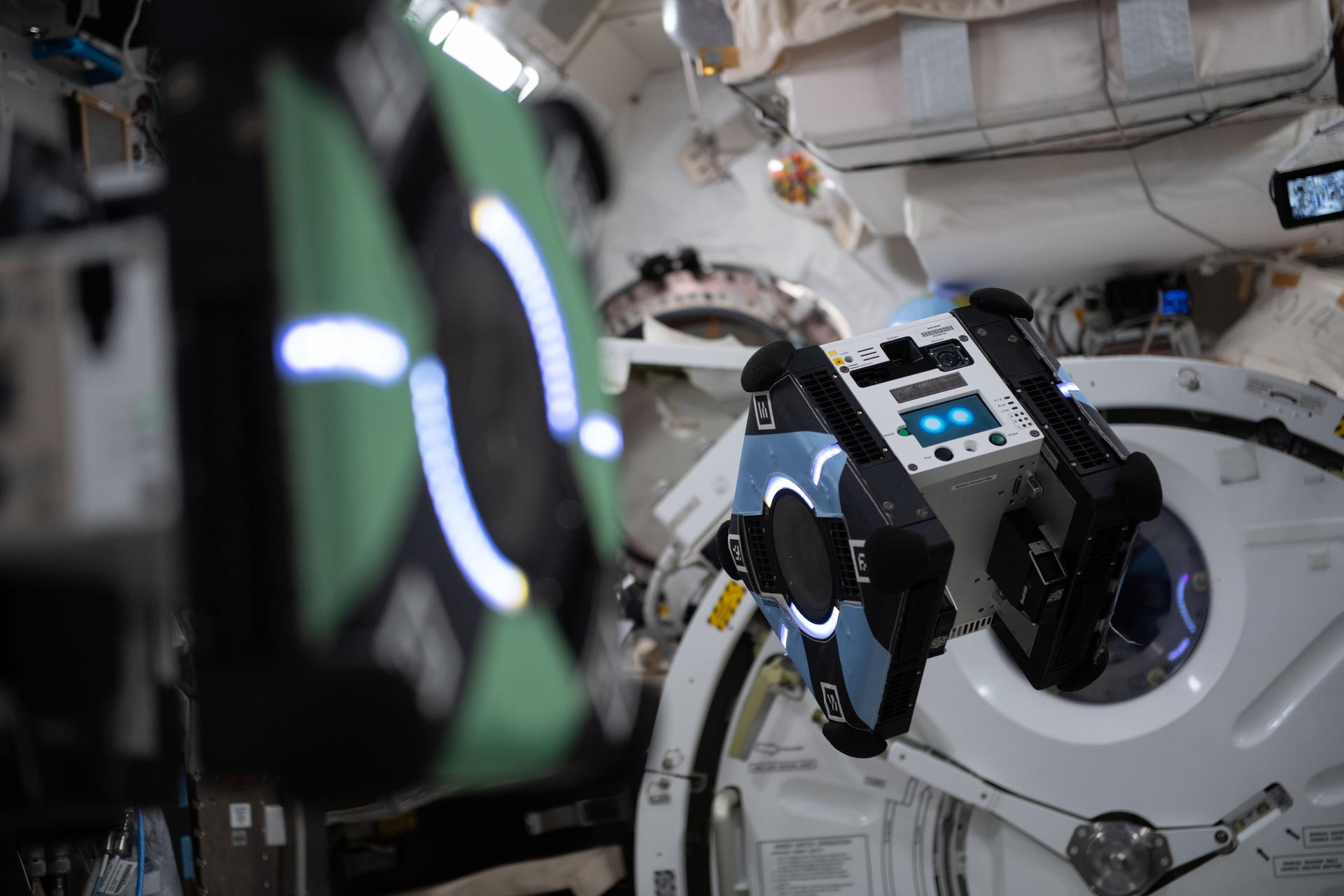
The International Space Station is a colossal orbital laboratory, roughly the size of a soccer field. It was built by connecting modules that were developed by different nations. Inside the Japanese Experiment Module ’Kibo’, a free-flying NASA robot named Astrobee is hard at work. Its mission is to take over routine chores, freeing astronauts to concentrate on research. With days scheduled to the minute, any time spent on maintenance is a costly distraction for the crew.
In actual operation, however, Astrobee didn’t work as flawlessly as expected. It frequently lost its bearings, requiring astronauts to step in for recalibration. NASA engineers and Professor Kim’s team collaborated to find a way for the robot to operate reliably without supervision, so the astronauts could focus on their critical research.
The root of the disorientation is the absence of distinct gravity. Terrestrial robots rely on an Inertial Measurement Unit (IMU) to sense tilt and orientation relative to the gravity vector. Professor Kim points out that “Terrestrial navigation algorithms are designed based on gravity, making them difficult to apply directly in space where reference points are missing.“ As a result, tiny errors compound over time causing the robot to completely lose its sense of direction.
To counter this, the team turned to Visual-Based Navigation (VBN), enabling the robot to deduce its orientation by seeing its surroundings through cameras. At first, the team presumed that simply adopting established technology would be sufficient. They were wrong.
The station’s interior is a chaotic jumble of cables, experimental rigs, and floating personal items. A view available one minute might be blocked by a drifting tablet the next. This unpredictability confounded standard navigation systems. “We thought we could apply Earth-based technology,“ recalls Professor Kim. “It did not perform reliably in the ISS environments.“
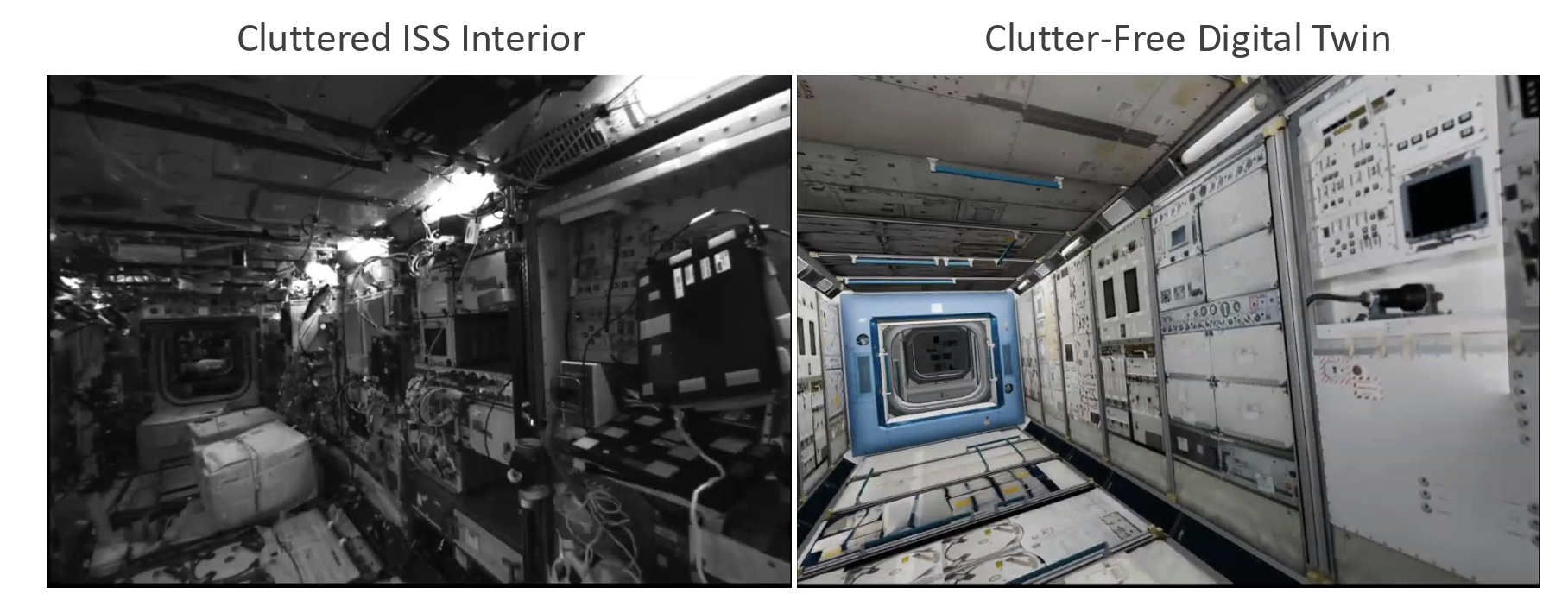
The breakthrough came in the form of ’digital twins’, precise 3D replicas of the physical space. Using NASA’s blueprints, the team constructed a sanitized virtual model of the ISS, stripped of all transient clutter. The robot was programmed to cross-reference the messy real-time footage from its cameras with the pristine images generated from the digital twin.
Professor Kim explains, “The digital twin serves as a ground truth, enabling the robot to filter out visual noise and recalibrate its position.“
With this corrected data, the robot interprets its environment as a collection of lines and planes. These extracted geometric features serve as a ’visual compass,’ providing an absolute directional reference. The system leverages the ’Manhattan World Assumption’, a principle positing that man-made environments consist primarily of orthogonal surfaces such as walls and floors meeting at right angles. The boxy modules of the ISS are an ideal testbed for this approach. By locking onto these structural geometries, the robot can triangulate its position with minimal error.
The team achieved a ’drift-free’ navigation capability. Upon applying the new technology, the average rotational error was reduced to 1.43 degrees—a figure that does not increase over time. The robot no longer requires a human hand to guide it.
Professor Kim anticipates that this technology will be valuable on Earth, not just in space. It could serve as a guide for drones and robots in indoor environments where GPS signals cannot reach. The system relies on visual data to detect structural patterns, making it ideal for buildings filled with lines and planes. Professor Kim notes that “orientation techniques based on these structural features are applicable not only to space stations but also to typical urban settings.“
Insights from the NASA collaboration
Ask Professor Kim why humanity should venture into orbit, and his answer is refreshingly blunt: “Because space now holds real economic and industrial value, showing commercial potential.“
With SpaceX proving that space can be a business rather than just a frontier, a wave of startups has emerged, targeting everything from lunar mining to satellite assembly. Yet, NASA remains the silent partner behind this private-sector explosion. Its decades of accumulated technology and talent form the bedrock upon which these new enterprises are built.
It was this ecosystem that drew Professor Kim, originally a drone specialist, into the fold. His journey began with an internship at the NASA Ames Research Center during his doctoral studies. The center was then in the thick of developing Astrobee. To mimic microgravity, researchers floated the robot on air-bearing tables using carbon dioxide jets, manipulating the lighting to rigorously test its ability to locate itself.
This research was a natural fit for Professor Kim’s expertise. His time at the agency revealed that terrestrial drones and space robots share the same theoretical foundation, despite their vastly different environments. The logic behind mapping an environment and determining location is universal, differing in its application.
The connections made then have lasted nearly a decade, evolving into the current joint research. Kim expressed his gratitude: “This research would have been impossible without the help of my mentor at the time, Dr. Brian Coltin, my NASA colleagues, my current co-researcher Dr. Ryan Soussan, and Dr. Terry Fong, who provided the opportunities for the internship and joint research.“
Professor Kim was particularly struck by the agency’s attitude toward failure. During his time there, he witnessed NASA pursuing bold experiments, backed by substantial budgets and exceptional talent. “Because only successful projects are publicized, it appears as though they never fail,“ Professor Kim said. “But behind every public triumph lie dozens of quiet failures.“ He notes the agency’s strength lies in its willingness to endure those setbacks to achieve a single breakthrough.
This focus on real impact shaped their assessment standards as well. Beyond conventional academic metrics, NASA placed particular emphasis on the real-world impact and practical significance of the research. While it is common practice to submit two papers upon completing a Ph.D, some researchers submitted only one, or opted to share their results on preprint servers like arXiv rather than in formal journals.
“Despite its conservative nature as a government agency, NASA is surprisingly open in its approach to research,“ Kim recalled. “I was impressed by the culture of valuing the intrinsic value and contribution of the research over mere outcomes.“
Sustained investment in science has paved the way for a vast industrial infrastructure and countless space startups led by NASA alumni. Professor Kim points to the robust U.S. ecosystem of manufacturers specializing in ’space-grade’ components capable of withstanding extreme conditions. It has created a virtuous cycle where government investment nurtures talent and technology, fueling a wave of startups that drive the private sector.
For those aspiring to join the agency, Professor Kim offers advice grounded in realism.
“I want to give you some realistic advice. The researchers I met at NASA were all from the world’s top universities. It may sound cliché, but you must excel at mathematics and your studies in general. While it is good to dream big, making that dream a reality requires overwhelming competence. The door to the global stage is always open. If you work hard to build your skills, the opportunity will surely follow.“
This article was produced as part of the NASA Impact Series by Popular Science Korea.
