

In hindsight, the North American “murder hornet” (Vespa mandarinia) scare of 2020 was probably a bit overblown (not to mention culturally problematic). Of course, you still want to avoid the venomous sting from a northern giant hornet, as they’re now known. According to entomologist Masato Ono, receiving a dose of the insect’s potent, neurotoxic venom felt “like a hot nail being driven into my leg.” And while not necessarily as painful, it’s still best to keep clear of similar yellow hornets like V. analis or V. simillima.
However, some animals have no fear of a hornet’s stinger. What’s more, certain birds and spiders willingly seek the insects out as meals. Some frog species also have an appetite for hornets.
“Although stomach-content studies had shown that pond frogs sometimes eat hornets, no experimental work had ever examined how this occurs,” Kobe University ecologist Sugiura Shinji said in a statement.

One of the most pressing mysteries is whether or not these amphibians devour hornets in a way that avoids their stingers, or if they simply tolerate the venom. To fill in this knowledge gap, Suguira and fellow researchers recently offered all three hornet species (V. mandarinia, V. analis, and V. simillima) to hungry black-spotted pond frogs (Pelophylax nigromaculatus). The team only used each frog once, and paired them with the hornet species that corresponded to their size. The largest frogs received a roughly 1.75-inch-long northern giant hornet. They then recorded how the amphibians reacted to their potential snacks.
The results detailed in the journal Ecosphere were unambiguous. Frogs attacked and consumed V. simillima, V. analis, and V. mandarinia at a respective rate of 93, 87, and 79 percent. They didn’t avoid the stingers, either. In some cases, the frogs were even stung in the mouths and eyes.
“While a mouse of similar size can die from a single sting, the frogs showed no noticeable harm even after being stung repeatedly,” explained Suigiura. “This extraordinary level of resistance to powerful venom makes the discovery both unique and exciting.”
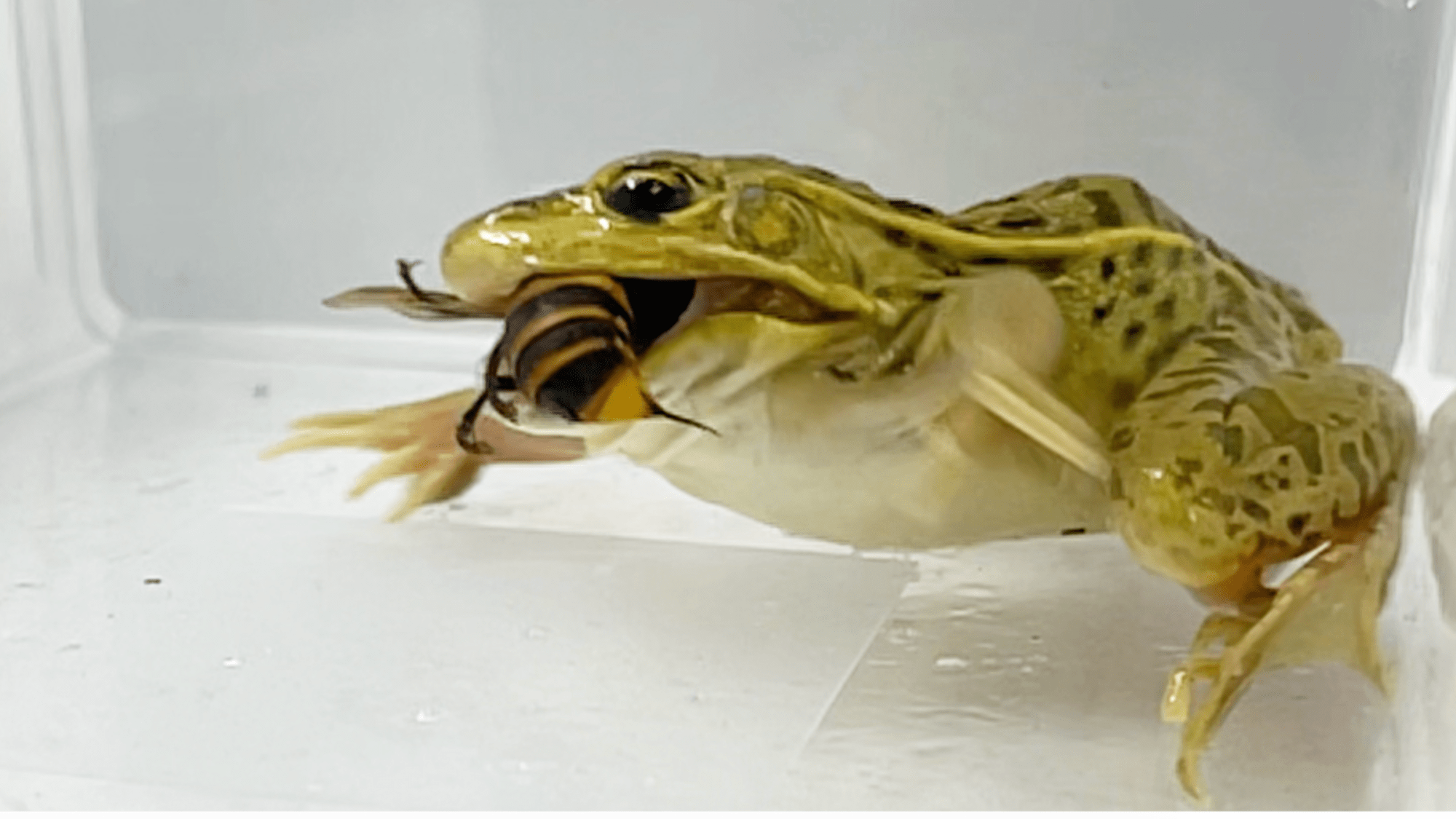
Prior studies have indicated there isn’t always a connection between pain and lethality in a venomous insect’s sting. A single sting from a bullet ant (Paraponera clavata), may make you feel like you’re dying, but you’ll most likely survive an encounter with the world’s most notoriously painful insect. Meanwhile, a common bee sting may be enough to kill someone allergic to their venom. Knowing this, Suigiura theorizes that the pond frogs used in his study may have evolved a double tolerance to both the hornet venom’s pain and toxicity.
“This raises an important question for future work,” he said. “Namely, whether pond frogs have physiological mechanisms such as physical barriers or proteins that block the pain and toxicity of hornet venom, or whether hornet toxins have simply not evolved to be effective in amphibians, which rarely attack hornet colonies.”
With the confirmation that certain frogs are more than happy to dine on stinging hornets, researchers may soon study the amphibians in the hopes of identifying their mechanisms of venom tolerance. Once better understood, the information could inform new antivenoms, as well as medical treatments tailored towards pain resistance.
