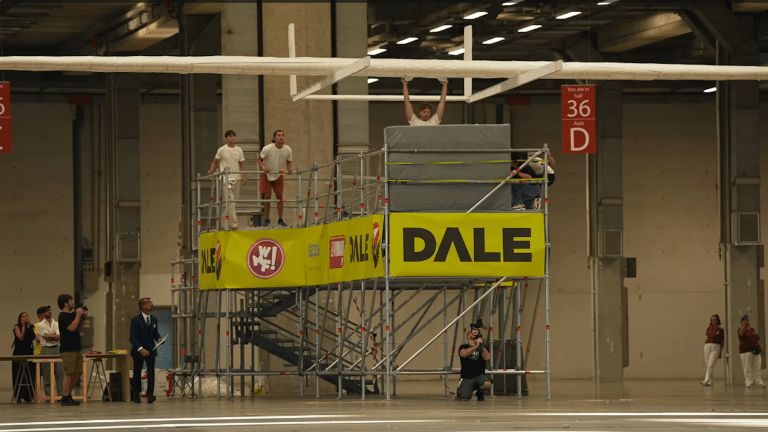
Rising to Eight Feet High The bottom of each strip of tape on Elizabeth here marks one foot. Team Gamera

Records are made to be broken, and a bunch of students at the University of Maryland are smashing the ones they just set earlier this summer. They're so close to winning the crazy-hard American Helicopter Society's Igor I. Sikorsky Human-Powered Helicopter competition — watch an amazing eight-foot flight past the jump.

Henry Enerson, a freshman at UMD, is one of a handful of pilots taking turns furiously pedaling in the cockpit of the Gamera II, a human-powered quadcopter. The team has already met one major requirement of the Sikorsky Prize this week, hovering for 65 seconds. Now if they can hit one minute and get a little higher than 8 feet -- to exactly 3 meters, or 9.8 feet -- they'll win the $250,000 32-year-old prize.

The team has been testing all week but had to take a break for a few hours today so the students could go to class. We're following their progress and we'll update here if they set any further records -- meanwhile, watch Henry's flight below.

19 Comments

Sweet! Now just make it smaller with more RPMs and a steering system, and I got my new ride to work.

This is so amazing, it strains belief. This is the future, as imagined by Leonardo Da Vinci.

The sheer lightness and strength of that structure must be astonishing.

---
Always defer to facts rather than philosophy.

Great job, hope they make it.

Just for a little PopSci fun, you guys might search your 20's archive. I came across a story about a man powered helicopter in one of the issues. It was quite possibly from 1925, but I'm not positive.

The most interesting part was that they said that the craft weighed 92 lbs -- about the same as one that was featured here a month or so ago.

I wish I could fly all day from my own physical effort,..... dreamy sigh...

Throw a motor on this thing and I think they'll be onto something.

Yea moe, they would be "onto" a helicopter......I think HUMAN POWERED was the key word.

Where's the amazement here. You motherfuckers better not make this a transatlantic transportation vehicle. I'm not about to pedal for 26 hours over a shark infested ocean, fuck that shit.

UofM actually a pretty respectable rotorcraft engineering program. While it looks like lots of fun, sadly this human-powered project is mostly a waste of effort, since it has no real value in the commercial world. Their instructors have actually done these students a disservice by encouraging this type of project.

It would be better if the faculty would direct these grad students towards research projects that have some value to industry. While these projects may not be as fun or glamorous as a human-powered helicopter, the students would learn something of far more real value for their careers, as well as learning the very important lesson that serious engineering work doesn't involve fun and games.

What a stunning engineering feat! Kudos to the entire design team. (oh and thumbs up for the cyclist too)

OK now take it to a dirigible hanger and see what that puppy can really do!

@riff_raff
lol ... you could not be more wrong. It is projects that capture the imagination that often produce advancements that would otherwise not be achieved. The goal is "glamorous" and "fun" but to meet it, many important and useful things are learned including the most important lesson of all, creative thinking to overcome huge hurdles. You sound like one of those folks that say the space program is a big waste!

By the way, yesterday I went to see another team that is trying to put up a claim on this prize. They made their first test flight last week. Search for Atlas and AeroVelo. Unfortunately when I got there, they had just made an attempt and I think they damaged a rotor. I couldn't stay long enough to see if they were able to fix it and try again. They got off the ground but I missed it! They may be a bit behind the Maryland team but have the credentials to make up the gap quickly.

@riff_raff
If there's no serious engineering involved, why has it taken 32 years for a team to come this close to claiming a quarter of a million dollar prize? Why haven't you whipped this up in your garage in your spare time? Or could it be that the engineering is extremely difficult and these students are learning real-world skills, and yes enjoying it at the same time?

Couldn't they use a smaller rotor and introduce a gear system where as the RPMs increase, the biker changes gears...even though the torque would decrease a lot, the speed of the rotors would increse while allowing the pilot to still pedal at a manageable pace. I'm no engineer but i feel like it's well within our grasp to do this on a more practical level than shown here...

Me thinks they need a telescopic needle under the buttocks of this flyer, then YES will fly one minute and get a 9.8 feet ever so easy! They just need a itty bitty motivation under the seat of their pants, lol.

JRS ONE-

I didn't say that the task was not difficult, nor did I imply that it did not involve any engineering ability. What I said was that in the end, all of the effort that went into this particular achievement was mostly for naught. Regardless of the prize money, a human-powered helicopter has no commercial value in the real world.

In fact, I would even add that most of the specific design principles and techniques used to construct this rotorcraft also have no value in the real world. How many helicopters are there produced with blades made from carbon stick trusses and mylar skins?

I would reiterate my previous comments. Engineering professors/faculty should push their undergrads towards projects that, while far less glamorous, will better teach the student the real world lesson of what an engineering career involves, and what type of engineering work truly is valued by industry.

As a mechanical engineer myself, I have seen many recent engineering post grads start work at my company. They all talk glowingly of how much fun their 6-week university projects were. But later, when they've been working on the same old analysis report for several months, the sparkle in their eyes is long gone.

The sad reality is that as a professional engineer, you're lucky if 20% of what you do is interesting. The other 80% is just "work".

@riff_raff
I don't think it's useful to make learning boring just because your career will probably be boring. Why discourage students from becoming engineers? I'm not an engineer, but none of the work I did in school courses had commercial value either. If it did, why would I be paying to do it for course credit instead of just doing it for money? Nobody is arguing that human-powered helicopters are the vehicle of the future. Just because you can't sell your class project doesn't mean you didn't learn from it.

First of all, I think "commercial value" has little or no bearing on engineering studies for students. Imagine how many successful and useful discoveries would have been cancelled if commercial value was considered beforehand. Next, like all exotic endeavors, there are always things that can be taken away from the solutions and used in industry. I believe it happens all the time.

More importantly, these projects need to have an element of discovery which is not possible if you choose projects that hundreds if not thousands of professional engineers have already turned over many many times in the past. Luckily there are projects and prizes that capture the imagination which have no commercial value!

Yes, let's remove the sparkle in young engineering student's eyes!

riff-raff

Wow riff_raff, was there ever a sparkle in your eye or were you born a mature, cynical adult only interested in the bottom line? I am curious as to your use of the phrase "mostly" for naught. Elaborate?

One thing seems certain, based on the tone of the comments in response to my post, I can safely assume that none of you are engineers by profession. If you were experienced professional engineers working in industry, you would understand the reality that engineers are paid to perform a service that will ultimately result in their employer earning a profit. Unless you work in academia or government, the value of the $100K+ engineering salary your employer pays you is weighed against the value your work adds to their product. You only have a job as long as the cost of your services provides added value to your employer's business.

You all are also wrong to assume that I am simply a cynical adult engineer. In my 25-year career, I've worked both for large aerospace companies and for small commercial companies. The engineering jobs that always gave me the most satisfaction were those for small companies, where I was solely responsible for all of the work. And where after the job was finished, the company owner shook my hand and thanked me for doing a good job that earned him lots of money.

There's an old saying about college grads: "A students work for B students, and B students work for C students". What this means is that the most successful college grads are those that quickly grasp the fact that being able to provide value to your employers is more important than an academic record that shows you had "lots of academic experiences that put sparkle in your eye".

I'll leave you with this- One of the world's richest men is Bill Gates. He dropped out from Harvard in order to pursue a business producing software. Do any of you seriously propose that Bill Gates made the decision to drop out of Harvard and instead write software because it gave him a "sparkle in his eye"? No, it was because he quickly understood that, even though writing software was incredibly boring, it would ultimately be far more profitable than staying at Harvard.

Ok riff-raff... I AM an engineer: by degree, and by my aerospace employment (at our nation's largest aerospace company). And you ARE cynical. You need to get away from your singular, boring, repetitive, unrewarding work (yes, you said it was rewarding at the END with a pat on the back). My work has been immensely exciting and I have always kept that glint in my eye. Research and development is EXACTLY what these students are learning, and is exactly what they will perform in the companies they hire into, or that they form themselves. It is the same work I do daily, and is never dull, boring, repetitive. I have said a hundred times, "I would have PAID my employer to do the work I do, because it is exactly what I learned to do from high school on up through 8 years of college. I worked with the Burt Rutan in Mojave back when he was largely unknown, and this work propelled me into commercial aerospace and R&D.

And your uber-simplistic remark regarding Bill Gates was not even half-intelligent. He never realized nor even dreamed that writing software would be profitable. He was just a nerdy drop-out that had to lie to get his first product sold....


July 2013: The Future Of Flight

The incredible innovations, like drone swarms and perpetual flight, bringing aviation into the world of tomorrow. Plus: today's greatest sci-fi writers predict the future, the science behind the summer's biggest blockbusters, a Doctor Who-themed DIY 'bot, the organs you can do without, and much more.


Online Content Director: Suzanne LaBarre | Email
Senior Editor: Paul Adams | Email
Associate Editor: Dan Nosowitz | Email
Assistant Editor: Colin Lecher | Email
Assistant Editor: Rose Pastore | Email

Contributing Writers:

Kelsey D. Atherton | Email
Francie Diep | Email
Shaunacy Ferro | Email

circ-top-header.gif
circ-cover.gif
bmxmag-ps