
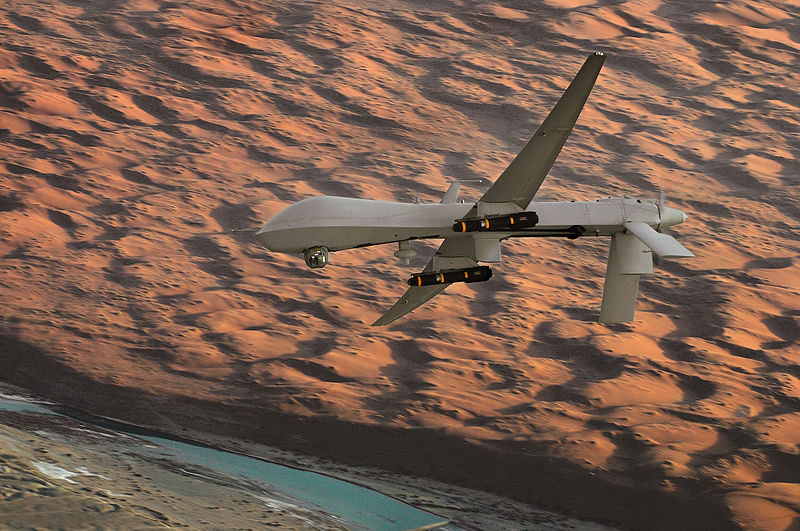
America’s drone fleet has become an increasingly relied-upon wing of its counter-insurgency strategy and plays a key role in its geopolitical policy, particularly in Pakistan where unmanned aircraft routinely venture into sovereign territory and deliver lethal payloads to targets on the ground. But the Washington Post asks: just exactly how far away are we from real “killer robots.” The answer, in this morning’s piece of recommended reading, is: we’re already there.
We know that various research and academic institutions are working on robot autonomy (regular readers see stories and videos of these autonomous ‘bots right here on PopSci all the time), but what’s a bit mind-blowing is just how far along some of this technology is. At Fort Benning, a team of Georgia Tech computer scientists is helping the military demonstrate software that can autonomously--without a shred of human input--acquire and make life or death decisions about targets on the ground.
That is, the only thing that’s missing is the capability to fire. Add that, and you’ve got a killer robot.Of course, these are just demonstrations (for now). But they create a blueprint for the inevitable future of warfare: when time is critical and running decisions up the chain isn’t feasible, software will make key decisions about what constitutes a target, what falls within the bounds of the “rules of war,” and whether or not it’s safe to commence firing. If a program can satisfy whatever requirements have been seeded in its coding, then it’s bombs away.
It all sounds a bit Skynet, but it’s moving forward at a rapid pace within the U.S. military, driven both by need (putting fewer human lives in harm’s way is obviously preferable) and that Cold War-esque mentality that if America isn’t at the front of autonomous warfare then it can only be behind. That sentiment is not entirely misplaced: South Korea has already deployed semi-autonomous armed robotic systems along the demilitarized zone bordering North Korea, and the Chinese have a dog in the hunt for autonomous weapons systems as well.
So what is the state of “lethal autonomy?” To put a number on it, it’s at least a decade (probably more) away from becoming battlefield reality. I sat in on a lecture at last month’s AUVSI unmanned robotics conference titled “Armed and Autonomous” where the focus was on the idea of deploying armed UAVs into contested airspace--using unmanned planes to deliver surface-to-air and air-to-air weapons in areas where anti-air defenses are still intact.
What might surprise many is that the computer programs necessary to evade air defenses and execute these kinds of missions autonomously already exist. The backbone technology is there, we just don’t trust it enough to actually deploy it. The idea of unleashing armed and autonomous robots, aerial or otherwise, is naturally abhorrent to us because robots--at least the robots that we have now--are incapable of making common sense decisions or distinguishing--with 100 percent accuracy--between friend or foe, surrendering troops or hostile enemy, the benign and the threatening.
But that capability gap between human and machine, as WaPo reports, is shrinking. The question is: when will it have shrunk enough that we trust robots with life and death decisions? As we’ve been coldly reminded by incidents in Iraq and Afghanistan, even highly trained soldiers don’t always make the right decisions on the ground. At what percentage of error are we willing to say autonomous robots are ready for war?
Click through below for the Post piece. It’s a quick and engaging morning read.

Five amazing, clean technologies that will set us free, in this month's energy-focused issue. Also: how to build a better bomb detector, the robotic toys that are raising your children, a human catapult, the world's smallest arcade, and much more.


Online Content Director: Suzanne LaBarre | Email
Senior Editor: Paul Adams | Email
Associate Editor: Dan Nosowitz | Email
Assistant Editor: Colin Lecher | Email
Assistant Editor: Rose Pastore | Email
Contributing Writers:
Kelsey D. Atherton | Email
Francie Diep | Email
Shaunacy Ferro | Email
America - A disgusting killing machine.
Boka-a trolling troller
I hope our drones never become autonomous. too much in the hands of machines.
why learn from your own mistakes, when you could learn from the mistakes of others?
of course the military will lead the way in fully autonomous machines, machines will be better at war than us; stress, fatigue, revenge, ect. can be eliminated, the problem is losing control, they will eventually be smarter than us and could become uncontrollable, what a combination, this is not fantasy, the terminator scenario is a threat that the DOD believes is real and is working to prevent, the problem is we get only one chance to get it right and murphy's law loves it's chances, cheers
@boka
really dude, what else do they teach you in that hellhole of a country, not only are you wrong but stereotypical, its like saying, all of china and north korea are communists, when really some of the people are against it. get your facts right, it makes you look stupid
@boka
That was a troll response and very off topic. The U.S. is not the only (neither the forerunner) in automated war technology.
--
This transformation is all but inevitable for one reason: American society followed by many others are trouble with the desire to end military conflict for a severe public distaste in bloodshed (as it pertains to the loss of life of fellow countrymen) conflicted with the necessity to maintain multi-regional stability and strike capability worldwide in the interest of individual national security (which logically necessitates the act of war).
In order to accomplish this, automated systems are an effective solution that will achieve national security objectives for a downsized and increasingly reduced funded military by maintaining operational effectiveness and efficiency. It will also appeal to the general public (and military members) that devices are being employed that will allow troops to go into battle and decrease the likelihood of anyone getting injured or killed in combat.
It's a solution to continue violence by ending war casualty rates. This is fueled by a public that will support legislative and executive action to respond to a national threat, but are not willing to sacrifice life, limb, or their own loved ones supporting a national security endeavor.
"We can go to war, just don't let any of our troops get hurt." A growing contradictory sentiment in privileged developed nations. It's easier if a robot does it.
I dread the day when these drones get hack by a country and go on a sudden civilian killing spree and the USA is to blame and we do not have a clue of how it happen?
Mean while the world looks at the USA with horror and shock.
I only present this worst case scenario, so I hope appropriate policies are made in advance. Autonomous could prove to be an evil thing.
Use some common sense folks. What happens when there is the first friendly/civilian casualty from a fully automated drone? Heads will roll at the top of the military chain. Generals/admirals are political animals. They know this.
As far as the US is concerned, I believe humans will, for the foreseeable future, always have a say in the final decision on what targets are attacked (with the exception of area denial weapons e.g. landmines).
What you may see is semi-autonomous drones, where a human designates/approves a target, but the drone makes all decisions on how to engage the target(s).
@democedes...i guess you need to reread the article and the post article (see the link), they are developing the capability for fully autonomous systems, they don't develope these expensive systems to not use them, and if we don't someone else will, for better or worse
@democedes
"What you may see is semi-autonomous drones, where a human designates/approves a target, but the drone makes all decisions on how to engage the target(s)."
This is portrayed in the movie "Eagle Eye." The problem in that system is, if you have a highly computer centric network that an AI has unfettered classified access to, the AI system can apprehend control of other system components for its designated uses.
As far as semi-autonomous systems are concerned they already exist and our battlefield operational (i.e. U.S. Air Force Global Hawk).
"at least the robots that we have now--are incapable of making common sense decisions or distinguishing--with 100 percent accuracy--between friend or foe, surrendering troops or hostile enemy, the benign and the threatening"
Human troops have the same exact troubles. One day, most likely a robot will just be able to be better then the grunt on the ground... and that's when they'll be used.
In some local paper the caption reads: "5 people in the town of where ever were killed by an autonomous drone today". To me that reads just morally wrong.
@mp
It's morally wrong if a live soldier does it. It's collatoral damage, system malfunction, and/or operational design flaw if a machine does it. Either way it's warfare.
@eregorn8
They're already being used right now. Two different companies (Foster-Miller & iRobot; go figure) have developed ground based umanned combat units that work alongside fire teams on the ground in combat. More sophisticated designs for landwarfare are being designed by these two companies and others right now.
Drones and robots are beginning to dominate the land, air, sea, and space domains of combat.
--Just came up with an idea for the next Call of Duty franchise; Call of Duty: Modern Warfare 4: Digital Domain--
lol @ Boka. but yes skynet is real. thats the worlds reality in the near future. that and Deux Ex.
_________________
The people of the world only divide into two kinds, One sort with brains who hold no religion, The other with religion and no brain.
- Abu-al-Ala al-Marri
@Jedi
Doesn't have to be. I like my freedom and humanity, complete with the ability to ####, too much to see that go away. So long as people take responsibility to stay in control, these bad things won't happen.
pheonix1012, Pay attention ok. If a person comes into the middle of the night and breaks into your home and you wake to see this person with a knife, you did not create this situation, but it was put upon you. It is ok if you defend yourself and all those in that house. You are not the aggressor, you are the defender.
Got me so far.
Ok. Well we have our government and we have our chain of command in the military and we have our training and we have orders from your chain of command. People in the military do not kill people willy nilly. They follow the government, the chain of command, their training and their orders. They are not killers, but defenders of their home and since they are part of the USA, USA is their home. These people are HEROS! GOT IT. They are not killers.
Now I understand when you are in the heat of battle and many are intently trying to kill you and all the those around you, you may feel the passion of killing, but you do not arrive to this situation by you own choice. This whole situation was force upon you and you are defending your own country. I 100% support all those in our military and I am a veteran and a patriot too. Those who serve in the military are good people. The military is observant and puts out with killer bad attitudes at first notice.
OUR MILITARY PEOPLE ARE HEROS!
The drone won't be making all the decisions. The decisions will have been made before a drone is launched.
i.e "fly above that enemy controlled piece of land and kill anyone with a beard, holding something that looks like a gun"
@mp
I think you missed the point of my statement. The implication was that use of automated technology that no one has a real measure of control over, could offer anyone within the command structure a scapegoat whenever something catastrophic goes wrong involving collatoral damage in war.
I'm not bashing the actions of U.S. troops (you have to pay attention and read between the lines dammit!!). I'm stating a truth as it is perceived in the media when things like this happens.
It doesn't matter if a soldier makes a mistake or a piece of hardware makes a mistake (or is compromised as you put it). Warfare is an evil thing. These robotic devices are no more evil than the intent of our use for them and whatever result occurs thereafter.
Then take the time to consider the concept of violence. If someone dear to you were killed in an altercation with another person upon which they were the aggressor and their murderer was the defender, regardless of your civilized appearance and actions on the outside, someone that you care for that deeply means more to you than the plight of some random person defending themselves. You are naturally more subject to despise this person for taking someone precious from you, and given the chance you'd seek vengeance through your bare hands.
If you consider the previous, you will realize that our opinions are all biased. Where you see a hero from your perspective someone else might see a butcher. Of course (again) the plight of some random person doesn't apply to you. Still this will not stop the fact that when horrible mistakes happen in warfare, the perpetrators responsible will face being labeled by certain people for their negative actions.
Your proclamation of the U.S. troops is well placed, but that is only relative yourself and all who support U.S. troops. The rest of the world doesn't share that same sentiment. Naivety is irrational because it is tantamount to the realm of sinful ignorance.
@pheonix1012
i hope you are right
_________________
The people of the world only divide into two kinds, One sort with brains who hold no religion, The other with religion and no brain.
- Abu-al-Ala al-Marri