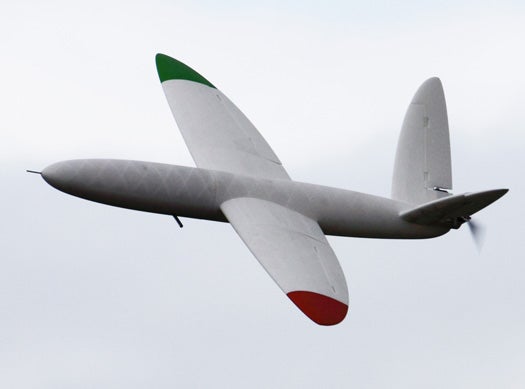
Engineers at the University of Southampton in the UK have designed, printed, and sent skyward the world’s first aircraft manufactured almost entirely via 3-D printing technology. The UAV--dubbed SULSA (Southampton University Laser Sintered Aircraft)--is powered by an electric motor that is pretty much the only part of the aircraft not created via additive manufacturing methods.
It’s no slouch of a UAV either. SULSA boasts a 6.5-foot wingspan, a top speed of about 100 miles per hour, and is nearly silent while cruising. Created on an EOS EOSINT P730 nylon laser sintering machine, its wings, hatches, control surfaces--basically everything that makes up its structure and aerodynamic controls--was custom printed to snap together. It requires no fasteners and no tools to assemble.
This, of course, is the dream of aircraft makers big and small. Building something as large as a Boeing 787 for instance requires a lot of machining, a lot of custom tooling, and above all a lot of waste. Additive manufacturing (that’s a fancy way of saying 3-D printing) builds components layer by layer, allowing designers to create parts with virtually no waste. It also lets them tweak designs on the fly and go from CAD drawing to prototype extremely quickly (which is why it’s also referred to as “rapid prototyping”).Moreover, it allows aircraft engineers tap design tricks that are known to be more efficient and effective but are also expensive and wasteful to create in practice--like the elliptical wings on SULSA. So perhaps it’s no surprise that elsewhere in the UK a team of Airbus engineers is working on printing an entire aircraft wing--that is, a real jetliner aircraft wing, the kind that would carry people--with the ultimate goal of printing out most of the important components of an entire passenger aircraft.
138 years of Popular Science at your fingertips.
Each issue has been completely reimagined for your iPad. See our amazing new vision for magazines that goes far beyond the printed page
Stay up to date on the latest news of the future of science and technology from your iPhone or Android phone with full articles, images and offline viewing
Featuring every article from the magazine and website, plus links from around the Web. Also see our PopSci DIY feed
A 10,000-rpm, no-pulse heart is completely revolutionizing how we think about transplants. Plus: rapid-response virus hunters, a shocking cure for migraines, the world's youngest person to have achieved nuclear fusion (in his parents' garage!), and much more.
Like to see this developed for our countries failing infrastructures. ie: bridges, highways, electrical grid
Would be neat if the Printer would print a "Track" to Drive along as it builds the structures..
Have a automated system to maintain the upkeep
I wonder what it would cost if a company now sells these 3d printed planes to the public. Would it be affordable. If they can work out any problems with 3D printing on cost or quality it could start a new revolution as large as the industrial revolution itself. Many markets could change. Just imagine 3D printed Cars and 3D printed Engines, 3D printer Wind Mills, Toys, Even printers or Robots.
At the very least, many of the Components of cars and other products could be printed. As it now slowly seems to be happening with small Airbus parts. And at other companies. What massive impact this will start having on current jobs and global markets in the coming decades i can only imagine.
Hmmm, this airplane design looks familiar.
Check out these links.
http://www.youtube.com/watch?v=zGVWcF4fssI
http://onlinedocumentariesvideos.blogspot.com/2011/03/saqqara-bird-ancient-egyptian-plane.html
http://www.bibliotecapleyades.net/esp_aviones_precolom02.htm
What goes around, comes around.
http://www.world-mysteries.com/sar_7.htm
http://www.2atoms.com/weird/ancient/plane.htm
Many of the these websites like to point to aliens of these planes. But as was shown recently on PoPSci of the bone fragements found of a human, showing the posibility of walking 3.7 million years ago. Ancient human cultures could of grown up in intelligents and been just wiped out from some natural event many times in the past.
Of course if you do research into the ancient monilith structures around the earth, art, religous writings much can argue different, that we did have space aliens and influence humans.
It's fine not to believe in space aliens, if this beyound your own inmagination, but it is very interesting and exciting just to try to understand what inventions and technology exisited long long ago.
And yes, this is science too.
Impressive, but when the plan flies out of the printer then I will be really impressed.
@Bubbam why should be surprised that that ancient people figured out the basics of aerodynamics? They had the same brain we have, they could observer birds and flying insects and understand how they worked.
@cholin3947, So I get the impression from you, there is not much to learn from history, ancient religious teachings, other cultures and old cultures, art and archeology..unless its hot and fresh in the media TODAY, PoPSci, you really or not interested or surprised. Oki doke.
Bubba,
The exact opposite. To think we are special or smarter then the previous thousand generations is foolish and vain.
Indeed, it is now believed that the some of the ancients had electricity from batteries, mechanical computers, and various types of flying aircraft. Why not? They weren't any less intelligent than we are, and we only spent 200 getting from what was essentially late iron-age technology to what you see around you now.
@DainBramage
Show me an article documenting a working flying machine predating the Wright Flyer? I know that the Egyptians(?) had carved small, hand-thrown devices similar to paper planes, but I'm 99.99% sure that the first powered flight not involving hot air balloons was in 1903.
Great work.
Any number on how long it took for this plane to be 3D printed?
Also what about the surface finish?
@Bubba
'It's fine not to believe in space aliens, if this beyound your own inmagination...'
Please don't insult everyone's intellect or imaginative powers. Assuming that all that don't believe the same things as you do are somehow intellectually impaired only shows me how little you understand the world around you. It also shows that you often have this problem yourself. Also, your spelling sucks.
@khaelmin, yes my spelling and grammar do suck at times. no one is intellectually impared. you fine. i was just speaking to others, that on occasion harass me. i did not mean to insult you or anyone else. take care.
@Khaelmin, I am sure you live in the glory of your own mind. Narcissistic self rightists jerk!
Of Topic Question for PopSci
Can you please give us a Black List ability for the Comment Section?
*Off
@Prbsolver, ptssss! ptssss! I am still here. lol
Great developments on the 3D-printing front! Can't wait to start seeing 3D-printed structures show up on more mainstream products!
@Vector13: He didn't say "powered flight," he said "flying aircraft." He's right that ancient civilizations had electricity, we have found ancient batteries in the middle east (in Iraq, I believe) that were probably used for medical therapies (anesthesia), and we've found a mechanical computer that's estimated to be at least two millenia old. It was found in a shipwreck and they believe it was used to calculate stellar cycles. It's not a stretch to believe that someone, somewhere, may have come up with some sort of glider that worked well, maybe combined with hot-air balloons to get altitude.
@BubbaGump: Sure, there's plenty to learn from ancient times. I know of some structures made from boulders that are something like 100 kilotons apiece, that fit together so closely you can't slip a sheet of paper between them. Even our strongest modern cranes can't lift 100,000 tons. How did the ancient people do it? We don't know. Can't figure it out. Maybe magic actually existed back then. Maybe dinosaurs were still around and trained as pack animals. Maybe aliens came and did it with tractor beams. None of these can be tested of course, and the most likely IMO is that they had dinosaur pack-animals. Something to think about.
Gump, the problem is that you won't accept anyone who doesn't agree with you. A good scientist accepts that any speculation he makes is probably wrong, and accepts any alternate theory to be as valid as his own - untested and of a speculative nature. Not to say he doesn't argue his case, but he accepts evidence (the "what") even if he rejects the interpretation of it (the "how/why/when/etc.").
Your belief in aliens is, for now, as untested and unprovable (as far as undeniable 100% proof) as my belief in God and special creation, or mainstream science's beliefs in the big bang and evolution of life from a dead rock.
You're a bit of a hypocrite. One post you say you had no intention of insulting someone, but in the very next, you fling insults at him. Wonder why no one here likes you? That's a good reason not to.
You also come across as extremely arrogant - cholin3947 mentions that it's no surprise to him that ancient man may have come up with these kinds of things, (you realize he was AGREEING with your premise of ancient man's intelligence, right?) yet you turn around and basically antagonize him.
Antics like that are the reason users like Prbsolver wish they could block your comments, and quite frankly, I'm inclined to agree with him.
@Onihikage, I like when you comment, really. But there is so much about me and the universe you don't know; please do not assume I do not accept other peoples comments. You assuming to much in your commentary here about me. I really do reading your opinions and I really do like varied open mind intelligent comments! I do not like people who just show up randomly and attacke other peoples comments. When they do this, I then suggest they show their own intelligent comments. .... I give them a nice and polite introductions.... wait... a day or two will pass.. nothing... or never.
@BubbaGump - Get a life. Trolling forums is not a way to make friends. Your comments over the past year are always antagonistic or hypocritical towards your own beliefs stated in a previous comment. Grow up, if you're already over the age of 50 it still isn't too late to do so. You are never a polite person and you contradict everything that people say.
/endrant
/endthread
Industrial production may yet see another increase to the likes of the early twentieth century.
@cwrx08, you login is just over 6 hours old. So your first contribution to society is to be an antagonist, 'all right then'. Well, welcome aboard to PoPSci, I look forward to your future intelligent comments about the articles or have something positive to say..... about anything. I am sure you will be an inspiration to all. Take care.
First of all, you need a printer large enough to produce the parts. Some need to be structured so componets could be put into them to control parts and systems. You also need space for the systems you put into them and passengers. Then they need a propulson system with the thrust and endurance. I see nothing larger than a UAV at this point. It's a thought though of printing machines and parts and maybe another compond they use for other purposes that won't fail.
I wonder if they could make an affordable, high-performance glider that can be easily mass-produced using this technology.