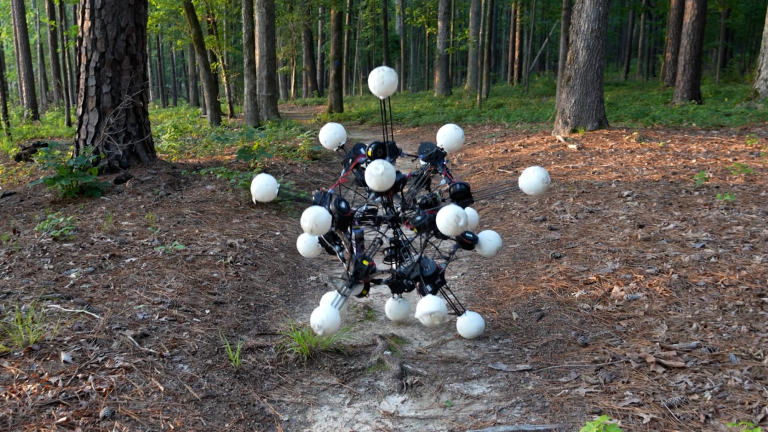
Not sure whether to use a cylindrical crawler or a buzzing helicopter for your remote sensing needs? This robot makes the choice easier, incorporating both abilities. In the video below, you can watch as it rolls along, then tips up vertically to take off like a helicopter.
This robot was developed at the University of Minnesota’s Center for Distributed Robotics, where designers led by Nikolaos Papanikolopoulos built two separate transmissions for flight and rolling. IEEE Spectrum reports in further detail on the rolling/flying bot, which was presented at the IEEE International Conference on Robotics and Automation in Shanghai.Ground robots can perform autonomous sentry duties more efficiently than an airborne bot, and they’re somewhat easier and cheaper to design. But flying robots are more agile and can navigate around obstacles--or even climb stairs. An ideal robot would be able to do both, and this one fits the bill.
But it was neither easy nor cheap to pull this off, IEEE reports. It was too hard to build a motor system capable of slow-speed forward ground motion as well as the high-speed rotor action required for vertical flight, so the designers had to make two. Just getting the robot to stand up was a challenge — the mechanism that folds the rotors down cost $20,000 to make, according to IEEE.
Future designs would ideally be cheaper and less complicated, able to quietly roll around before unfurling into a sinister Sikorsky MH-53 Pave Low helicopter.
[IEEE]
Five amazing, clean technologies that will set us free, in this month's energy-focused issue. Also: how to build a better bomb detector, the robotic toys that are raising your children, a human catapult, the world's smallest arcade, and much more.


Online Content Director: Suzanne LaBarre | Email
Senior Editor: Paul Adams | Email
Associate Editor: Dan Nosowitz | Email
Assistant Editor: Colin Lecher | Email
Assistant Editor: Rose Pastore | Email
Contributing Writers:
Rebecca Boyle | Email
Kelsey D. Atherton | Email
Francie Diep | Email
Shaunacy Ferro | Email
Either the pilot hasn't got his wings yet, or there are still some control issues to be worked out here, seemed a bit wobbly. Also who's the lucky guy that gets to run into the insurgent hideout, yell "time out!" and mount the "training gear"? HaHa
Obviously, the previous commenter has never designed anything. To accomplish this kind of performance in a prototype is really very good. And I don't think anyone is claiming it's ready to go into an "insurgent hideout" yet. Robots are definitely the way to go for dangerous missions. They keep our police officers and soldiers out of harm's way. We should applaud any efforts to do so.
I'm loving it !
They should put a vbar or a skookum onto this thing for super stability. Man this is so cool, wish i could fly it, at least i have my own whirlies here at home. too cool !!!
hey !..... but the video doesn't show the one in the concept picture, i don't like contras that much.... :(
add a small powerful explosive...sneak into area at night n take out a room full of insurgents
mm... put a human with a seat and controls in a gyro ball, then you have your first mobile "flying car" so-to-speak. attach guns to the exterior of the gyro and suddenly you have a militarized ground and air support vehicle. already turned into a weapon... i wonder how devastated the inventors would be... maybe nobel prize v2.0
@ee.phil Jezzz Phil can't you take a joke, and yes I understand the issues involved, I am an engineer, (although not a controls engineer). I realise just deriving the CL transfer functions here would drive most people mad. That said, my overall point was that personally I would have polished it up a bit before showing off.