
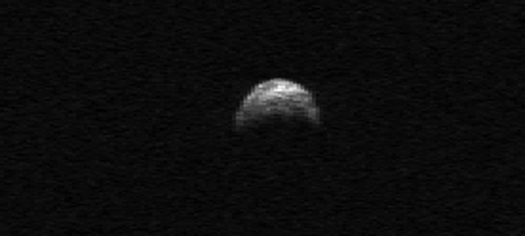
2005 YU55 Arecibo Observatory/Michael Nolan via SPACE

Just this week, the crew aboard the International Space Station had to take shelter in its emergency quarters after a piece of a destroyed Chinese satellite passed “danger close” to the orbiting outpost, sharply reminding the space community of the dangers posed by space debris. The rest of us will get our reminder in November, when a massive asteroid will make a close flyby of Earth at a distance of just 0.85 lunar distances.

Asteroid 2005 YU55 was discovered six years ago and does not pose a collision risk, but it is passing close enough to be deemed a “potentially hazardous asteroid” by the Minor Planet Center in Cambridge, Mass. And in the grand scheme of the universe--or even the solar system--it will pass extremely close to the home planet.

At 1,300 feet in diameter, the slow-rotating asteroid would not be overlooked if it happened to slam into the planet. Its flyby, which will begin unfolding during Nov. 8, will mark the closest-ever observation ever of an object this large.

So how are scientists reacting to this cosmic near miss? With glee, naturally. Extensive plans are being laid to radar image the slow-rotating hell out the rock as it passes, possibly down to resolutions nearing just 15 feet. That will help them build better 3-D models of YU55, as well as project its density and shape.

The good news for the rest of us: increased knowledge of the rock’s spin rate, shape, density, etc. will also improve researchers’ modeling of its whereabouts when it’s not around, enabling better prediction models stretching for decades or even centuries. That way should YU55 come around again we’ll perhaps have a more precise idea of its path, and a better than six-year heads-up.

[SPACE]

20 Comments

It's not impossible it could hit us on the 9th.

If something we can't see or are unaware of is in it's path it could nudge it's orbit and send it on a collision course.

After all that's why it's called a game of cosmic billiard balls.

There is no way we can know for absolute certainty that nothings exists in it's path to make it deviate from it. ZERO chance of certainty.

So therefore the probability of it hitting us is NOT zero!

Ok.. so 1 lunar distance is from Earth to Moon, so .85 Lunar distance means this object is going to be closer to us than the moon itself is. That's pretty significant!

2005 YU55 may only be 0.011403988939885189% the size of the moon, but that's still quite the "chin dusting"

And I agree with gizmowiz, nothing is EVER Zero when talking in cosmic terms! YU55 could get caught in either our gravity or the moons for that matter. I wonder if their are moons with moons somewhere out there.. now THAT would be a site to see!

This should prove to be a very interesting birth month for me.. I wonder how visiable 2005 YU55 will be in the night sky...

They should land some instruments on the meteor as it passes by to take a hike with it. You get a low cost space explorer.

feel free to correct my math if I'm wrong, but...

0.39624 / 3474.8 = 0.000114032462

where the first number is the diameter of the asteroid in km, and the second number is the diameter of the moon in km, the third number tells us that the asteroid is slightly more than one ten thousandth of a percent as large as the moon... meaning, unfortunately, we probably won't be able to see this with our naked eye, even given that it'll be closer to us than the moon is. Too bad, I was really looking forward to being able to see something like this in the sky.

That aside, though, does anyone know if our moon's (or even our own) is going to have any weird effects on this thing's trajectory? I mean, our own moon is obviously affected by our gravity, so this much smaller thing is probably going to be affected... hopefully we'll get followups, because I find this really interesting.

I dont wanna die!!!!!!!!!!!!!!!!!!!

Uh... Wait... too soon?

I'd feel better if people were calculating this on slide rulers.

.85 lunar distance is very vague.

Lunar Distance is 384,403 kilometers according to wikipedia.

that times .85 is 326,742.55 km. How ever, having only 2 places of accuracy in the multiplier, rounding is needed. Which would be either 327,000 km +/- 500 km, or 330,000 km +/- 5000 km. Worst case is 325,000 by that estimate

FYI, .84 would be 322898.52, which has a best case of 325,000. so I feel safe in saying that their calculations place the asteroid at coming no closer than 325,000 km to the Earth.

Any questions?

well I suggest we use a rocket engine to slam into it, and push it near enough to use as a mining site with a space station, its possible it could even hit the moon, that would be cool

"Ok.. so 1 lunar distance is from Earth to Moon, so .85 Lunar distance means this object is going to be closer to us than the moon itself is. That's pretty significant!"
Yes. inside lunar orbit is VERY signifcant deal. I was going to say the same thing.

@jefro 85 "lunar distance is very vague." not at all. IMO most people who read this article knew what it meant immediately. the distance from the earth to the moon. Also you could spend about 3 sec searching in Wikipedia and get your answer or read the comment below yours.

dude, i thought exactly the same thing as caleb when i read this, except my thoughts were along the lines of detonating a nuke directly in front of it, slowing it down enough to go into some form of high or even a highly elliptical low earth orbit.

Lets see... judging from the pic, its roughly spherical, and at 1300 feet in diameter you'd have hundreds, perhaps thousands of times the volume of the international space station to do all sorts of cool stuff with

"They should land some instruments on the meteor as it passes by to take a hike with it. You get a low cost space explorer."

Too bad all that Fukushima water can't be magically towed up there. It might be a good time to really see what a nuke or twelve would do to a 1000ft piece of rock... at least fun to watch.

Nuke it! That ALWAYS works in the moving pictures.

Kokopure
2005 YU55 = 0.39624 kilometers or 1300 feet
Moon = 3,474.8 kilometers or 11,400,262.5 feet

1300 feet is 0.011403246197181863% of 11,400,262.5 feet
0.39624km is 0.011403246229998847% of 3,474.8km

My original % calculations were quick and lacked the decimals, my apoligies.

In any route, this object is going to pretty damn close in a cosmic sense of distance.

I would advise against any attempt to detonate the astroid, because you never know what effect will be or how it will change it's orbit, and being this close as it is... I wouldn't screw with it's orbit.

Starship Troopers!!!

"Rico!" lol

@kokopure

unfortunately, I think our gravity WILL affect this thing's orbit. This is because if the moon is both smaller and further away, the asteroid, which is larger and closer, might at least be slightly thrown off its original sun orbit... but we'll just have to see.

@Dragan408

Did you say that the moon was smaller than the asteroid? And I think it's safe to say Earth's gravity DOES affect the asteroid's orbit, and that those talented folk who track YU55 have taken that into account when projecting out its 0.85 lunar pass.

@kormiko

lol. Thank you.

So with what atmosphere is the nuke going to transfer its energy when it goes boom!, unless you'll meant a ground level detonation on the Asteroid that for all the calculations with hopefully a low not zero margin of error won't hit us.

Is not that difficult. All we need is Bruce Willis and his team of world class deep rock drillers, two space shuttles, and a nuclear bomb. Just send them to the asteroid to drill down 800 feet, drop that sucker in there and high tail it outa there.

Shiraz,

That's very wasteful. Why not just go 500 feet deep from the other side? ;)

Will it be visible to the eye when it passes ?? or will you need a telescope ?


June 2013: American Energy Independence

Five amazing, clean technologies that will set us free, in this month's energy-focused issue. Also: how to build a better bomb detector, the robotic toys that are raising your children, a human catapult, the world's smallest arcade, and much more.


Online Content Director: Suzanne LaBarre | Email
Senior Editor: Paul Adams | Email
Associate Editor: Dan Nosowitz | Email
Assistant Editor: Colin Lecher | Email
Assistant Editor: Rose Pastore | Email

Contributing Writers:
Rebecca Boyle | Email
Kelsey D. Atherton | Email
Francie Diep | Email
Shaunacy Ferro | Email

circ-top-header.gif
circ-cover.gif