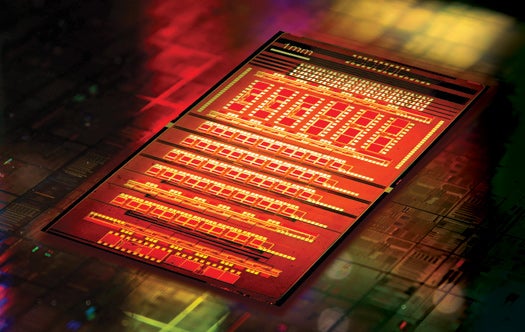
The speed of light is as fast as it gets, and IBM researchers are exploiting that fact to give supercomputers a boost. They’ve made the smallest-yet silicon chips that use light to transmit information.
Most parts of the chip resemble those found on any other commercial chip. The parts that process or transform information—in other words, the parts that do the actual computing—still deploy electrons moving through semiconductor gates. But the interconnects, the lines that shuttle information between different areas within a chip, are drastically different. Instead of shuttling electrons, which can slow down significantly when the interconnects heat up, they shuttle light. That’s because light is easy to contain and loses less information as it travels. The researchers hope that this quick communication will make possible the first exascale computers—that is, computers that can perform a billion billion computations per second, 1,000 times as fast as today’s speediest systems.
One other benefit, says IBM engineer Will Green: The optical interconnects use significantly less power, making them cheaper to run. That’s particularly important given that supercomputers typically consume megawatts of power during operation. IBM, which has already made a working prototype, says a commercial version of the chip will debut in a supercomputer in around 2018.

Click the image above to see inside IBM's optical microchip as it turns electrical pulses into light and back again. If you are unable to view Flash files, click here for a static version. Illustrations by Aaron Newman; Flash Design by Josh Rashkin
This month's How It Works section is brought to you by Digi-Key. All posts are purely editorial content, which we are pleased to present with the help of a sponsor; the sponsor has no input in the content itself.
Five amazing, clean technologies that will set us free, in this month's energy-focused issue. Also: how to build a better bomb detector, the robotic toys that are raising your children, a human catapult, the world's smallest arcade, and much more.


Online Content Director: Suzanne LaBarre | Email
Senior Editor: Paul Adams | Email
Associate Editor: Dan Nosowitz | Email
Assistant Editor: Colin Lecher | Email
Assistant Editor: Rose Pastore | Email
Contributing Writers:
Kelsey D. Atherton | Email
Francie Diep | Email
Shaunacy Ferro | Email
FINALLY! Now those CPU's can crunch as fast as they want and not get backlogged due to slow bus speeds. This combined with carbon sheet transistors and nanotube computing is going to pole vault the computing industry into the future, The Singularity *IS* here!
only downside to that much computational power, is when those processor hungry AI programs get introduced, well we all know where that rabbit hole goes.
Well this still doesn't solve the SPAM POSTS. I thought this was delt with. Can't popsci just block all Chinese IP addresses? They all write stuff about their great new site that sells fake clothes, shoes, etc...
I came up with this concept in high school and presented it in a class project at VCU in 2006. I cant believe that they are making my idea!
But why do we have to wait 7 years for it? Seriously, 7 years? I get so tired of these tech companies trickling out the tech to milk people of every penny they can. I need some capital...
I would think that the heat issue would be more important than the electric bill. Getting heat out of a processor chip is often the limiting factor.
So it's not really a light "driven" computer...it's more a light "optimized" computer. The computing is still done in boring old semiconductors, that get hot and slow down.
No, they do get hot, but dont slow down. did you not read carefully? they said that electrons do, but thats the whole purpose of using light is because heat wont slow it down. But you are right, it isn't light driven, it is light optimized. but it gets a good deal out of what we take for granted.
As of now, the bandwidth specifies the speed of the internet connection. This would take up a lot less room that could be made to fit more stuff in there. Until that happens though, we have to wait the five seconds it takes to load this page.
yeah, there's a reason why ac current won over dc current, dc current has a very fast power drop off waste from pushing electrons through conductors, nikola tesla, my hero, figured out, "hey this way they don't actually have to move very far!" thus the alternating current was born.
we'd probably get the same exact speeds if we decided to re structure the entire computer around alternating current instead of direct. because it's the same principles of the ac vs dc war back in the 1900's. while the power might be significantly lower so too is the diameter of the wire itself.
but let's face it, the light show that this computer will make when all is said and done is going to be freaking sweet! modder's heaven, functionality and aesthetics!
To be clear, yes, for now silicon chip technology still run the computations. The improvement this story highlights is in the ability for optical fiber to cleanly transmit 8 discrete data streams to the processing device with zero possibility for cross-talk between data streams. It works simply because the light is each data stream is a different color!
Optical processors are in the pipeline but what good would the processor be if it couldn't receive data as fast as it can be processed?
Someone could not understand why it would take 7 years to bring the entirew system to the marketplace, complaining about how the high tech companies are cheating the little guy who had the brainstorm. The answer is simple - naivete'.
The individual inventor can no longer assume that there are no other people working on similar projects. Security is of utmost importance. Sometimes that means not discussing your work - even with your family.
Just amazing; however, in light of the new experiments about the speed of light won't that reak havoc with the long term viability of these machines or will their be sufficient stability in the device?
http://www.relativitycollapse.com/speedoflight.html
http://www.relativitycollapse.com/e=mc2.html
So now the roomtemp superconductivity of water-doped graphite in loose structure could feasibly lay gridpoints for a processor too, keeping the electron base tech for a buffer computer of a higher order, too.