Ornithopter makes majestic, record-setting flight

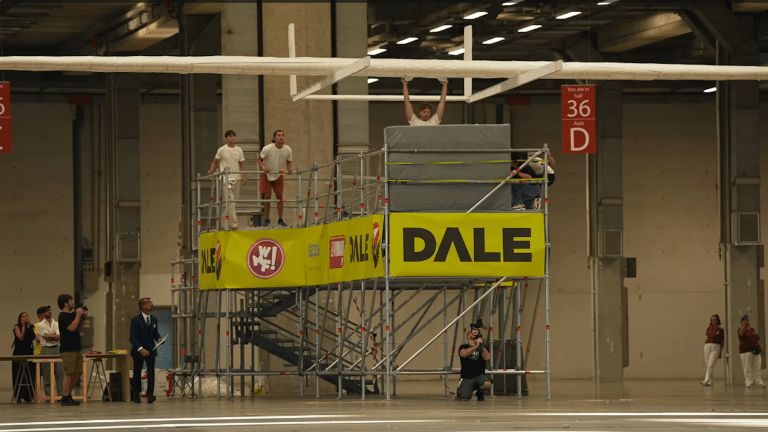
Snowbird The Snowbird weighs just 94 pounds but has a wingspan that nearly matches a Boeing 737. University of Toronto

A Canadian engineering student achieved sustained flight in a human-powered ornithopter for the first time in August, and has just filed a claim for a world record, according to the University of Toronto.

The Snowbird is the first contraption of its kind to allow humans to fly like birds, by flapping massive wings to create lift.

The record stands on the likely-enormous shoulders of Todd Reichert, an engineering PhD candidate at the University of Toronto Institute for Aerospace Studies, who designed and piloted the craft. An SUV towed him to takeoff, and then his wing-flapping device sustained altitude for 19.3 seconds and carried him 475 feet, with an average speed of 16 miles per hour. It's a stunning sight: (Wings start flapping about 1:40 in)

Reichert, 28, lost 18 pounds over the summer in his quest to fly the Snowbird, which has a 105-foot wingspan (just six feet shorter than a Boeing 737) and weighs just 94 pounds. It is made of carbon fiber and balsa wood.

He actually flew the craft by pedaling with his legs, the Toronto Star reports. Pulleys and ropes attached to the wings would pull down when he pedaled forward, and the wing spar would bring them back up. The aircraft even sang as the wind blew past the airfoil and support lines, according to the Star. It was the Aeolian tone, a musical tone generated by wind blowing over an object.

Reichert noted that people have been trying to fly like birds throughout history: “This represents one of the last of the aviation firsts,” he said.

He also told the Star that he didn’t sleep the night before the event.

Reichert performed the record-breaking flight Aug. 2 at the Great Lakes Gliding Club in Tottenham, Ont. On hand was the vice president of the Fédération Aéronautique Internationale (FAI), the body that governs worldwide aeronautical sports and world records. The official record claim was filed this month, and the FAI is expected to confirm it in October, according to a University of Toronto news release.

28 Comments

O Canada.

A new level of stealth can be achieved if powered with a mechanical engine...

Imagine having a UAV or other similar platform flying above an enemy and they don't know you're there because there's no telltale sounds of propellers or jet engine exhaust screaming out the back end...at least, not as loud.

The problem with current stealth technology is that you still hear the jet engine or the propellers...with this, you can silently fly over someone and they wouldn't hear you coming. Imagine if a UAV were the size of a large bird...radar would think it was actually a bird and you wouldn't even notice it...

This would be good for slow-flying UAVs that need to loiter above for hours at a time...not good for bombers or fighters that need to get somewhere fast.

The video doesn't work for me. I'm very sad

Didn't Daedalus already accomplish it over 2000 years ago?

This is itneresting. My only concern is the fact that it didnt fly very far and used a car to take off....does'nt count if you ask me.

What it needs is a lightweight pneumatic piston motor. A person could pedal to store energy, and then release it while pedaling on takeoff. Instead off constantly tiring yourself to stay aloft, you can glide and use the stored energy take a break. This way you could stay aloft longer while not being a marathon runner!

Does it count as flying under human power when he is more like gliding using the momentum impart by the car towing it to liftoff?

If the video doesn't work for you, just right click and select "Watch on Vemeo".

An amazing achievement! Some are critical here but if you watch the video, it is clearly flying on it's own. The pilot likely could not fly further because of the airfield length (used for small planes and gliders).

True stealth aircraft minimize their radar profile through various means, but being stealth also means being silent, or, just as good, faster than sound.

You can't hear supersonic stealth aircraft until they're already passed you.

This really, really remind me of Miyazaki's movies, he usually puts flying ornithopters into the mix.

Wow whoever said to right click and watch the video on vemeo is crazy. Its the exact same video. In my book it doesn't count, are is pulling it to get it into the air. I believe that he should have to run off a cliff and use hand pedals to make the wings flap then and only then I'll say it counts.

To those with criticism: just give it time, and surely improvements will be made. The Wright brothers' first model to get airtime had very little airtime, as well. What matters right now is that someone has established a [somewhat] working model from which to progress. Hurray to progress!

*and don't call me Shirley*

EDIT: @new: did you expect a different video? Far Out Man suggested that because Marwanshah said the video 'doesn't work' which usually means it won't play. It helps to figure things out before you do or say something unnecessary.

next step add a super lightweight vertical-axis wind turbine

http://www.thekpv.com
The hybrid electric kinetic powered vehicle

That's just beautiful. When you see it, it's hard to believe no one has really been successful at it until now.

By the way, in the other videos you can see that's its a very short airfield (with a road crossing at the other end, no less) so that's at least partly why the short flight. Also...it's a test flight.

Leonardo da Vinci would be pround

This is not news.

I traveled in Mexico some time in the 70s. In a remote part of the desert, I met a man who invited me into his shack. He was kind enough to feed me the meager meal he had gathered near his house. Some ground corn and cactus. The cactus was pretty bitter. But I didn't want to offend, so I ate it anyway. It made me nauseous, so I had to go outside to throw up. But I felt a lot better shortly thereafter.

He and I spent the rest of that night flying above the Chihuahuan Desert over the beautiful, moonlit landscape. It was effortless.

While I was critical myself, I guess it was a good point that this did sustain his flight, and it is interesting to make the vehicle such that the wings can withstand the stresses. It's a start, and a good one.

@QIII

Flawless execution. I applaud you.

This is a great story. In these days of mainstream media negativity and news broadcasts that go by the motto "if it bleeds, it leads", this deserves front page attention. Kudos to Todd and his entire team. They deserve to be a front page story in your publication. In this day and age, they actually achieved a feat that has been challenging mankind for hundreds of years.

@rpenri lol you don't hear our jets unless we want you too. Radar however is a different story. The enemy rumor of the aircraft I worked on was that it was at least thirty miles passed the drop point when you hear it, maybe even more. Of course eyewitnesses aren't around to testify so we make a guess as to the distance by the jerk of the heads in response as they realize a bomb is dropping and they still haven't heard the aircraft. All of this is achieved by moving faster than sound.

for those of you who don't think much of it because it didn't fly far, not only is the airfield short (as has already been pointed out), but this is a new version of aircraft, and the Wright Flier didn't fly very far either.

For my 2 cents... I think it looks like a very nice piece of engineering, very elegant, even... but I'm not convinced enough to call that flight, versus, "slightly sustained gliding."
My reasoning, from basic observation…I didn't see any lift being created by the "flapping". Am I wrong? It seems the maximum altitude was achieved during the tow, and then it was just, really, a gradual descent.
I don't think this was "nothing"... but again, don't think I'd actually call it human-powered flight.

Sounds like a fail to me. Seems like if you accidentaly flap to fast on one side you'll flip over and crash...or if you flap the wings they'll both snap. Idk it just sounds like a fail, like it was really lucky he even got off the ground.

It was not towed by an SUV unless you meant smart Utility Vehicle.

Nonetheless, quite an achievement!

This is not the first human to fly under their own power. The first human powered flight was in 1977 by the Gossamer Condor. The next major flight crossed the English Channel in 1979, 22 miles, by the Gossamer Albatross.

Nice GLIDER.

hm.. well.. it was cool to watch...
but,

How does one determine where the student powered flight begins and where the "we pulled it with a car to get it up" stops?

The kid "did" get it to flap.
The flapping didn't make it crash.
But,
Did it go any further due to the flapping?
or,
Was the flapping simply a tolerated phenomena while gliding due to powered launch.

If they continue the program:
They should quantify the performance as delivered from the vehicle.
Then quantify the contributions from the student.
Is the student truly sustaining the flight or just bouncing up and down.

he should have let this man fly with him :))
in his 100th birthday this old man take his first flight
"http://airsoc.com/articles/view/id/4fc605e0c6f8fa1210000007/100-year-old-takes-to-the-skies-for-the-first-time?ev=10&evp=tl"


June 2013: American Energy Independence

Five amazing, clean technologies that will set us free, in this month's energy-focused issue. Also: how to build a better bomb detector, the robotic toys that are raising your children, a human catapult, the world's smallest arcade, and much more.


Online Content Director: Suzanne LaBarre | Email
Senior Editor: Paul Adams | Email
Associate Editor: Dan Nosowitz | Email
Assistant Editor: Colin Lecher | Email
Assistant Editor: Rose Pastore | Email

Contributing Writers:
Rebecca Boyle | Email
Kelsey D. Atherton | Email
Francie Diep | Email
Shaunacy Ferro | Email

circ-top-header.gif
circ-cover.gif