Move over, hovercraft. This airplane can perch, bird-style, on a power line.
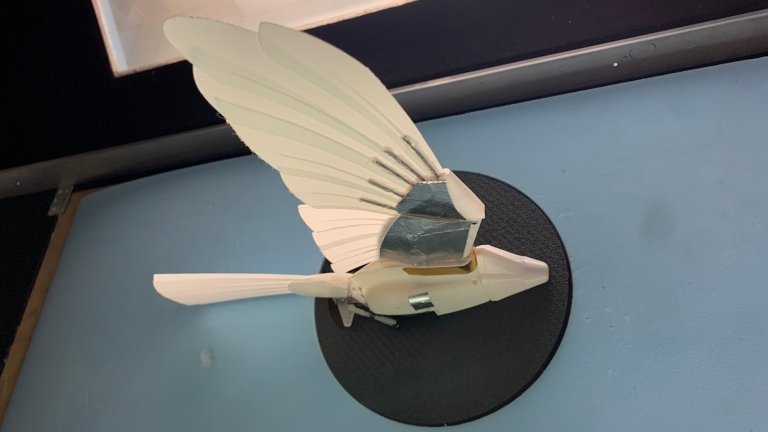
Using computer algorithms, MIT researchers have designed a foam glider with a single motor on its tail that can perch like a bird. The work has implications for robotic planes, potentially allowing them to recharge their batteries by perching on power lines, according to MIT News.
Watch a bird careening through the trees, and you might wonder how it can suddenly stop and alight on a single branch. There are certainly no flying machines capable of such aerobatics.
It’s because birds take advantage of a phenomenon called stall -- not a word you usually want to hear in aviation.
Birds come to a stop by tilting their wings back at sharp angles. This creates turbulence and large, unpredictable whirlwinds behind the wings. If an airplane pointed its wings up in this way, it would lose lift and fall out of the sky. But MIT researchers wanted to take advantage of stall -- specifically, post-stall drag -- to help a plane come to a controlled landing.
It’s difficult to predict how the wing whirlwinds will manifest, so MIT Associate Professor Russ Tedrake, a member of the Computer Science and Artificial Intelligence Laboratory, and Rick Cory, a PhD student in Tedrake’s lab, had to model what a stall looks like.
They also found they had to create error-correction controls to tweak the glider’s path in case it deviated from its flight plan. Using algorithms developed at MIT, they were able to calculate the degree of deviation that the controls could compensate for, MIT News says. The result is a model that looks like a series of tubes, which includes all the possible trajectories and the tolerance of the error-correction controls.Once the glider is launched, it keeps checking its position and executing the command that corresponds to the flight path “tube” it is in.
To stop, it tilts itself up in a dangerous-looking stall and wafts forward, ultimately reaching a tiny perch, where it alights.
The team used wall-mounted cameras and an external computer to monitor the glider’s position and run the control algorithms. To expand the technology to robotic airplanes that interest the Air Force, more powerful on-board processors would be needed. Meanwhile, Tedrake's lab has already begun to address moving the glider's location sensors onboard, according to CSAIL.
[MIT]

Five amazing, clean technologies that will set us free, in this month's energy-focused issue. Also: how to build a better bomb detector, the robotic toys that are raising your children, a human catapult, the world's smallest arcade, and much more.


Online Content Director: Suzanne LaBarre | Email
Senior Editor: Paul Adams | Email
Associate Editor: Dan Nosowitz | Email
Assistant Editor: Colin Lecher | Email
Assistant Editor: Rose Pastore | Email
Contributing Writers:
Rebecca Boyle | Email
Kelsey D. Atherton | Email
Francie Diep | Email
Shaunacy Ferro | Email
This type of technology is a huge breakthrough. It will definitely allow for the heightened development of unmanned air surveillance vehicles. Imagine a surveillance robotic bird being able to spy on a terrorist hide out from the perch of a power line. This type of technology is already being developed in military labs. I'll post a link to a great video about these unique UAV's.
http://www.ndep.us/Robot-Birds
i understand how it basically "perches" on the line, but is it possible to take off from the perched position? after all, eventually, if this technology (sorry about the pun) "takes-off" you will need the plane to take off as well,
so, does anyone know if MIT, or some other lab, is planning on making take-off possible?
Sanud002
Where would you find a terrorist within a hundred miles of a power line? LOL...
If they were in the city...you wouldn't need a UAV to eavesdrop on them. A wiretap, a parabolic microphone, or even an agent standing close enough could hear what they were saying.
Birds have been perfected over millions of years, the steps we are taking at duplicating their flight are pretty rudimentary. If you watch birds closely you will see that their wings are designed to flex in a controlled fashion so that flight stability is maintained, you will also notice they rotate their wings and change their shape to alter lift as well as move their wings fore and aft to change the position of lift relative to the CoG to alter their vertical direction. The best view of the fantastic stability of their "design" I have seen is watching albatrosses surfing the lift of a ship I was on, they get hit by vortexes coming off the ship and their wings bend al over the place but they stay on position. That how aircraft should be designed.
By the way, when did the we loose the plot, the Wright Bros had the aircraft the correct way around (canard wings and pusher props) and then somehow it all got turned the wrong way round.
Are you serious? This is what MIT students did? I did that in my parents basement when I was 15. I'm glad I didn't pay for college.