The CentraSight Implantable Miniature Telescope VisionCare

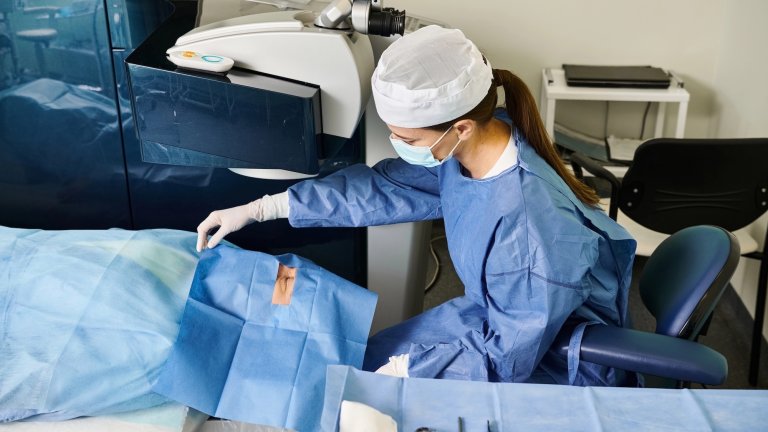
The rapidly aging population of the United States as the Baby Boomers reach their golden years doesn't bode well for our collective vision: 30 percent of Americans over age 75 suffer from age-related macular degeneration (AMD), a common condition that causes the retina to degrade and decay, resulting in partial blindness. But after five years of deliberation, the FDA has approved the first implantable miniature telescope (IMT) that fits directly into the eye to correct the effects of AMD.

Those effects are pretty serious; as the retina degenerates, the center part of a person's vision grows blurry or completely dark. The IMT corrects this by expanding an incoming image onto the peripheral parts of the retina that are still in good health. Once implanted directly into the cornea, the device makes use of the remaining working retina cells to produce a donut-like image that users can see.

Of course, that donut-like image isn't anything like our natural vision. Users have to go through a rehabilitation process to learn to see with their new eye, and even if a person has AMD in both eyes (most do) the IMT can only be implanted in one eye so the other can still provide peripheral vision. This kind of altered eyesight is likely headache-inducing, and may not work well for all candidates because of the intensity of the rehab process.

Further, the IMT is by no means a cure-all for all AMD. It is designed to treat a specific form of AMD known as "end-stage" (that's right, it's the more advanced stage of the condition), a kind of AMD that affects about 500,000 Americans. However, though far from a panacea, it is available right now and in two-thirds of trial cases the IMT has significantly improved vision, and by extension quality of life, in patients.

That's a pretty big deal, considering end-stage AMD is expected to affect more than a million patients by 2050. By then we'll all be cyborgs anyhow, but in the meantime the IMT should serve as a dependable technology that will keep more of the population in at least serviceable vision for longer.

[Singularity Hub]

7 Comments

I wouldn't want any kind of implant like that.

If you were blind, smith, you would. Life is not worth living if your used to seeing the world around you, and then having it gradually decay into nothing.

Wonderful medical advancement.

I can't wait for the day when science can just grow us new eyes.

Terminator world is happening. Me no likey

--GTO--

@Cetus: we can grow ears...

I have a dear family friend who has been losing his vision for a few years and has recently all but lost it completely. He's basically looking through a paper towel tube. He is a father of three girls and the major breadwinner of his house. These technologies cannot come fast enough. I've promised him that if he makes do for five to ten more years --which he will, he's a trooper-- then he could get his eyes fixed. (I hope I have not lied to him )
I also suffer from severe far-sightedness and it makes me sad that all the major breakthroughs in vision restoration are not for my condition. I'm still very happy for those that do get helped but I'm jealous I guess.
BRING ON THE CYBORG ACTION!!!

BOOT JORDAN!!!! What a punk!

We are the Borg. Resistance is futile.


June 2013: American Energy Independence

Five amazing, clean technologies that will set us free, in this month's energy-focused issue. Also: how to build a better bomb detector, the robotic toys that are raising your children, a human catapult, the world's smallest arcade, and much more.


Online Content Director: Suzanne LaBarre | Email
Senior Editor: Paul Adams | Email
Associate Editor: Dan Nosowitz | Email
Assistant Editor: Colin Lecher | Email
Assistant Editor: Rose Pastore | Email

Contributing Writers:
Rebecca Boyle | Email
Kelsey D. Atherton | Email
Francie Diep | Email
Shaunacy Ferro | Email

circ-top-header.gif
circ-cover.gif