So far, it's just an idea

Concept Plane Airbus unveiled this 2030 concept plane at the 2010 Farnborough International Airshow. Airbus

Of all the aviation tech emerging from the Farnborough International Airshow, Airbus’ futurist visions are among the coolest.

The aviation firm unveiled its 2030 Concept Plane earlier this week, which includes dreams of a self-cleaning cabin; extra-long, slim wings; a U-shaped tail; and an intelligent fuselage designed to improve efficiency.

Airbus acknowledges the plane is somewhat a flight of fancy, but it’s worth imagining how aviation would look if advancements in existing technologies “continue apace,” as the company puts it.

Some of the concepts:

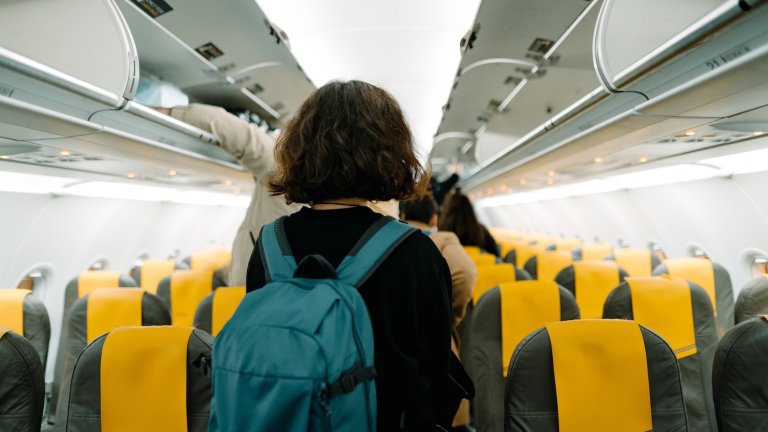
  • Smart seats made from plant fibers, which could change shape to offer a comfortable fit
  • See-through walls that offer passengers a 360-degree view
  • Fuel cells, “cryo-power,” and even human body heat to provide power
  • Self-cleaning materials that use beads of water to remove dirt and pathogens
  • Holographic projections of virtual decors, allowing travelers to transform their private cabin into an office, bedroom or Zen garden

“It’s not a real aircraft and all the technologies it features, though feasible, are not likely to come together in the same manner. Here we are stretching our imagination and thinking beyond our usual boundaries,” says Charles Champion, vice president of engineering at Airbus, in a press statement.

Accompanying the concept plane is a futurist document (PDF) that would make Burt Rutan blush. "Futurologist" Robin Mannings envisions planes flying in formation like a flock of geese; flying aircraft carriers used for long-distance flights, which would allow small aircraft to dock; cryo-planes powered by hydrogen; and more.

He even suggests flying cruise ships, complete with casinos and entertainment, which might generate enough revenue to make the tickets free.

Here's hoping these planes of the future look as cool as this design.

Concept Plane Engines: The Airbus concept plane has embedded engines, a U-shaped tail and a smart fuselage intended to improve energy efficiency.  Airbus

[Airbus via Smart Planet]

17 Comments

Why would a plane need to fly in a flock? It's not like the aircraft can't navigate on it's own. Military aircraft fly in formations because they're all going to the same place and when in combat, are in danger of other aircraft trying to shoot them down. Strength in numbers.

Passenger planes don't have that problem. Unless the ban on shooting down passenger planes has been lifted, I don't see any point to it.

Also, the phenomenon in which a bird/aircraft flying behind something (drafting) uses less energy is useless in this context. For that to work, the aircraft must be extremely close to the other, so close it's dangerous. Not only are these passenger planes larger and less maneuverable than fighters, I'm sure the exhaust from one aircraft going into the other's engine would put a pilot in a bit of a pickle as his engine loses power due to lack of oxygen/cold condensed air.

"Also, the phenomenon in which a bird/aircraft flying behind something (drafting) uses less energy is useless in this context. "

Wouldn't the fact that the air is alot thinner a couple miles up kill some/most/all of the benefit of drafting anyways?

"and when in combat, are in danger of other aircraft trying to shoot them down. Strength in numbers."

I'd kind of look at it the other way-- if you had a dozen planes miles apart wouldn't an individual be less of a target since the only benefit of going to that location is the possibility of taking out one plane? If those planes are in formation, the enemy fighters wouldn't even need to be all that accurate with their shots... just fire twards the middle of the mass and you're bound to hit something.

@rpenri
The amount of turbulence created by a bird is in proportion to the size of its flight surfaces (wings). Thus, a plane with a wingspan 100x that of a bird will have, proportionally, 100x the turbulence, I would imagine, making it possible for other planes to fly close enough. And your argument regarding "strength in numbers" with military aircraft is incorrect as well. With a cluster of aircraft, you only need to hit one with a missile and the explosion and shrapnel would take care of the whole formation. Efficient flight happens in formation. Efficient combat does not. Go read Ender's Game, you'll see.

@neuenkir "The enemy's gate is down!"

glad our tacticians dont rely on enders game for tactics. combat planes fly in formation, because to counter enemy fighters, having more planes close together doesnt allow the enemy to get behind you without someone being behind them. formation is effective for travel but once combat happens, they split up.

So many great technologies that American will never see because our airlines are simultaneously broke and greedy. When they are already charging money for peanuts and pillows, I think there is zero chance of getting a holographic projector!

most of these technologies would exist better in a water based cruise ship. a flying cruise ship isnt really feasible, need more efficient and faster planes, that fit more people comfortably. or space based planes, cruise up to limit of space/atmosphere, cruise around gambling and etc, not a casino to travel to europe or denver.

Flying in a tight formation increases fuel economy by about 12%

funny you should doubt, rpenri, because popular science already had an article about this very question of flying in formation:

http://www.popsci.com/technology/article/2009-12/increase-aircraft-efficiency-researchers-look-natures-flying-formations.

In it they quote a 15% increase in efficiency.

"See-through walls that offer passengers a 360-degree view"

Although this is kinda cool to me...I would bet that it scares the cr@p out of a lot of people.

It may even prevent those who have never flown before from ever trying it.

That's a great vision and all but maybe Airbus should've hired a tech writer and/or editor before informing the world how we'll live and fly in 20 years. For a company that espouses so much brilliance, go back and look at the copy... it's riddled with typos. And I'm not just talking the difference between "program" and "programme." If that's their attention to detail, I'm going all Boeing all the time!!!

For a cruise-ship type large aircraft, see our SE4BWB flying boat at cookaerospace.net

ahhhh soooo cooool!!!! i would love to be able to see the sky as i fly through it!!

Oh God, See-through walls? remind me not to look down.

Anyone get visions of the fat people of earth in an aircraft like the one found in WALL-E?

I'd like to know more about the "Smart Fuselage". What is the idea behind it? Does it morph it's shape while in flight? Also, a 360 degree view of the outside of the aircraft, small windows with narrow views already put the fear of flying in some. And self cleaning is a must with all of the motion sickness that will be created! What about the term " small aricraft to dock", sounds like a flying aircraft carrier. I would believe that all of the technology would work along before tickets being Free. Just some of my thoughts, anyone with the answers?

Concept Airplanes will be great for just flying to from city to city or Island to Island. However if we are ever able to tap in the Earth's Electro- Magnetic Energy The US Air Force and the US Navy is doing a studies on this now . We will have rail trains without rails such as going East to West North to south And vice -versa.Plus these Trains will be able the travel the speed of sound.So it means good bye Air buses hello the new Air ship Blimps which will take only couple days to get Europe If we cantape this Electro Magnentic below the sea level It means goodbye the way we do things in society Our cars will be able run on anything in the distance futurePlus all the internal Communications heat or cooling will be solar connected or wind or felocity energy Plus car does create it's own energy this also can be tap into the electric portion of the super hybrid car.or any other vehicle.


June 2013: American Energy Independence

Five amazing, clean technologies that will set us free, in this month's energy-focused issue. Also: how to build a better bomb detector, the robotic toys that are raising your children, a human catapult, the world's smallest arcade, and much more.


Online Content Director: Suzanne LaBarre | Email
Senior Editor: Paul Adams | Email
Associate Editor: Dan Nosowitz | Email
Assistant Editor: Colin Lecher | Email
Assistant Editor: Rose Pastore | Email

Contributing Writers:

Kelsey D. Atherton | Email
Francie Diep | Email
Shaunacy Ferro | Email

circ-top-header.gif
circ-cover.gif