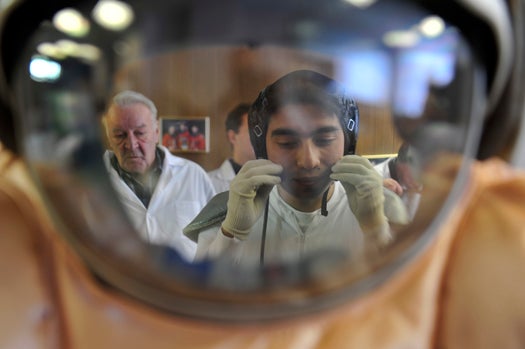
The first two members of Russia's upcoming 18-month "Mars mission" have been selected by the European Space Agency; Frenchman Romain Charles and Colombian-Italian Diego Urbina will join 3 Russians and one Chinese national in the Mars500 spaceship, which will carry out a 520-day simulated mission to Mars beginning June 3.
Let's hope they all get along.
The upcoming mission follows on the success of last year's precursor isolation experiment, in which a crew of six was sealed inside a fake "spacecraft" in Moscow for 105 days. During that time researchers studied the effects of isolation on the crew, as well as the strain of close living quarters and working conditions. That mission simulated an abbreviated trip to the Red Planet; the upcoming "journey" will mirror the real thing.
At 520 days, the mission will mimic an actual voyage to the Moon and back. The sealed containers (again in Moscow) in which the mockup mission will unfold contain not only a spacecraft, but a Mars lander a Martian landscape as well. Around 250 days in the crew will be split, with half of the astronauts moving into the lander for a simulated trip to Mars' surface. There will even be a simulate spacewalk, in which the crew will suit up in modified Russian Orlan spacesuits. For the duration, the crew will be constantly monitored for both psychological and physiological signs of stress or deteriorating wellness.Those chosen to go to the "surface" will likely relish the opportunity to stretch their legs. Living quarters inside the experiment only add up to less than 20,000 cubic feet. That might sound like a lot, but for a crew of six that's not a whole lot of space, especially when you factor in the 18-month grocery supply that must be stored on board as well.
There will be communication with the outside world via radio and email, but radio communications will be delayed a full 20 minutes as they would be on a real interplanetary mission and emails will take twice that time to get through. Both will be disrupted periodically, because what's the point of locking six men in a container if you don't mess with their heads a bit?
The remaining four crew members will be named later this month.
[ESA]
138 years of Popular Science at your fingertips.
Each issue has been completely reimagined for your iPad. See our amazing new vision for magazines that goes far beyond the printed page
Stay up to date on the latest news of the future of science and technology from your iPhone or Android phone with full articles, images and offline viewing
Featuring every article from the magazine and website, plus links from around the Web. Also see our PopSci DIY feed
A 10,000-rpm, no-pulse heart is completely revolutionizing how we think about transplants. Plus: rapid-response virus hunters, a shocking cure for migraines, the world's youngest person to have achieved nuclear fusion (in his parents' garage!), and much more.
I don't have a problem with the first person to set foot on another planet not being American. But I most definitely do find it problematic that we're not even trying.
Indeed it seems our culture of exploration on the US has disappeared. We seem to be fine with just sitting back and letting everyone else do it. We should get off of trying to be a world peacekeeper (which no one else wants) and get back to exploring. There are resources on the moon and in many other reachable places that could solve some of the problems on this planet. There is obviously something else out there besides us and we won't find them if we're sitting on this planet with our thumbs up our collective butts. We have to at least try.
Gee... 520 days just to the moon and back seems like an awfully long time. What genius decided to take a ‘shortcut’ somewhere? Or are there big signs between Earth and the moon that read ‘Come See The Solar Systems Largest Non-Stick Frying Pan!’ that they just HAD to stop and see?
mars.....not the moon.....might wanna improve your reading and comprehension skills
blackhawk...this kind of study is useless in trying to figure out how to explore mars. im happy were not doing this worthless experiment. Living for the 520 days is the easy part. The hard part is keeping them alive and getting them there. If you have trained for years with the 5 other people, 500 days together is nothing in order to fullfil your life long dream of going to mars. What are they going to learn from this experiment? astronauts get bored as fuck, want to kill eachother, and etc. Its common sense
All space travel should be done by robots. Humans cannot exist in space. Don't believe what you see in the movies.
@nizeke:
I agree, it's only a partial mission simulation (at best). Since they are on Earth, they aren't undergoing ALL the stresses of space to do a real simulation. No zero-gravity and no fear of danger to stress the minds of the astronauts.
I think our time would best be spent over those 520 days to develop ways to shorten that trip and make exploring Mars easier. How about VASIMR engines?
Personally I don't see much wisdom in going to Mars that much. We could learn a lot about the planet, have some national pride at being there first, and search for life (either dead or alive). But then what?
the US isin't spending money on reasearching for travel to the mars because the goverment is smart enogh to let other contrys expiriment for us and just use what ever they came up with as a base for our research when we have enogh science and technology to get there fast without the killing each other part.
I wonder about the fact that the people in the experiment know that it a simulation , frustration in that fact alone is another psychological factor to consider in the simulation experiment .This could weigh on the people inside .
In the real mission the reality of actually being millions of km away from earth stuck in a can for over a year vulnerable with only sombody elses technology and your wits ,far away from the simulation would set in and the effects are untestable.
You could also argue that men on submarines would have something to say about how humans might handle a mission to mars , or early sailers that explored the seas for the New World .
I think alot can be learned from a simulation experiment like this but only if its closer to mission time , too many parameters will have changed by the time these men actually get to go anywhere , as far as I understand we dont have the right equipment right now to go to Mars .
@ nizeke
Forth paragraph, first sentence… “At 520 days, the mission will mimic an actual voyage to the Moon and back.” My reading comprehension is fine but your sense of humor could use some work.
I totally agree with you concerning the worthlessness of this simulation and the fact that it’s a good thing we aren’t part of it. Put those smart/motivated people to work on something useful.
Umm, actually, it IS about Mars, believe it or not. The Moon was a typo, as you should be able to infer from the times Mars is mentioned (7) to the 1 time the Moon is mentioned. Also, using historical knowledge, the Moon is most certainly not 250 days away using our technology.
Nizeke, you are correct in your statements.
This makes me want to watch space odyssey ..
It is indeed about mars. My mention of the moon was only to infer that there are resources there (an abundance of helium 3) and its the closest body as well. So, if the closest body has resources then why not explore the rest as well or, at the very least, we should be going to the moon.
Don't we do this everyday in the space station? Small space.. at zero gravity.. which you will not get in this experiment. Plus these volunteers might feel on a pyschological level that if something goes wrong, they can quit the experiment. Seems like a waste of resources when we should have better data already.
Very good news, but sad that there is not a real mission doing this in space.
Like others have said, I'm glad other countries are doing this experiment so that our astronauts can be working on the technology to get us there. We have plenty of real life examples such as the ISS and submarines.
Hopefully they are having these volunteers do real science while they are twiddling their thumbs for the better part of 2 years.
There is considerable research on how to take that 520 and bring it down to about 30 days. The propulsion systems are what hamper our efforts to make it there and back in any sort of meaningful time period. You wouldn't cross the ocean in a rowboat and right now, our space craft have a similar relative speed. Some of the new systems are theoretically able to get to Mars in about 4 to 6 weeks. I think I read about it on PopSci a few weeks ago.
What happened to the Americans??? o well it would be funny to see their video logs for each day.
@nizeke
You're a dick.
@nizeke:
You should check yourself before you wreck yourself.
"Etc. is short for the Latin et cetera which means literally "and so forth." Therefore, when you say "and etc." you're really saying "and and so forth." This is clearly redundant. Just say "etc" (or preferably "et cetera"). (It may help you to remember that "etc" was once abbreviated &c.)" - www.englishchick.com
At 520 days, I think the danger of serious complications from blue balls is frightening.
nizeke - In polymath87's defense the article does say "At 520 days, the mission will mimic an actual voyage to the Moon and back."
Looks like you could use some work in the areas of reading and comprehension skills yourself.
cberst- besides the title itself being the leading definition of the missions intent. a past poster has already pointed out that moon sentence was a clear typo as in the article mars is mentioned 7 times to the moon's mentioning once.
problematicearthling- do you have nothing better to do than post on popsci critiquing my grammar? I only made fun of polymath because he was ripping on the article for something he misread. and even after i made the comment directed to polymath, i at least posted something relevant to the article.
"im happy were not doing this worthless experiment. Living for the 520 days is the easy part. The hard part is keeping them alive and getting them there."
I disagree. Eventually we will have technology to keep people alive for 500+ days and get them to Mars and back. But why spend untold billions on that when a fairly simple experiment might show that living together in such a confined space for so long cut off from everything they know is really dangerous? You said yourself that we already know that astronauts get bored and want to kill each other. The article about the 105 day experiment said mind-numbing boredom made it difficult for the subjects to learn and complete simple tasks. Don't you think it might be useful to test a few ideas about how to keep astronauts busy, happy, and entertained enough or what kind of personalities work the best so they don't kill each other or become completely useless before stuffing them in a multibillion dollar spacecraft and launching it into space?
DAMN IT! WHY ARE THEY DOING THIS!?!?
We can get to Mars in 40 days!
http://www.gizmag.com/ad-astra-ion-engine-mars-39-days/12342/
FOR F*CK'S SAKE US GOVERNMENT! CAN WE PLEASE GET ON THE BALL HERE!?!?
~S
@jrs one
good counterpoint, but i think we can agree that no matter the combination of personalities or whatever other attribute you wanna throw into the mix, 520 days in a room "the size of a cargo container" isnt really feasible. But the point was made and is well known that better engines and technology is being developed to reduce flight time, and reduce space needed for other life support systems(possibly even producing some food while in transit). So while this study may prove that it isnt possible to survive 520 days and have your mind intact, i propose by the time this study comes to a conclusion the estimated trip time will already be reduced, and the study's finding will be void.
except the finding that i hope the US doesnt rely on russia to get our astronauts into space (lol?)
@jrs one
and yes it probably is a good idea to test some ideas of how to keep the astronauts sane, but i from what this article states, the last experiment (105 days) yielded mind numbing results, i doubt giving them a chess set will have a different effect. and this article also doesnt include any kind of new ideas to keep them busy and happy, besides the actual landing, which is if they even last that long
Unless this experiment products it's own oxygen, and recycles human waste products for it's own water, this experiment is already a failure.
Interesting! I hope that everyone has a great weekend. That goes for all the other times.
@nizeke it did say in the article to the moon... it was most likely a typo.
"At 520 days, the mission will mimic an actual voyage to the Moon and back."
The best way to speed up a manned mission is to worry about the return after they get there. Send an expendable person . A shrink would do.
Now that sounds like fun :) I hope they don't go crazy :)
Seriously, a experiment like this one will give huge amounts of very useful data...Mars, here we come :)
Ivan Malagurski
Clay,
I think you mean "At 520 days, the mission will mimic an actual voyage to Mars and back"
(Mars, not Moon).
I also don't think a 520 day study is worthless just because there will likely be technology that can get us there faster. If we can get there in 4-6 weeks then this could simply study some of the psychological effects of a 40 day trip there, a 14 month stay on the surface, and a 40 day trip back. There are also places beyond Mars that we might someday visit that would require around a 520 day trip. Just like how we don't have the technology to go and stay on Mars for a year+ now, I think this study will find we don't know what it takes psychologically to do this either. It's not as if this study will divert a major portion of resources from ion engines or whatever else we need. Why not get started now? It would be such a waste to overcome all the technical hurdles of establishing a semi-permanent base on Mars but have to delay because we are 20+ years behind on how to prepare astronauts mentally.
@nizeke
I sense insecurity.