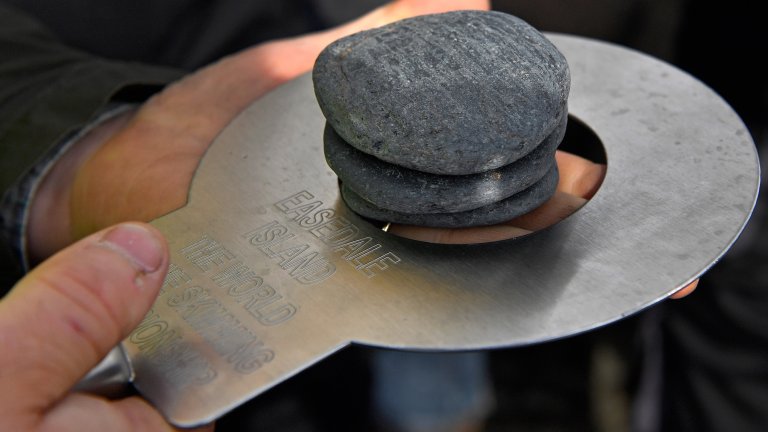
The new compound is about 18 percent more magnetic than former magnet king iron cobalt

Most Magnetic Ever Iron and nitrogen make things really magnetic Andressa Lunardelli

A more powerful magnetic material may have emerged to topple previous record-holder iron cobalt, until now the most magnetic material on Earth. The new iron and nitrogen compound might also force physicists to revise their understanding of magnetism, according to the Minnesota Daily.

The iron and nitrogen compound proved 18 percent more magnetic than iron cobalt in tests done by Jianping Wang, a physicist at the University of Minnesota. There also appears to be a "new physics" at work in the substance, but physicists at other labs must replicate the experiment and verify the work.

Wang reportedly found localized electrons in his iron and nitrogen compound, which have never shown up before in magnetic materials. Localized electrons are electron-pair bonds shared by nonmetals, as opposed to the free-flowing electrons typically related to magnetism and electric current.

Some physicists suspect that localized electrons, rather than free-flowing electrons, are more responsible for magnetism in materials. The discovery also appears to overturn traditional theories that set limits on the strength of magnetism in substances.

Japanese researchers at the Central Research Laboratory of Hitachi also created a magnetic iron and nitrogen compound in 1996, but no other scientists were able to get the same results. Wang has taken special care to allow other scientists to duplicate his experimental setup.

If the findings hold up, they could lead to a significant boost in magnetic materials that allow for more efficient power generation and transmission.

[via Minnesota Daily]

20 Comments

Finally, a new material that will make an electric personal aviation system possible!!! Yeah yeah, once the manufacturing of a material like this is able to replace the mags we currently use it could even open up the realm of the pure electric drive(ala Tesla), not to mention cleaner power, uber efficient electric vehicles of common use... but what get's my blood running is this...

We've got the Martin JetPack, big loud motor/fans, 30 min of flight per tank which is awesome!!!! Beats the SkyTrek hands down... But personally, take a propane fuel cell to provide the power, pump it to 4 mini-electric turbines built with this crazy new battery material, and a carbon-fiber wing like the guy that flew across the English Channel...

Think along the lines of Moller SkyCar that you strap into, built for one and that's the idea...

Who needs a reservation when you have 150mph for 2 hours a fill, and all you need is a gas station with a big white tank out front to refill....

*** and before anyone get's all high and mighty about infrastructure, actual poundage of propane(or butane) needed for 2 hours of flight based on current fuel-cell technologies, or anyone else getting tied up in nitty-picky specifics, POUND SAND!!! By the time this material could even be produced at a volume commercially viable we'll have either hit the Greenhouse cliff and cycled into cataclysmic climate change, or, something easier to create and far more powerful will have come along(thank you nanomaterials supergeeks)... For the rest of you, happy day-dreaming!

This material could completely eliminate the rare-earth element shortages (e.g. neodynium) that plague the electric motor industry. Iron and nitrogen are both abundant and cheap! Hopefully manufacturing this stuff will not be too expensive.

taureanirishman

You know, sometimes I think that if Apple made a jet pack, it would be adopted widely enough for other companies to want to duplicate and in turn, make the products more cheaper as they figure out ways to churn them out at a cheaper and more efficient rate. Of course, Apple's jet pack would surely still cost 30% more than the next guy, but they would probably idiot-proof it enough to where its relatively safe.

A lot of things that people envisioned being standard in the future, like flying cars and jet packs, aren't available now because of pricing, safety, ease of use, etc.

The technology to build it is there...it just takes someone with a bit of innovation to make it available to the masses.

And the cold hard cash to R&D it properly, I should add. I'm sure an iPhone, iPad and such are expensive things to research and develop.

Trireme, you took the words right out of my browser!

So much of what we do now would be sufficient technologically to solve major problems *if* 2 problems were solved:

1) the source was sufficiently abundant and/or sustainable such that we can use it cheaply in all instances of the tech intended.

Fuel cells, for instance. They are more than capable of powering cars with current tech...if we had as much platinum as we do iron. The fact that the best fuel cells that reach the levels of performance needed to power a car and the lifetime to match the body all require platinum is bad enough...at current prices. If we actually tried to make a fuel cell for every new car, the price of platinum might be multiplied by a factor of 10.

2) the processing was sufficiently energy efficient/easy/cheap. (These 3 are massively interrelated.)

We could save a lot of fuel by building cars out of titanium, aluminum, & carbon fiber. All three elements (no, carbon fiber is not an element, but carbon is you wise guy) have weight, strength, toughness and other characteristics that make them perfect for certain car parts. (Carbon fiber, for instance, can be built into strong framing parts, but cannot serve as the engine block because of heat stress, for instance.) If we could do a better job of harvesting cheap heat and recycling/reusing waste heat then we could slash the price of aluminum. Hand-set processes makes it uneconomical to build carbon-fiber in complicated shapes which might otherwise be self-reinforcing and thus super-strong in an accident.

The idea that we need breakthroughs in *materials* ignores the amazing materials we have. We really need any wonder-material to not only have the relevant super-strength, super-magnetism, whatever. We also need to have

1) enough of the raw material
In this case, we're golden

and 2) a manufacturing process that can be scaled up, can fabricate the shapes needed, and is cheap enough that if we used it in all the applications we can imagine, it wouldn't cause any of those products to be too expensive to compete.

This material has a super-property (magnetism), ridiculously common raw materials (iron and nitrogen)...if it can only be manufactured in the final forms required at a price that is not much more than current plain-iron magnets, this will revolutionize a lot of things.

The problem is a lot of materials have super-properties and even a few have common raw materials. We have to have *process* breakthroughs before the world is going to change.

--)->

Magnets 'GONE WILD'!!

If you like magnets; this should tweak your interest:

"Weinstein's magnets are about the size of a stack of five dimes, weigh an ounce, and cost $300. Commercially available electromagnets that can produce a comparable magnetic field weigh two tons and cost $60,000 to $100,000"

Source: www.chron.com/disp/story.mpl/metropolitan/6928891.html

I am curious does it retain its magnetic charge or is it just magnetic?

Has any one heard of Heim Theory? It seems to me that this discovery is very much in agreement with this theory of physics; it's been a little while since I last read about it, but the talk of localized electrons reminds me of the theory. I my be entirely wrong, so please correct me if I am.

With regards to "localized" vs. "free flowing" electrons... is this covalent vs. ionic bonding?

Why is it that two magnets whose similar poles when clamped together fall faster than a non-magnetic material? When opposite poles are joined, then the magnets fall slower. Could this be the basis for magnet motors?

Also, why does light produce a 90 degree phase shift in a circular gravitational field?

I read about this elsewhere to find more info and they actually do not have a process for mass producing this substance and don't plan to explore it. It's Fe16N2 if I recall correctly. Any scientists looking to apply their ingenuity could seize the opportunity to develop that process.

@rpenri

True, and if said jetpack were made by Apple, it wouldn't actually fly, and it would really just be an iPad, which is really just on iPod Touch, which is really just an expensive, useless device which douchebags will surely carry around with them to make themselves appear much more important and tech-savvy than they really are, much like everything else Apple makes, including said jetpack.

Finally, powerful magnets that are cheaper than neodymium or the price of a junker hard drive.

At last, we now have an alternative to China's monopoly of rare earth metals (like neodymium) for our magnets

LOL!!!!

Ivan Malagurski

What is fascinating about this article is that both father and son Weinstein are Jewish, both holding high positions in universities and institutions and then being able to create to make mega bucks for themselves with private patents! Yet almost nobody else can get into these now Jewish controlled institutions once the preserve of the Anglo Saxons! which would give access and the possibility to test ideas with tools unavailable to the general inventing public.This guy has even said he based his work on another persons discovery! These Zionists have weaselled aka networked their way into every opportunity that we pay for! Stolen inventions more like it.

@Whys333 This isn't ionic vs. covalent, they both deal with an electron pair and how it is shared between two atoms. The "free flowing electrons" are just that, they aren't held between two specific atoms, but are free to pass to any of the atoms in the substance. This is what allows electric currents to flow.

@Benshaw Racism isn't cool dude.

This could help make much more efficient wind turbines and make it cheaper and get ride of the rare-resource sucking ones we use now. Neodymium was the first thing I thought of too, trireme. This is a great replacement for it. Hopefully this is true (as it said, they need to reproduce the experiment in other labs) and we can mass produce these things soon. I would have some small wind turbines. I plan on getting the Nissan Leaf and run it on solar, I won't use wind because the neodymium shortage that is bound to happen. Even though the electric and hybrid cars suck up rare resources too, because solar works basically just as well, and about the same price at my location, solar would be a better choice... Hopefully this can replace some of the rare resources in hybrids and EVs aswell.

@Benshaw

I don't think this is the proper venue for your anti Jewish sentiments...


June 2013: American Energy Independence

Five amazing, clean technologies that will set us free, in this month's energy-focused issue. Also: how to build a better bomb detector, the robotic toys that are raising your children, a human catapult, the world's smallest arcade, and much more.


Online Content Director: Suzanne LaBarre | Email
Senior Editor: Paul Adams | Email
Associate Editor: Dan Nosowitz | Email
Assistant Editor: Colin Lecher | Email
Assistant Editor: Rose Pastore | Email

Contributing Writers:
Rebecca Boyle | Email
Kelsey D. Atherton | Email
Francie Diep | Email
Shaunacy Ferro | Email

circ-top-header.gif
circ-cover.gif