Printable Nanocircuits Promise to Make RFID Tags More Ubiquitous Than Bar Codes
The product would also be the first to use printed nanotube transistors
Printable RFID Tags
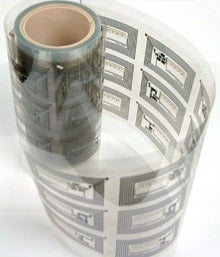
Bar codes in the supermarket might face extinction sooner rather than later, if radio-frequency identification (RFID) tags can cost just a penny apiece, rather than the dime or more they currently run. Now South Korean researchers say they have the technology to print RFID circuits on plastic film, courtesy of nanotube-containing inks, Technology Review reports.
A version of the RFID tags slated to hit the market later this year would be the first product to use printed transistors based on carbon nanotubes. Printing means the application of different layers of antenna coils, nanotube inks, and capacitors and diodes.
The researchers at Sunchon National University in South Korea successfully printed out the plastic RFID tags using common industrial methods such as roll-to-roll printing, ink-jet printing, and silicone rubber-stamping.
These processes churn out tags for just three cents per piece, but the group ultimately hopes to pass the one-cent milestone by figuring out how to lay down all the nanotube ink layers in one go during the roll-to-roll printing. Many RFID tags today cost anywhere from 7 cents to 15 cents, if not more.

Cheap RFID
But some hurdles remain before you’ll see these newer tags at checkout lines. The current prototypes are three times the size of a typical barcode, and can only store one bit of information — just enough to either give a yes or no response to an RFID reader. Such tags also only work with readers up to 10 centimeters away, because of their weak power signals.
That should change with the 64-bit tag set to come out next year, and then ultimately a 96-bit tag, a real barcode-killer.
Even the pricier RFID tags today have already found use in EZPass highway tolls and as anti-counterfeiting devices.
[via Technology Review]