The Copenhagen announcement would allow nine European countries to share a common renewable energy source
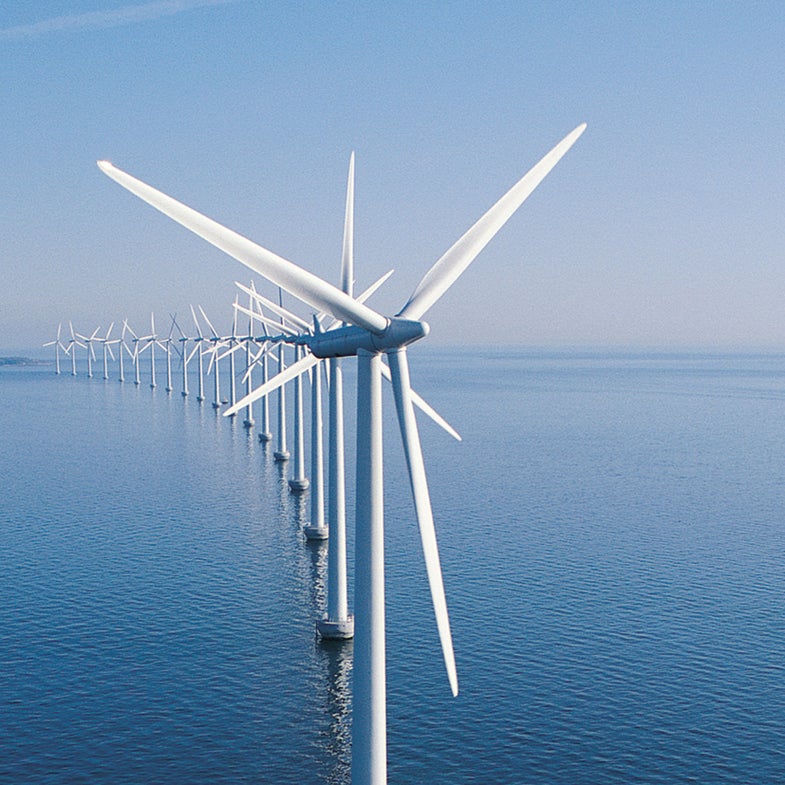
Offshore Wind Power A European supergrid could enable easier sharing of offshore wind power. Siemens

Offshore wind power may soon cross national boundaries more easily than ever, based on news from the Copenhagen climate summit. Nine European nations announced plans for a "supergrid" in the North Sea that would allow them to connect Irish wind farms to continental Europe, or vice versa.

No funding figures have emerged just yet, but the project could help Europe reach its goal of getting 20 percent of its electricity from renewable resources by 2020. Green, Inc. reports that offshore wind power currently makes up just 0.3 percent of Europe's electricity use, compared to Denmark's 4.5 percent of electricity from offshore wind farms.


The North Seas Countries’ Offshore Grid Initiative includes Denmark, Germany, France, Belgium, the Netherlands, Luxembourg, Sweden and Ireland. A supergrid connecting all those nations might not only create a wider electricity market, but also encourage offshore wind power development.

European nations such as Norway have begun installing deep-water wind turbines that could expand the current offshore wind farms. U.S. companies such as GE have also begun investigating gearless wind turbines that could find an offshore home in Europe.

[New York Times]

15 Comments

Cuase nothing says your on a top noch cruise ship like passing by the wind farms at sea!

Since wind is the engine of the climate, how long do you think until we discover that wind energy is actually causing man made global climate change? If you picture the earth like a simple energy system, pulling a gigawatt out here and a gigawatt out there, no problem, its like burning whale oil for your lamps if you only have a couple of lamps in the country.

Start pulling terrawatts out worldwide now you have a problem. Now everyone has three whale oil lamps and is burning them every day. Now you have no more whales.

I can picture a generation or two down the line, and the same type of people screaming about co2 today, saying we must do something, anything, right now before we analyze it too much. Will find that their hurried and ill thought out ideas actually are destroying the planet for real this time. But of course they will just shift the blame, it wasn't us it was big wind energy making billions, we're too smart we'd never do anything that stupid, like whale oil lamps.

Its not that I'm against wind energy I like alternative energies and think we need to pursue them strongly I'd love to be off the grid. But I am against rushing into large scale change when we have no idea what's going to happen. Like taking medicine to cure one disease that gives you side effects you have to take another pill to cure. Let's figure it out right the first time and the consequences of our actions before we do it, thats all I'm saying. Remember there is such a thing as change for the worse.

On a slightly different note, this past summer there was an article about possible stuff being added to the white house, like solar panel, adjustable tint windows and various other stuff. One of the things was a squid-esk windmill that supposedly is coming out next year and is somewhat tiny and plugs right into an outside outlet and starts working for somewhere around $400. Does anyone remember this? Has anyone a link for it's web site?

It's winter in North America and it's cold. Go figure.

freudianslipnslide.blogspot.com

[Headline]

US..The Nation of One, Vows To Continue The "Need More Nuclear, Need More Coal, Need More Natural Gas" Argument While The Rest of The Modern World Moves Forward With Securing Future Energy Needs.

Film at 11.

In reply to the first post, I don't think I would mind seeing windmills on a cruise, if they meant that my country wasn't dependent on fossil fuels, especially imported fossil fuels. Wouldn't it be better to see windmills along the horizon, instead of a yellow-brown haze from the exhausts of a fossil fuel power station hovering over the land and sea?

In particular, I don't think the Dutch would mind the aesthetics of windmills, as they are part of their cultural landscape. Even the modern ones have a stark beauty, especially when you consider that they also symbolize a brighter and more sustainable future.

While I do not like our need for fossile fuels and do think we should look for alternative energy. I just don't think putting a bunch of windmills in the ocean and pulloting the ocean as solving anything.

1) Windmills are no more visual pollution than power lines, gas stations, house meters, or electrical outlets. The aesthetic arguments are weak at the best of times.

2) Windmills will not slow the Earth, vastly change weather, or anything like that. Let's face it, planet big - man small.

3) CO2. The ultimate enemy! Hardly. Where did all that coal come from? Plant and animal matter made from - gasp - carbon. All that corbon has been in the air at some point, putting it back out there will only open it up to being returned to circulation - good for plants, if not for O2 sucking beasts. Global warming? Increased ocean surface area and increased temporate lanmass - not good for coastal cities, harldy lifethreatening to humnity as a species. Might drive a few animals extinct - a drop in the bucket compared to the numbers wiped out by deforesting.

4) Windmills are a good idea when they give us cheaper renewable power, allowing us to conserve fossil fuels for tasks where it is more useful and necessary (jet fuel, etc).

By 2020, those windmills will be so much scrap metal. I expect and hope that long before then, FocusFusion.org will have distributed its generator design to manufacturers world wide, and power will be in production at under ½¢/kwh. Windmills, solar, and all the other insanely expensive and unreliable ways of making electricity will be economic roadkill. Good riddance.

Hey Oak what is the lifespan of the average windmill?

The average lifespan of a windmill is 20 years. The question is how do you define life span. Complete replacement or complete rebuild of components? The first means nothing reusable except as scrap for recycling. The second means that the blades have to be dismounted, inspected, repaired or replaced, the entire electrical power plant has to be dismounted, disassembled, parts repaired and/or replaced. Costing not more than half the cost of replacing entire unit and taking not more than half the time it would take to build a assemble a new windmill on site.

As to the question of environmental impact, local, regional or planet wide, there would certainly be local environmental impacts, from dead birds to minor local changes in weather. Planet wide impact would be less than burning of non-renewable energy sources. The long term shift to renewable energy sources is unavoidable. The best way to use non-renewable energy sources is create long term renewable energy sources, like hydroelectric power plants, capable of generating more energy than the energy consumed to create them.

Fusion power has several draw backs. Massive heat release, and the risk of massive explosions capable of killing tens of millions of people. A fusion reactor would be nothing more than a controlled hydrogen atomic power planet. All it would take is a well trained group of terrorists to convert a hydrogen atomic power plant into a hydrogen bomb. Plus it may be possible for just one employee of such a hydrogen atomic power planet to attack the weakest spot in the hydrogen atomic power planet to convert the hydrogen power planet into a hydrogen bomb. Renewables are the best safest choice for long term power generation for the Earth and for the Earth's Human population.

Beyond the wind power component here - it's nice to see European nations joining together to promote change. That's really the driver of this story. Europe is more progressive on these technologies because fuel costs are so incredibly expensive. I really don't understand the argument against wind. We've harnessed it for hundreds of years to power human life. Why not continue to do so. As for CO2 - we are burning more than what is naturally absorbed into our system in a shorter period of time. In a million years, the earth will take care of herself. We are just trying to survive for the next 100 years. Beyond that it's anyone's guess.

So have any of you guys changed the parts out of a windturbine on high seas? I'd bet cost would add up a bit different there.

Windmills are a good idea when they give us cheaper renewable power, allowing us to conserve fossil fuels for tasks where it is more useful and necessary (jet fuel, etc).
www.eprostateproblems.com/

What we need is end user technologies that use less power but do the same job.


138 years of Popular Science at your fingertips.

Innovation Challenges


Popular Science+ For iPad

Each issue has been completely reimagined for your iPad. See our amazing new vision for magazines that goes far beyond the printed page


Download Our App

Stay up to date on the latest news of the future of science and technology from your iPhone or Android phone with full articles, images and offline viewing


Follow Us On Twitter

Featuring every article from the magazine and website, plus links from around the Web. Also see our PopSci DIY feed


February 2012: The Future of Fun

Science is reinventing play, from extreme sports to gamification to ridiculous roller coasters to the playgrounds of tomorrow, and this issue is chock full of fun. Also, on a less fun note: Did global warming destroy my hometown?


circ-top-header.gif
circ-cover.gif
bmxmag-ps