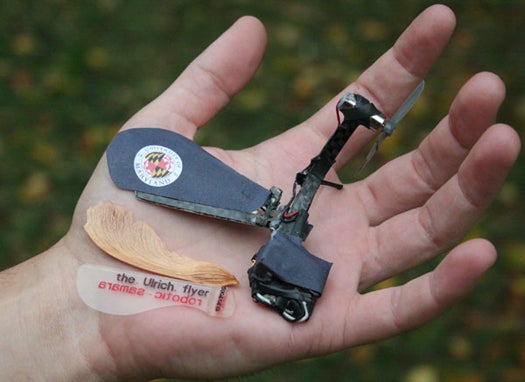
University of Maryland Monocopter via Bot Junkie

Last year, after untold millions of dollars, DARPA failed to renew a Lockheed program to design a UAV based on a maple tree seed. While that program, backed by tons of cash and one of the world's largest aerospace companies, amounted to bupkis, a University of Maryland project to create a maple seed UAV has finally accomplished what DARPA and Lockheed couldn't.

Over the course of about a year, the U of M students constructed a maple-seed-mimicking UAV, camera and all, from $500 worth of parts. The UAV can take off and land safely by itself, but the camera still needs a little work. It uses a battery to power a little propeller and a camera, and is piloted with a radio controller.

I think it's safe to say that the Lockheed version, a video of which can be seen here, cost a great deal more than $500. To see the University of Maryland UAV in action, along with a history of the project from conception, through testing, to completion, check out the video below. But ignore the music, it's a little over the top for a science project (what, no Carmina Burana?)


[via Bot Junkie]

9 Comments

It's going to be the next Ghost Recon's UAV I guarantee it.

-He who says it cannot be done, should not interrupt the one who is doing it.-

What i love is that it looks like something a 9 year old put together to go with his g.i. joes

To cool. It looks as if its perpetually crash landing.

very cool . how long is the flight time for that one . must be using small lightweight Lithium Polymer battery 1 or 2 cells . if it is Im guessing 8 minutes in the air .
Nothing stopping it being made larger to carry more go juice . Also needs the camera mounted on a swivel so it doesnt spin around like that so you can focus . I also bet in can auto-rotate to the ground with a good pilot haha

Nice engineering. I do wonder what the advantage is -- the small size? Not really discussed here or in the Lockheed article

what i think should be done about mounting a camera is either a 360 lens basically a camera pointed at the business end of a vortex shaped mirror. or one that just spins with it then generates a video out of all that is captured. but puting a swivel on it would seem like it would have some balancing problems...

the uses for it though are pretty cool, it's small and from the looks of it easily maneuvered so it could theoretically be used as an indoors uav. used by the common foot soldier, it would make going around corners a hell of a lot easier.

next to be seen, a program that makes the thing follow an rfid tag.

Advantages -

1) Cheap to mass produce.
2) Naturally self slowing in decline (no crashes)
3) Too small to shoot down
4) No propriatary tech in the bug itself, that would be in the software on the recieveing end.

Uses -

1) Plane drop thousands softwared together to present a real time 3d image of the battlefield as long as these things were hovering in the area.
2) Light, "just arround the corner" scouting.

Would it be possible to use a higher speed camera that takes pictures based on the rotational speed of the craft? Then you could have a feature on the remote control that allows you to change the frames captured per second until you get a clear picture.

Wow, hard to believe that a government supported corporation and an agency cannot engineer a simple design principle!!!
What is even harder to believe is that the design principle is more than 60 years old, I know because I have built similar aircrafts 25 years ago.
This is nothing new in the RC modeling world.


Download Our iPhone App

Stay up to date on the latest news of the future of science and technology from your iPhone with full articles, images and offline viewing


Follow Us On Twitter

Featuring every article from the magazine and website, plus links from around the Web. Also see our PopSci DIY feed


Become a Fan On Facebook

Share links with friends, comment on stories and more


December 2009: Best of What's New

In our December issue, Popular Science names the 100 best innovations of the year: bombproof wallpaper, self-parking cars, the fastest helicopter, and 97 more. Plus inventor profiles and videos.

Check out the best of what's new here.

Popular Science Photo Pool


Share your photos in the Pop Sci pool at www.flickr.com!
tags_sprite.png
POP_embeddedForm_cover_May09.jpg