
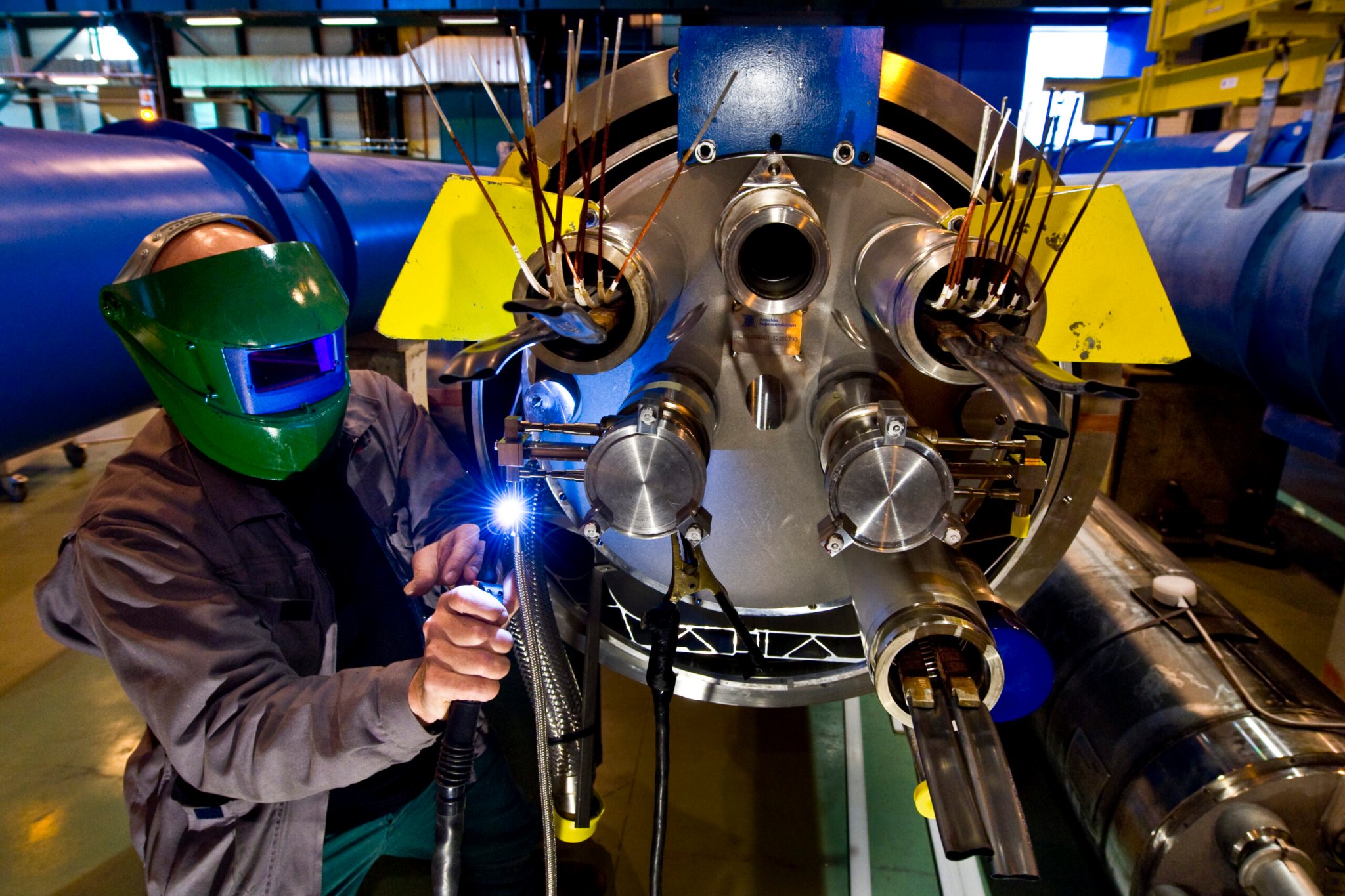
Over the weekend, Cern ran particle beams through the Large Hadron Collider for the first time since it was shut down last September. After a helium leak caused magnets to overheat, operations at the LHC were suspended for cleanup and repairs. After tests on October 23 and 25, scientists hope to have the LHC running again in full by November.
The LHC ring -- which measures 17 miles all around -- is divided into eight sectors, two of which were tested this weekend. Scientists introduced proton and lead ion beams clockwise and counterclockwise through the 2.2-mile-long sectors. Cern reported that results showed "a perfect functioning of the machine," in preparation for a fully circulating beam next month.
Superconducting magnets in the LHC function at a temperature of 2 Kelvin -- that's two degrees above absolute zero. Maintaining this kind of cold requires the use of superfluid helium, which in turn allows the electrical current to pass through without encountering any resistance, Cern's Christine Darve told PopSci.com. By sending the intense proton beams through what she calls a "moon vacuum," scientists are able to reap 100 times more energy than through a normal magnet.
By 2011, scientists hope to accelerate the proton beams up to 3.5 trillion electron volts, but this weekend they started out with just 450 billion. Collisions of the beams as they travel at near lightspeed may yield new particles, which scientists hope will provide clues about the Big Bang and the nature of the universe.While this may be possible in the future, scientists are now glad to see that the magnets, which are connected by six conductors capable of transmitting up to 13,000 amps each, are once again in working order.

The incredible innovations, like drone swarms and perpetual flight, bringing aviation into the world of tomorrow. Plus: today's greatest sci-fi writers predict the future, the science behind the summer's biggest blockbusters, a Doctor Who-themed DIY 'bot, the organs you can do without, and much more.


Online Content Director: Suzanne LaBarre | Email
Senior Editor: Paul Adams | Email
Associate Editor: Dan Nosowitz | Email
Assistant Editor: Colin Lecher | Email
Assistant Editor: Rose Pastore | Email
Contributing Writers:
Kelsey D. Atherton | Email
Francie Diep | Email
Shaunacy Ferro | Email
Big Band? Really, I hadn't found a correlation between Glenn Miller and Particle Physics.
Should state "nearly the speed of light". Popsci; making stuff up as usual.
okay, dude if you hate popsci and there articles so much (which yeah do if your going to take such as shot at them), then why do you read it?.....either say something constructive or say nothing at all
I never said I hated PopSci; so I am not sure how you came up with that. I just think that reporting the truth is better than reporting something that sounds more spectacular than the truth.
It is theoretically impossible to make matter go the speed of light. It would take more matter than is available in the observable universe to make a single proton go the speed of light. PopSci, with Sci being for Science should know that.
BTW: I think you meant "you do" instead of "yeah do", and "there articles" should be "their articles".
Nit picking, but I doubt Cern is generating electricity as it states in the picture caption, expect they are conducting it instead.
Check your information 3DTOPO, you have your facts wrong.
Absolute:
And they're probably referring to losses *from* heat.
That's true - I meant to say "take more ENERGY than is available".
The faster matter travels, the more mass it contains, which in turn requires exponentially more energy to go faster. To make matter actually go at the speed of light (in a vacuum), it would take more energy than is available in the entire observable universe.
You are both right. E=mc².
Einstein showed that matter and energy are different aspects of the same thing. Mass is a measure of energy content.
It has been shown through countless experiments in the past 100 years that Special Relativity's predictions pretty much hold out. Special Relativity states that particles of any mass, no matter how small, cannot be accelerated to the speed of light. As the velocity increases, relativity states that its relative mass will increase -- requiring much more energy to accelerate it any faster. Eventually, to reach the speed of light, it will require an infinite amount of energy since its mass will be infinite.
That's shown by the Lorentz Equation:
M_relative = M_rest / √( 1 - v² / c² )
As v approaches c, the denominator approaches zero. So, M_relative approaches infinity.
Whatever gaffs got by the PopSci editors, the fact that the worlds largest experiment is slowly building up to full capacity -- finally! -- is really the point.
Don't go crazy at me for asking since i'm not familiar with the theory but I was wondering, if for einstein's theory the more energy you use to move something faster, the more mass it gets, I wonder how that would work when it gets so massive that it has the same gravity as a black hole? Would that mean that the black hole is moving super fast or would it just suck up the energy that is making it move? And then if because it took in the energy it slowed down would it stop being a black hole and downgrade in mass? Just an interesting thought that i wanted to voice.
how would during the first few seconds of the big bang, matter violently expand, undoubtedly at faster than light speeds....i wonder if someone here knows what einstien thought of that....or was this only discovered when microwave background was scanned for the first time?
Scientists can rerun their experiments and their results may go one way or the other. However, there is a way to see if the speed of light is constant or not; whether e=mc2 is right or not, and that is to go back to the original equations of special relativity and see what they teach from the basic lorentz equations and the derived e=mc2....
http://www.relativitycollapse.com/speedoflight.html
http://www.relativitycollapse.com/e=mc2.html