Feature
Armed with better batteries and stronger materials, new submersibles aim to go deeper than ever before and open up the whole of the unexplored ocean to human eyes

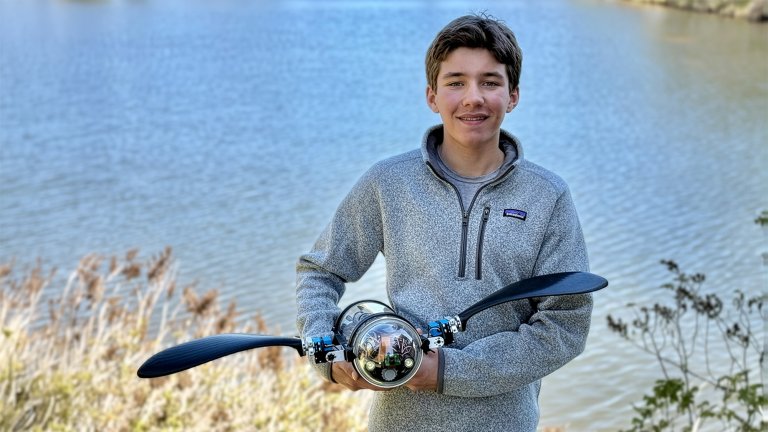
Flying Low: The Deep Flight II sub uses stubby wings that propel it down like an airplane goes up.  Nick Kaloterakis
By liberal estimates, we’ve explored about 5 percent of the seas, and nearly all of that in the first 1,000 feet. That’s the familiar blue part, penetrated by sunlight, home to the colorful reefs and just about every fish you’ve ever seen. Beyond that is the deep—a pitch-black region that stretches down to roughly 35,800 feet, the bottom of the Marianas Trench. Nearly all the major oceanographic finds made in that region—hydrothermal vents and the rare life-forms that thrive in the extreme temperatures there, sponges that can treat tumors, thousands of new species, the Titanic—have occurred above 15,000 feet, the lower limit of the world’s handful of manned submersibles for most of the past 50 years.

Now engineers want to unlock the rest of the sea with a new fleet of manned submersibles. And they don’t have to go to the very bottom to do it. In fact, only about 2 percent of the seafloor lies below 20,000 feet, in deep, muddy trenches. If we extend our current reach just 5,000 feet—another mile—it will open about 98 percent of the world’s oceans to scientific eyes.

The payoffs could be huge. Mining companies hope to search hydrothermal vents for minerals like nickel; gas and oil companies are eager to explore the seafloor for new energy sources; and marine biologists want to study how climate change has affected deep ecosystems. In addition, there’s simple curiosity of the man-versus-nature sort. With all the world’s highest peaks summited and both poles trampled, the deep seas are a ripe frontier.

But sending a vehicle that deep requires serious cash and engineering. The craft must be small enough to move on battery power and sturdy enough to withstand immense pressure—10,340 pounds of water per square inch at 23,000 feet, equivalent to having a school bus on your head. A manned submersible has to meet even higher standards: It must keep its occupants alive.

In 1960, American naval lieutenant Don Walsh and Swiss engineer Jacques Piccard made the only expedition to the world’s deepest point, piloting a 50-foot, submarine-like vehicle called the Bathyscaphe Trieste 35,800 feet down to the bottom of the Marianas Trench. They spent 30 minutes on the bottom of the world before surfacing with their glass viewing ports cracked by the pressure. No one has been back since.

And should they? There’s a heated debate among oceanographers over whether the next generation of deep exploration should be performed by robots, humans or both. The argument for remotely operated vehicles (ROVs) is led by oceanographer Robert Ballard, who gained fame in manned subs, discovering the first hydrothermal vents and exploring the wreck of the Titanic. His case is simple: With no power-sucking life-support systems, ROVs offer more time on the ocean floor—and therefore, more opportunity to explore what we don’t know—than manned subs. The robots send high-definition images and video to a ship by fiber-optic cable. The ship then sends the data via high-speed fiber-optic lines to a series of command centers, where oceanographers can analyze results in real time. “I’m interested in bottom time, not the spiritual experience of diving,” Ballard says.

Others argue that collecting samples from the seafloor is easier when a person is in the pilot’s seat, and that no machine can replicate the panoramic scope of human vision. In 2004, celebrated oceanographer Sylvia Earle was in a sub 1,400 feet deep off the Florida Keys when, out of the corner of her eye, she spotted a six-foot mola mola, an ocean sunfish previously thought to live only near the surface. Earle is the most prominent of many advocates for manned research, and she boils her case down to a neat metaphor: “Would you send a robot to taste wine in Paris?”

The Coming Subs

Today only five manned subs can dive to 15,000 feet: the French Nautile; two Russian submersibles; Woods Hole’s Alvin, which Ballard used to explore the Titanic; and the Japanese Shinkai 6,500, the world’s deepest-diving sub, which is capable of descending to 21,000 feet. (The Chinese government is reportedly working on a similar sub that would reach 23,000 feet.)

These vehicles all function in a similar manner. A support ship drops the vessel overboard. Anchored with weights, the sub begins to sink. To do some exploring in the middle depths, the pilot cuts some of the weight and the vehicle hovers, pumping water in or out to achieve a weight equal to that of the surrounding sea. Battery-powered motors propel the craft laterally for a short time, the ballast system takes on more water, and the craft sinks to the bottom. After scientists explore the seafloor and pick up samples with robotic arms, the pilot cuts the remaining anchors, and the sub surfaces.

This elevator-like model works, but because the vehicles house people, electronics and motors within pressure-resistant, spherical titanium hulls, they’re heavy—Alvin weighs about 36,000 pounds—and require enormous support ships. And because of the limitations of battery technology, traditional submersibles don’t give scientists much time on the seafloor; the Alvin’s current floor time is four hours. As a result, manned deep-sea exploration is incredibly inefficient. Imagine exploring all of Africa with only five Jeeps.

The story continues on the next page, followed by a closer look at Alvin and Deep Flight II.

single page
Page 1 of 4 1234next ›last »
Want to learn more about breakthroughs in electronics, medicine, nanotech, and more?
Subscribe to Popular Science today, for less than $1 per issue!

4 Comments

These "flying" subs are amazing and will lead to opening up the oceans for human expansion. fti- I do not believe that exploration should be performed only by robotics, we need the human to evalute all those new discoveries that robotics will just miss.

Robots are great but they will never have the intuition of a human. That intuition accounts for a substantial amount of discovery and survival. PopSci, this is an awesome article. Someday you'll be writing about me in my submersible.

Why are we looking for more energy sources on the sea bed? We already know of hydrothermal vents putting out huge amounts of usable power in fairly convenient locations. We need to get serious about replacing the oil economy, instead of just casting around for still more options.

Graham is right. A trip on Alvin is going to be immensely expensive (think of the size of the support ship needed -- try 10K or more per day for operation!), and cover very little territory. Many instruments are now very small -- acoustic current profilers, temperature, salinity, pressure, and nutrient sensors, etc., and various camera and bottom mapping systems are important tools that could fit easily on this machine. For a marine scientist such as me, this would be a dream tool. Unfortunately, nowdays a large gov. project budget is 500K. One would need several million to pay for this.


June 2013: American Energy Independence

Five amazing, clean technologies that will set us free, in this month's energy-focused issue. Also: how to build a better bomb detector, the robotic toys that are raising your children, a human catapult, the world's smallest arcade, and much more.


Online Content Director: Suzanne LaBarre | Email
Senior Editor: Paul Adams | Email
Associate Editor: Dan Nosowitz | Email
Assistant Editor: Colin Lecher | Email
Assistant Editor: Rose Pastore | Email

Contributing Writers:
Rebecca Boyle | Email
Kelsey D. Atherton | Email
Francie Diep | Email
Shaunacy Ferro | Email

circ-top-header.gif
circ-cover.gif
bmxmag-ps