Heeding a suggestion from one of our readers, let's follow up on our discussion of artificial gravity. As we described last week, although the film Armageddon attempts to portray artificial gravity aboard a rotating space station, it does not take into account the fact that unless the radius of the station is very large compared to the height of a person, anyone on board will feel significantly different forces acting along the length of their bodies. The result: nausea, vomiting, dizziness, disorientation, and nothing similar to the sense of gravity as we experience it on Earth.
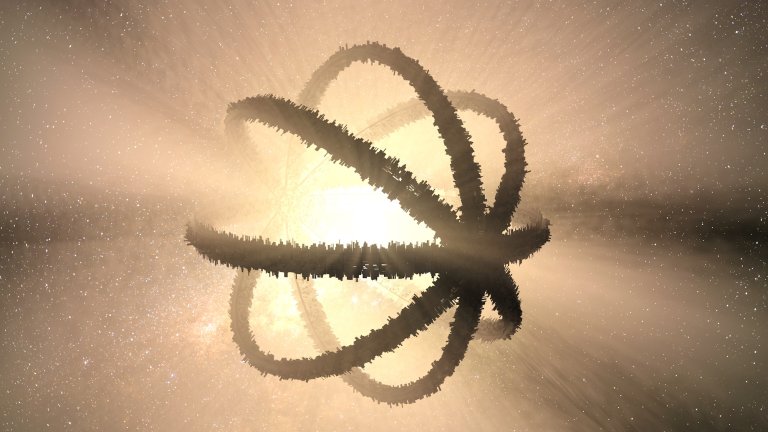
To contrast the slipshod action-adventure science that we are subjected to in Armageddon, we've included a clip from the sci-fi classic 2001: A Space Odyssey which, despite the relatively incomprehensible final 30 minutes, is not only a visually beautiful film but stunning in its efforts to incorporate some beautifully accurate physics into the action. It is worth mentioning that, aside from the occasional musical soundtrack, the film is one of the only "space movies" I've ever seen that actually portrays the absence of sound in the vacuum of space. But today let's focus on that rotating space station.The first thing we notice is that the space station is really big, and in the artificial gravity business, size does matter. The radius of the rotating station is large enough that any difference in rotation rate between the feet and head of an inhabitant will be negligible, and thus they will experience the sensation of gravity evenly throughout their bodies. It's no accident that the living areas (where we see all the windows) are on the outside rim. If you were to move along one of the spokes towards the center of the station (to make repairs, for example) then your centripetal acceleration would gradually decrease, along with your experience of artificial gravity. When you arrived at the center you would feel weightless.
We can see this expressed mathematically in the equation for centripetal acceleration:
ac = v2/r = ω2r
where v is the tangential speed, and ω is the angular speed of the rotating station. Because angular speed is the same everywhere along the radius, we can see from the right-hand term that as r approaches zero so does the centripetal acceleration.
However, we want our ac to be equal to g -- the acceleration due to gravity on Earth (9.8 m/s2). Let's do a quick movie-physics calculation to estimate just how big the station might be. Because the scene is so long and visual, we have plenty of time to estimate the rotation period: about 60 seconds. This gives us an angular speed of ω = 2π/t = 0.01 radians/sec. We can then determine the radius necessary at this rate of spin to produce a centripetal acceleration of g at the rim of the station. We get:
R = a/ω2 = (9.8m/s)/(0.01s)2 = 980 meters, which is about the length of ten football fields.
Congratulations to Stanley Kubrick and 2001 for the excellent, imaginative, and accurate demonstration of the principle of artificial gravity in the movies!
Adam Weiner is the author of Don't Try This at Home! The Physics of Hollywood Movies.
Stay up to date on the latest news of the future of science and technology from your iPhone with full articles, images and offline viewing
Featuring every article from the magazine and website, plus links from around the Web. Also see our PopSci DIY feed
Share links with friends, comment on stories and more
In our December issue, Popular Science names the 100 best innovations of the year: bombproof wallpaper, self-parking cars, the fastest helicopter, and 97 more. Plus inventor profiles and videos.
Check out the best of what's new here.
Re 2001: The film-making was Kubrick's, the science was by the film's corroborator & screen writer: physicist & author Arthur C Clarke.
Coincidentally, I watched parts of 2001 last night on blu-ray. (Yes, I fast-forwarded at the end!) A true elegant sci-fi audio/visual delight. I adore Clarke, but had to smile at a couple things he got wrong: the slow plodding walk on Velcro boots and floors vs. the reality of the current ISS astronaut's effortless pirouetting. And the non-necessity of the women's hair bun's. I find the free flowing hair of the ISS woman astronauts quite beautiful!
from coral gables, fl
If you have a problem with the last 30 minutes of 2001 a space odyssey you clearly haven't dropped enough doses. I bet if you were watching that scene in the 1960's it would have blown your mind
Those "hair buns" were helmets. And might not be such a bad idea.