For more photos from the set of Numb3rs, click ‘View Photos’ at left
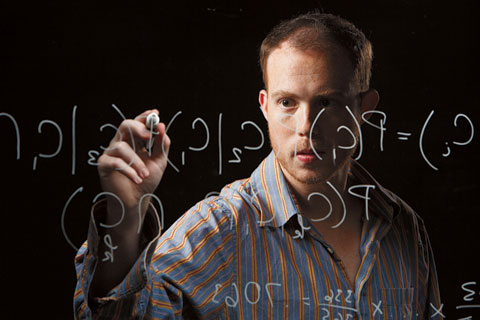
Andy Black doesn’t set an alarm. His mind, bubbling with mathematics, wakes him before the sun rises over Pasadena. Ignoring six days’ worth of red stubble, he drives to work in a 2003 Acura that looks, inside and out, brand-new. It’s a short drive to the spacious academic office where he works. There’s no one else in the building yet, which suits Black just fine; later, when the place fills up, people will be incessantly bugging him with math questions. He gets right to work, striding to a blackboard and briskly chalking a maze of arbitrage equations. The math is perfect.
At 32, Black is younger than his colleagues, but they rely on his mathematical prowess. Questions on conjoint analysis, orbifold supersymmetry or Dijkstra’s algorithm? Andy’s their man. On the precision of his blackboard equations rest their reputations. Possibly their jobs.
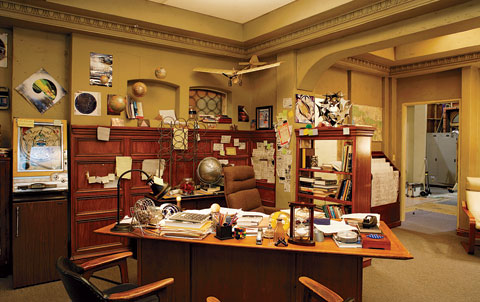
But here’s the thing: Black doesn’t really understand the equations. He’s copying the squiggles off a sheet of paper. And the office? It’s on a soundstage; the blackboard is part of a set. Black’s colleagues are the writers of Numb3rs, a television show about a genius who uses math to help his FBI-agent brother solve crimes. Black is the writing staff’s researcher. Now in its third season, Numb3rs airs on CBS, Friday nights at 10. Eleven million people tune in each week, enough viewers for the show to reliably triumph in its time slot, even over Law & Order, which moved into the neighborhood this year.
Just in the past few seasons, this
science-in-drama formula has flooded prime time, in the forensic-detective CSI troika, the medical-misanthropy fest House, the terror-tech showcase 24, the forensic-anthropology skein Bones, to name a few. Most of the shows enjoy even larger audiences than Numb3rs. For the studios, the marriage of science and drama has become a notably fertile one.
Still, science and drama are tense bedfellows. Warm emotion chafes cool constraint. Infinite possibility muddies precision. Left unchecked, most writers will wantonly sacrifice scientific accuracy for dramatic heat. Yet, counterintuitively enough for a medium long derided as the “boob tube,” the accuracy actually seems to matter to viewers, so much so that shows hire researchers whose entire job is to help maintain scientific verisimilitude. Like good marriage counselors, they listen to the story’s dramatic needs, explore the factual science, and work to find common ground. A man who lets his beard run wild but keeps a crumbless car-who melds chaotic creativity with precise discipline-is, it turns out, the perfect sort of man for the job.
ER + CSI = $$$$
This season, on the big four networks alone, there are at least 15 successful prime-time dramas in which science, medicine or technology play a defining role. That’s unprecedented. Across all 10 seasons of the 1990s, the networks mustered only 10 science-based shows.
If you conduct an epidemiological investigation into this outbreak, searching for Patient Zero, you will find yourself in a hospital ward in 1994, when ER made its debut. The anchor to NBC’s erstwhile must-see Thursday lineup has been on the air for so long, and its conventions have become so commonplace, that it’s easy to forget just how groundbreaking it was when it first aired.
At the most basic level, ER refo-cused the medical drama from patients to practitioners, explains Neal Baer, who wrote for ER after getting his medical degree at Harvard. But what that meant in practice was that characters spoke in authentic (and often incomprehensibly technical) jargon and spent significant screen time dwelling on the details of diagnosis and treatment. Astonishingly, viewers lapped it up. “Viewers like to be taken to a place they’ve never been before,” Baer says. “ER had cultural minutiae that were very flavorful and fresh.” (Heaping helpings of George Clooney presumably didn’t hurt.) And in a departure from then-standard
television-production practice, the details were supplied by a writing staff studded with actual doctors, beginning with lapsed M.D. Michael Crichton.
ER showed that you could play to an audience’s intellect-cram a procedural drama with accurate and arcane science and technobabble-and flourish. Then, in 2000, something happened that seems to have convinced television producers not only that they could do such a thing, but that they must. CSI happened. On most police series, the forensics guy would pop in, make a dark joke about the dead, and leave, his experiments kept largely offscreen. CSI put the lab work up front-and it became a runaway number-one blockbuster. Its success (today it reaches more than 20 million viewers) sent scientific seismic waves through the business. CSI spawned Miami and New York clones, and other shows immediately began to amp up their scientific bona fides. Law & Order: SVU, which Baer now runs, took its psychologist and coroner characters from the margins and made them central to every episode.
Six seasons later, science has made a nearly complete transition from stumbling block to selling point, says David Stapf, the president of CBS Paramount Network Television, the studio that makes Numb3rs and CSI. “We hear pitches all day long that 10 years ago I would have said, “Is that sexy enough?’ Back then, somebody in a lab coat didn’t seem like someone interesting.” Now the sexy icons of prime time are more likely to wear lab coats than swimsuits.
This fall, when the slick new Ray Liotta thief show Smith was euthanized after just three episodes, CBS replaced it with 3lbs, a series about a neurosurgeon (played by Stanley Tucci). 3lbs creator Peter Ocko speaks passionately about how central science is to his show’s appeal: “We found in our testing that CSI changed the demographic. People have become very science-literate, and they expect to learn something when they watch TV. They say, “Hey, a brain show! I’d love to learn about being a brain surgeon.’ ” To ensure that what we learn is accurate, Ocko employs two full-time researchers and has a neurosurgeon adviser on the set.
Which raises the obvious question: Why bother? Of all the people who watch 3lbs, the vast majority know exactly squat about brain surgery. In a couple dozen interviews this fall, I posed the “why bother” question to TV veterans, whose answers all played around a similar theme. As House creator David Shore put it, “If the science is wrong, we lose all credibility, and we’ve got no show.”
Set walls are thin, Neal Baer points out, and if somehow the camera were to catch the thin edge of the set or expose the bare plywood on the back side, the audience would stop suspending disbelief. It’s the same with thin science writing. Hollywood television writers credit the American public with good noses for sniffing out baloney. So the science must also look and sound real. “You don’t want to give them a line like, “There’s an aberration in the flux modulator,’ ” says Hart Hanson, the creator of Bones.
But let’s be clear: Television dramas aren’t after documentarian accuracy. They’re after verisimilitude. Science documentaries strive for total accuracy yet have a tiny fraction of the viewership of prime-time dramas. The dramas command vast audiences because, above all, they tell compelling stories.
Black does not, therefore, dictate real-world math to the Numb3rs writers for them to type up as a reporter might. Rather, the writers-hired for their creative chops-decide where they need math for story purposes. This makes Black’s job in some ways harder than the mathematicians’ whose results he simulates. He must reverse-engineer math to meet the story’s needs while maintaining the credibility of verisimilitude.
Emblazon it in lights on the marquee-the order of all things Hollywood is: Story first, Story first, Story first. It’s true on all science shows, even House, where the medical mystery figures so prominently. Writers typically begin with a character or emotional arc. Then they look for a good malady. It can require extensive research to find a slice of science that fits a story like a puzzle piece. Sometimes you have to jam it in.
And so, for all the efforts of researchers like Andy Black and the M.D. writers, for all the producers’ insistence that the science be accurate-a sincere insistence, I believe-“scientific accuracy” is a protean term in dramatic television. Some things get fudged, a lot gets foreshortened. And sometimes they nail it on the head.
MATH + SEXINESS = !!!!
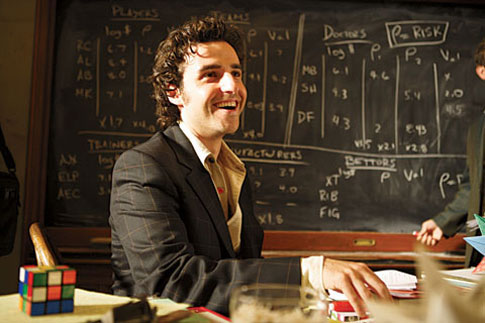
In every episode of Numb3rs, genius mathematician Charlie Eppes (David Krumholtz) helps his FBI-agent brother Don (Rob Morrow) catch a criminal. Usually it’s a serial robber, rapist or murderer who’s about to strike again. Don, at an impasse, asks Charlie if he has any mathematical solutions. This being episodic television, Charlie always does. He covers his board with equations (enter Andy Black, before the cameras roll, chalk in hand). In the end, Black says, “the criminal is straitjacketed by Charlie because math is persuasive and final.”
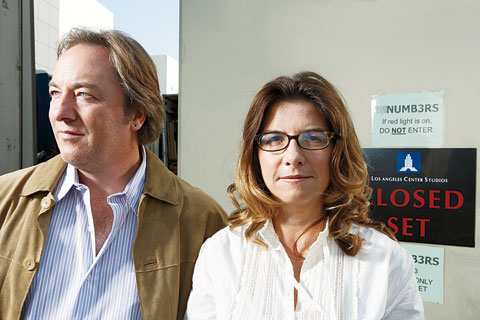
Wife/husband team Cheryl Heuton and Nick Falacci created Numb3rs after years of selling movie scripts that were never made. “The moment I knew this could work was in the summer of 2002, when we were on vacation in Maui,” Heuton says. “I was reading Michael Frayn’s play Copenhagen, which I found both intellectually rigorous and incredibly moving. I thought that if Frayn could make a conversation between two physicists more than half a century ago so powerful, surely we could manage a compelling TV show built around a mathematician in the far more commercially accessible world of TV crime-solving.”
From the show’s conception, they wanted Charlie to use real math. In the pilot, he writes equations to zero in on a serial rapist’s residence, based on the geographical pattern of his strikes. Called “geoprofiling,” this is a real-world technique developed by Texas State University professor Kim Rossmo. To describe geoprofiling, Charlie uses the metaphor of a lawn sprinkler. If you knew where several drops of water from the sprinkler fell, he explains, you could write equations that showed where the sprinkler is. So if you know where the rapist strikes, you can eventually determine where he lives. As Charlie speaks, equations appear in a scrawl on the margins of the screen, and in the main image the audience sees a real lawn sprinkler. Slow-motion drops of water arc through the air, and when they land, they morph into spots on a map. Finally, we move back to the sprinkler, which has become the location of the killer’s home. This is the first example on the series of what the show’s creators call “audience visions,” and it’s pretty cool. But come on. Math lectures? On prime-time television?
Even in post-CSI Hollywood, the idea seemed to go too far. CBS executives feared that viewers would flash back to high-school trig and flee; they urged the writers to minimize the math. Luckily, a focus group previewed the pilot and ratified the concept. “When Charlie started talking about math, the dial scores cranked way up,” Heuton remembers. “But in the crime sequences, they went back to, “Eh, I’ve seen this before.'” In a discussion session afterward, the audience agreed that they would watch the show again. When asked why, the unanimous answer was “For the math.”
Which left only the nettlesome challenge of filling those audience visions with real math every week. Gary Lorden, a Caltech mathematician, had been brought on as an adviser, but with full-time academic duties, he couldn’t attend to everything. Heuton tapped the back-channel Hollywood-researcher network and found Black, who was then doing legwork for Crossing Jordan, a show about a medical examiner.
“The first week I was scared to death. I had only gone through differential equations in college,” Black says. Numb3rs employs 10 writers, each of whom writes two or three scripts a season. (Black, who is not officially on the writing staff, will also get to write one.) At any given time, some writers are outlining, others are “on script.” One is shooting his episode, and two or three are in postproduction. Black has to help them all at every stage.
He contracted four math consultants at Wolfram Research, the creators of Mathematica, the standard professional software for math and technical computation, and Black spent hours every day reading math-oriented books and magazines and Web sites. He interviewed dozens of mathematicians. Two years later, he can speak intelligently about most math subjects. When he can’t, the answer is usually no more than a phone call away.
50 EPISODES x NOVELTY = GENIUS AS SUPERHERO
In late September, Numb3rs writer Don McGill outlined “Killer Chat,” the episode set to air on December 15. In it, Don and Charlie track down a serial killer of male victims. Black listened to the twists of plot McGill was crafting and offered several math applications Charlie could use.
First was multi-attribute compositional modeling, a regimen of equations that makes a numerical profile of a complex phenomenon. Originally developed in the 1950s in mathematical psychology to make personality profiles, the equations’ utility was expanded in 1971 by Wharton School of Business professor Paul Green, who adapted them to analyze financial markets. Black suggested it for a scene in which McGill wanted Charlie to study a set of crime scenes; they’re all empty houses for sale, but the FBI can find no further commonalities. Maybe Charlie could crunch the numbers and uncover a pattern that would reveal something about the nature of the killer.
At this point, McGill knows precisely what he wants Charlie to do, and Black has just a vague notion that his proposed math application might work. It’s only meant to be a placeholder while McGill writes. If Black were to prescribe something too specific, he’d constrain McGill’s creativity (again: Story first). Once a script is done, Black sends it to his mathematician-consultants, who recommend changes to Charlie’s approach and also supply the proper equations for the blackboard and the audience-vision graphics.
The show has a few rules about the use of math. For starters, Charlie won’t use the same device twice. (Principal-components analysis might be better at profiling houses, but they used it last year.) That means that, after 50 episodes, Charlie’s got a mighty big toolbox-much bigger than any single real-world mathematician would have. “Most working mathematicians are quite narrow in their focus,” Falacci says. Early in the series, the math advisers pointed out that it would be more realistic if Charlie called in an expert or two each week. But in television, audiences like the show’s problems to be solved by the hero, not some day-player they’ll never see again. “Charlie has to be a superhero in his breadth of knowledge,” Falacci says.
As a superhero, Charlie often applies mathematics developed for a different problem than the one facing him. Multi-attribute compositional modeling isn’t used for houses. Charlie has to improvise, Heuton says, because there aren’t enough validated crime-solving math applications to cover all the show’s episodes. She argues that such improvisations are in keeping with the spirit of math. “Mathematics is just a language-a language that’s fundamental and universal-and if you’re smart enough, you can do anything with it.”
Later in the episode, Charlie determines that all the murder-scene houses are in “hot zones,” where Megan’s Law predators are prohibited near schools and playgrounds. This finding bolsters the FBI agents’ suspicion that the serial killer’s motive is to punish child abusers (a suspicion they couldn’t confirm because none of the victims had adult criminal records). The math Charlie uses here is actually geoprofiling, Black says, but, cheating the no-repeat rule, they don’t call it geoprofiling on the show.
Geoprofiling has its critics. With data sets from only a few crimes, it’s hard to draw statistically strong conclusions. Numb3rs hears the same criticism from mathematicians. Charlie frequently comes to precise conclusions using scant data.
A related sleight of hand is time compression: Charlie solves huge problems in short order. On CSI, tests come back in hours; in real life, they would take weeks. “We get bagged on a lot for that,” says CSI executive producer Naren Shankar, possibly the only writer in television with a Ph.D. in applied physics. (Shankar’s first Hollywood job was as a science researcher for Star Trek: The Next Generation.)
“If you want to mock us, go ahead,” says Hart Hanson, who created Bones. “In television, we compress 10 steps into one.” To maintain dramatic appeal, writers must distill a story down to its most important events. In real life, lawyers sit and read in silence for hours. Most cops pass the day either making endless phone calls or driving in circles. Marriages can go for years without much in the way of drama. But the mundane details of reality don’t make for good television.
HOLLYWOOD + MATH = EYE-ROLLING EXPERTS
In the middle of “Killer Chat,” the FBI discovers that the murderer is luring victims to the empty houses by posing as an underage teen in online chatrooms. To cover his tracks, he employs “onion routing,” a sophisticated real-world hack that uses randomly selected servers to obscure routing information. At this point, McGill wanted Charlie to use a “trawling algorithm,” a cryptographic net to catch the killer’s true online identity. It’s an idea that has no mathematical basis, says Wolfram consultant Eric Weisstein. It comes straight from the writer’s imagination. Despite the dictum that the math be real, this objection caused Black only minor alarm. He had begun a weeks-long conversation with Caltech computer-science professor Steven Low, who was helping him come up with mathematics that, Black says, “could plausibly work” as McGill’s trawling algorithm.
Although Black looks first for math as it actually works, he sometimes has to create solutions that are math as it could plausibly work. This is the talent that makes him indispensable. Hollywood researchers are most valuable when they make the science work for any story. It’s no surprise that Black sometimes fudges it a bit.
After the first few episodes aired in 2005, Stanford University math professor Keith Devlin wrote a column for the Mathematical Association of America entitled “Numb3rs Gets the Math Right.” Except, of course, when it doesn’t. “In some episodes, the math is totally gratuitous and spurious,” Devlin says. Helping to track a fugitive through the mountains, Charlie uses 18th-century mathematician Leonhard Euler’s classic Konigsberg-bridge problem (which proved that it was impossible to circumnavigate the German city using each of its bridges only once) “as an inspiration” for the equations he uses. Mathematicians gave a collective eye-roll.
Generally, however, the math community praises the show. The series won the 2006 Carl Sagan Award for the advancement of the public understanding of science. Each week, Andy Black types up a memo about the episode’s math and sends it to a Texas Instruments”National Council of Teachers of Mathematics partnership, which creates study guides for instructors to teach the show’s math in their classrooms.
Watching the show, it’s obvious that Black is good at his job. Toward the end of McGill’s episode, FBI agents can’t determine the identity behind the killer’s chat-room avatar, but they have chat records from a group of identified suspects. Black suggested that Charlie make a mathematical model of the killer’s syntactical quirks; for instance, he always misspells “receive” and types “nuff” instead of “enough.” Assigning numerical values to these quirks, Charlie could find a match among the known suspects. It’s actual math: computational linguistic analysis, sometimes used to verify the authorship of typewritten suicide notes. And Charlie applied it appropriately, Weisstein says.
And from there, the show rises to a dramatic conclusion. The FBI, armed with guns and Charlie’s math, catch the killer (spoiler alert: it’s a woman) just before she kills again.
TURMOIL/TV = SCIENCE FASCINATION
By all indications, next season will top this one for the most science shows ever. CBS Paramount Network Television president David Stapf is developing a series about virus hunters from the Centers for Disease Control and Prevention. NBC bought a new hospital drama from Law & Order: SVU‘s Neal Baer in October. Audiences are clamoring for night after night of scientific lectures, and it all prompts the question: Why aren’t we glazing over?
Back in television’s ascendancy, during the nuclear stalemate of the cold war, the wildly successful Twilight Zone portrayed scientists as malicious. In the 1990s, as the economy boomed, interpersonal dramas like Party of Five and Melrose Place were the zeitgeist. In the post-9/11 era, it’s the certainty and world-weary confidence of shows like CSI that appeal. Says 3lbs‘s Ocko, “There’s so much turmoil in the world, unease about terrorism, economics, politics. Science proposes a way out. It’s a comfort.”