Your Second Life is Ready
Residents of one of the Internet's most populous virtual worlds shop, attend class-even run businesses. Soon you may do the same.

For an exclusive photo tour of Second Life, click here.
I’m standing in an airy train station surrounded by rolling, wooded hills. Distant sounds of birds and trickling water reach my ears over a low buzz of chitchat from the people around me. They have come from all over North America to meet here, and now they’re lounging on couches and standing in sociable little clots. Ballerinas are talking to men in body armor, while guys in suits show off their dance moves to aliens and ladies with wings. I try not to stare.
Or rather, a digital version of me called an avatar tries not to stare. I’m sitting at my computer, and my point of view hovers about three feet behind as I use the arrow buttons on my keyboard to amble toward the street outside. Next to me, a blue elf and a towering woman in a black cape tap on invisible keyboards that hover in the air. I can hear the click of the keys, and cartoon speech bubbles near their heads reveal that they’re discussing computer programming.
“Hi, I’m new here,” I type into a box at the bottom of my screen marked “chat.” When I “talk,” my avatar does the same keyboard-and-bubble routine. “I can tell,” says the woman in the cape. I’m wearing the generic outfit-jeans and a T-shirt-given to every new arrival here in Second Life, one of the biggest public virtual-reality spaces ever built online. Like the computer game The Sims, Second Life is software that enables you to guide your avatar through a 3-D landscape, chat with other avatars, and build objects with tools. But SL, as it’s known to its 300,000 members, or “residents,” isn’t a game. It’s more like an animated version of real life. There’s no way to win and no specific objective.
Launched in 2000, SL counts among its largest backers Amazon.com founder Jeff Bezos and eBay founder Pierre Omidyar. Today a session in SL usually means play: meeting new people (everyone who’s logged in is somewhere in the SL landscape), building a rocket, even having sexual liaisons in specially marked adult areas. But increasingly, people are logging on to work, shop, or go to class. Of course, the same thing could have been said about the Web 10 years ago. Like the Web, all but the basic infrastructure in SL is built by the people who populate it. Want a conference room where you can swap blueprints with a team around the world? Create one, and other avatars can come inside. Want to sell your band’s music? Build a jukebox, fill it with MP3s, and charge SL residents in Linden dollars (SL’s currency) to download them.
Mitchell Kapor, the founder of software pioneer Lotus, was the first outside investor in Linden Labs, the company behind SL. “Second Life is what MySpace wants to be,” he says. “People are inventing new uses for it all the time. And the e-commerce aspect of it is going to be huge.”
Although no major brick-and-mortars are doing business from within SL yet, they are taking note. The banking giant Wells Fargo built its own branded island inside SL, designed to train young people to be financially responsible. Wal-Mart, American Express and Intel are looking at using SL for their corporate training. And why not? With its natural interactivity and open platform for creation, Second Life, or something like it, may very well be the next generation of the Web. For example, if I was online banking in SL, I wouldn’t have to browse through several static screens of text. I could just walk into a virtual bank, stroll up to a teller, and deposit real-life money the newfangled, old-fashioned way: by talking to a person.
But before I do that, I need to learn how to dress myself and get around.
“Have some clothes,” the caped woman says, handing me a box. I click on a pair of red pants inside, but something goes wrong and I wind up crashing my new outfit. Just as I’m at my most confused, a guy with a skull for a face walks up and points his finger at me. Lights jump between my body and his hand. “I’m stealing your soul,” he explains.
Now I just want to get out of here. I push a button on my screen that says “fly.” Instantly, I’m hovering 50 feet above the ground, gazing down on an island that looks like Hawaii populated with characters from Star Trek. I check my (real-life) watch and remember that Ihave business to take care of. I’m meeting SL journalist Wagner James Au, who has spent the past three years documenting the evolution of SL in his blog New World Notes (nwn.blogs.com). Unfortunately, the meeting is in SL, and I have no idea how to get there. Then I see a message at the corner of my screen: Au is offering to teleport me there. I click “yes,” the screen goes black, and suddenly I’m standing on a lovely balcony overlooking the sea. Next to me is a man in a white trench coat. “Welcome to my office,” Au says. “Let’s go buy you some hair.”
We teleport to a shopping area called Midnight City, where the skies are dark and buildings glow with neon-lit virtual fashion items for sale. As I browse the goods, occasionally flying a few feet in the air to peek into second-story windows, I realize that the current Web has forced us into a cramped two-dimensional space that doesn’t quite capture the way humans naturally think, socialize, and, well, window-shop. Second Life could bring us back to the three dimensions where we belong.
Streaming a New World
A couple weeks later, I’m on my way to the real-life San Francisco offices of Linden Lab, nestled near the Bay at the edge of the city’s North Beach district. There are no elves here, but the woman who greets me does have blue hair. Inside, surrounded by tilted glass walls and wide-open workspaces full of toys, it’s hard to shake the feeling that I’ve walked into a weird outpost of virtual reality.
A guy with a giant smile and spiky gray hair who wears a familiar jeans-and-T-shirt combo pops out of his office to say hello. He’s Linden Lab’s CEO, Philip Rosedale. The resemblance between Linden Lab and SL is no accident, he tells me. He wants both to be social working environments, or what he calls “the perfect spaces for building things.”
Seven years ago, Rosedale left an executive position at streaming-audio company RealNetworks to launch a 3-D world where groups of people could gather “to realize their dreams and ideas.” At that time, there was a belief in the computer industry that only artists and game designers could create 3-D objects and so there wasn’t any point in setting up a virtual world based on the idea that ordinary users would build everything there. What those naysayers hadn’t counted on was the explosion in broadband adoption. Faster Internet connections allowed Rosedale and Linden Lab’s chief technology officer, Cory Ondrejka, to create a graphics system built on streaming images. That means everything you see in SL is coming to you live from Linden Lab computers. All the intense computational work is done before it reaches your screen, so SL can be ever-changing. This is completely different from most videogames, where everything you can possibly see has been predetermined and pre-drawn and is stored on a CD or cartridge.
Rosedale’s other big idea was to offer SL residents easy-to-use building tools to help them create stuff the way one might in programs such as Photoshop and PowerPoint. Rosedale’s plan worked, and SL quickly caught on with a broad demographic, not just twentysomething male ber-geeks. Today, there are as many women as men using SL, and the average age is 32.
An SL account is free; Linden Lab makes money selling land, on which users can keep the things they build. With residents building everything themselves, Linden Lab’s 100 or so employees are less world-creators than they are world-enablers. They have to maintain an environment that people want to be part of, which means a few ground rules. Residents who engage in harassment or destructive behavior can be kicked out of SL, and civic complaints are aired in regular town-hall meetings with Linden staff (held in SL, of course).
To spur development early on, Linden Lab offered financial incentives in Linden dollars to residents who created areas that became popular destinations. This laid the groundwork for SL’s now-thriving economy, which currently has an annual gross domestic product of $64 million (U.S. dollars). Residents buy and sell Linden dollars for real money (Linden takes a small cut of all currency exchanges) and can do a brisk business peddling everything from developed real estate to exotic body parts for residents who don’t want to design their own. There are at least 3,000 entrepreneurs making $20,000 or more a year on SL businesses; BusinessWeek devoted a recent cover story to Anshe Chung, who earns hundreds of thousands of (actual) dollars as SL’s biggest real-estate mogul.
Residents retain the intellectual-property rights to the things they build, even though the code stays on Linden’s servers. Ren Reynolds, a writer and consultant who analyzes virtual worlds, believes the strength of Second Life is that it combines almost limitless creativity with ownership. “It’s a hotbed of capitalism without restraint,” he says.
The next version of Second Life will be seamlessly integrated with the Web, making it easier for real-world businesses to sell items through SL. For example, a retailer like L.L. Bean could have a “door” to an SL store on its Web site, inviting people to jump from 2-D browsing into a 3-D saunter around, where an avatar with your exact measurements could try on clothes for you. Or a consumer-electronics company could offer in-person technical support from an avatar who had a precise 3-D replica of, say, that new digital camera you couldn’t figure out, and could show you which button you needed to push. As the wall between the Web and Second Life grows thinner, having an SL account might become as common as having an e-mail address.
Coffee Dates and Classes
For now, residents use SL mostly as a way of broadening their social lives. If you’re accustomed to talking with friends in chat rooms or instant messaging, jumping into SL is like moving from radio to television. Suddenly, your chats are enhanced with body language and atmosphere. Instead of emoticons, your avatar’s face displays basic emotions that you can choose from an onscreen menu. There are places to mingle with other residents: in hobby areas, dance clubs and at special in-world events. There’s also a thriving singles scene. Some meet for SL coffee dates before taking it into the real world, while others prefer purely virtual flings. (You can buy a naked body for your avatar if you want to try an adventure on the “adult-only” islands.)
Rosedale says the next frontier for SL is work, not play. In the past year, several companies have built replicas of their conference rooms in SL so that far-flung employees can meet and exchange information, and even collaboratively build prototypes of real-world projects. A company called Electric Sheep recently began selling its services as a kind of virtual architecture firm. Corporations and universities pay Electric Sheep to create office buildings in SL for meetings, events and special projects. Working in SL will only become more appealing as graphics become more detailed and SL adds voice chat, eliminating the keyboard-and-bubbles bit.
More than a dozen colleges are also experimenting with SL. At Montana State University, architect Terry Beaubois taught a class from his office in Silicon Valley using SL, flying out (on a real plane) to meet his students in person only every two weeks. SL is perfect for architecture, he says, because replicas of full-scale structures can be created and demolished in seconds; plus, “you can fly around and look at the buildings without any people in them.” A version of Beaubois’s classroom could become the standard for long-distance learning. Unlike Web-based classes, which are rich in content but low in back-and-forth interactions, SL classes can involve informal chatting and collaborative work on 3-D models of molecules, engines-anything.
The final step for SL is what residents call “mixed world” events: gatherings that take place simultaneously in SL and in the real world. At a conference earlier this year, Linden Lab threw a party at which attendees sipped beer and chatted next to a giant-screen projection of the SL version of the gathering, and a webcam streamed an image of the real party into SL. When people waved at the webcam, avatars saw it and waved back. People chatted across worlds, with small social groups forming around keyboards. There was a sense of immediacy in the communication-the screen on the wall was just another room into which the party had spilled over.
As SL broadens, imagine a similar mixed-world meeting of the United Nations, or a mixed-world congressional hearing. Citizens could do more than watch on C-SPAN; they could actually participate by lining up at virtual microphones to ask questions through their avatars. SL might enable the electronic town-hall meetings that the Internet has long promised but rarely delivered.
Creating a Coliseum
Now I’m full of ideas, and I’m itching to make something of my own. So James Au guides me to one of SL’s many “sandboxes,” designated areas where residents create objects that are wiped away every 24 hours. You can take your objects with you if you want to keep them.
“OK, let’s start with spheres,” Au types when we arrive on a vast plain where, far away, I can see some people making a racecar. Au waves his arm, and as if by magic, a giant sphere appears in the sand. We use a suite of tools similar to those in Photoshop to stretch the sphere, twist it, and give it color. Then I push a button that makes the shape solid. Now we can give it weight, or make it light and bouncy.
“Wow, that’s so cool!” I say. I’m ridiculously proud to have made a thing that looks like a blue lump. “That’s nothing,” Au replies. “A friend of mine built a Roman auditorium and slapped it down on her island.”
His story captures the present-day ethos of SL, where everything you can imagine can exist. But it also hints at what makes this virtual world a window onto the Web’s future. Not only is it a cool place to visit, but it’s a cool place to build things that other people will use. And it’s that urge to make, to expand, that helped the Web go from zero to ubiquity in less than a decade.
It reminds me of something Rosedale said when I visited Linden Lab: “In Second Life, you can get everything you want on the first day. What’s interesting is what you do the next day.”
Annalee Newitz wrote about electronic voting in the November 2004 issue.

by Courtesy Annalee Newitz

by Courtesy Jonhenry Righter

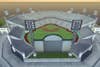
by Courtesy Electric Sheep

by Courtesy Jonhenry Righter

by Courtesy Jonhenry Righter

by Courtesy Wagner James Au

by Courtesy Jonhenry Righter

by Courtesy Jonhenry Righter

by Courtesy Jonhenry Righter

by Courtesy Jonhenry Righter