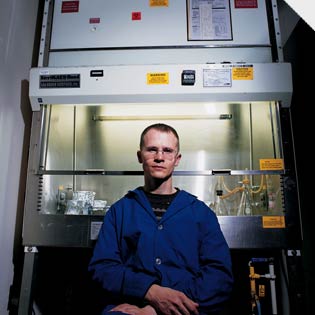
University of Connecticut grad student Tom Foral saved anthrax samples when he should have destroyed them. He faced prison and big fines; now he has a record that could squelch hopes for a military career. Photograph by Michael Duva

It’s impossible to miss the note of fear in the voices
of prominent American bio-scientists. Laws rushed onto the books after 9/11 introduced new criminal penalties for improper handling of potential bioweapon materials, and the first prosecutions have made it clear that the feds mean business. Section 175 of the USA Patriot Act, which sailed through Congress during the height of the postal anthrax terror, applies to anyone working with, storing, or transporting some 60 “select agents.” The Public Health Security and Bioterrorism Preparedness and Response Act of 2002 piled on more fines and more jail time.
Of course, anything to do with bioweapons can strike fear in the average American, who might reasonably expect that the government would ratchet up penalties for careless handling of controlled materials in the age of al Qaeda. Problem is, the select agents list covers a broad array of microbes and toxins of longstanding interest to medical researchers looking for vaccines, cures or antitoxins. The list includes the Ebola, yellow fever and Marburg viruses; anthrax and brucellosis-causing bacteria; food-borne aflatoxins and botulinum toxin, as well as ricin, the castor-bean-derived toxin whose manufacture in a north London flat led to several arrests in January; and a lot more. All are causes of human and animal disease, and research work requires that the toxic materials themselves be widely held. Samples can be found in more than a thousand science and medical labs across the country. Hence, there are a lot of scientists who feel newly exposed to a risk of inadvertently making a now-criminal error. One side effect of tougher laws could be a reduction in the amount of materials available for necessary research — and thus a reduction in the amount of research — nationwide.
“In scientific research,” says Ronald Atlas, president of the American Society for Microbiology, which represents more than 42,000 members, “we’re used to regulations that stipulate you have 30 days to correct a situation, not years in jail.”
Well, we all live in a more dangerous world. The legislation is not intended to prevent research, and specifically exempts “prophylactic, protective, bona fide research or other peaceful purposes.” So it might be easy to dismiss fears of the legislation as overblown, until you consider the ordeal of the first researcher to fall afoul of the Patriot Act. In November 2001, FBI agents visiting a University of Connecticut pathology lab found two vials marked “anthrax” in the freezer of graduate student Tom Foral. The anthrax-laced tissue samples came from the necropsy of a cow that had died of natural anthrax years earlier. Foral had saved them, along with an assortment of other pathology specimens, after a professor asked him to clear out a malfunctioning storage freezer. Foral says he had taken “clear out” to mean “save what you can use and destroy the rest.” His professor told the FBI that he assumed Foral had destroyed everything. Foral’s frozen, unprocessed specimens posed no direct health threat, though someone could have cultured anthrax from the contaminated tissue and blood.
Foral’s supervisors tried to explain to criminal investigators that when the student added the specimens to his reference collection he was doing nothing out of the ordinary in this line of research. “That’s the training graduate students get,” says Kirklyn Kerr, dean of the University of Connecticut agricultural college, where Foral continues to study the West Nile virus. “My own faculty advisor used to tell me, â€Never discard anything unless you have a duplicate.'”
Last July, federal prosecutors formally charged Foral with “unjustified possession of a select agent” under the rules of the Patriot Act, a crime punishable by up to 10 years in prison and a $250,000 fine. “He wasn’t authorized to save it,” says U.S. Attorney spokesperson Delcie Thibault, explaining the decision to prosecute. “He had never done any research with anthrax, and he had no plans to do so.”
Citing Foral’s cooperation throughout the investigation, the prosecutors offered a deal involving visits to a probation officer, community service and the insertion of a letter in Foral’s ROTC file detailing his “illegal activities” — no small matter for a student who had long planned a career as a military doctor. Foral felt trapped: “I had no choice but to accept [the deal]. Lawyers are too expensive, and I’m in the midst of applying to medical schools.”
Was this the intent of the law?
“Certainly it puts a chill over anyone trying to do research,” says Harvard microbiologist John Collier, a leading anthrax researcher who has since destroyed his sole strain of the bacteria.
Naive students are not the only researchers to run afoul of new federal interest in the handling of toxic materials. In January, prominent infectious-disease researcher Thomas Butler, of Texas Tech University Health Sciences Center, ended up in handcuffs after he was alleged to have falsely reported several vials of plague bacteria as missing. According to the journal Science and other publications, Butler admitted he made the false report to cover up the fact that he had forgotten to properly document destroying the bacteria, as required by the new rules. Released on bond, he was made to give up his passport, agree to stay entirely away from biological research materials, and wear an electronic monitor, pending trial. Butler was asking for trouble, clearly, but a colleague at his university described the incident as “a minor problem that’s been handled with a wartime mentality.”
Not surprisingly, some liability-
conscious universities have begun advising their scientists to immediately destroy stocks of any biological agents not currently in use. Among the instances most disturbing to researchers was Iowa State’s wholesale destruction of its entire anthrax collection — the original “Ames strain” linked to the fatal postal contaminations.
Although other institutions have isolates of the strain, no two collections remain exactly alike in a world of rapidly evolving microbes. Indeed, the profligate gene variation of bacteria and viruses explains why researchers, from graduate students to tenured professors, continually save specimens from different sources and from one year to the next. By studying the subtle genetic changes between isolates, researchers come to understand a microbe’s vulnerabilities, as well as variations in the toxicity and antibiotic resistance of different strains. The forensic tracking of bioweapons to their sources likewise depends on being able to compare the genetic “fingerprints” of the broadest possible array of isolates.
So although the scientific community as a whole has rallied around the demand for greater national security, many scientists argue that the overzealous application of new laws may hamper the fights against both bioterrorist threats and natural disease.
“I’m very worried that the nation is going to shoot itself in the foot by imposing too strict regulations,” says Collier, now part of a National Academy of Sciences committee examining ways to minimize the misuse of biotechnology while making regulations more conducive to vigorous, open research.
Speaking before a House committee on scientific discourse and terrorism, Atlas recently argued that advances in lifesaving treatments depend on researchers having access to reference cultures. “We must remember that natural infectious diseases are a greater threat than bioterrorism,” he warned.
The White House Office of Science and Technology Policy (OSTP), alarmed about the destruction of irreplaceable specimens, recently urged microbiologists not to destroy dormant stocks but to send them to the federal government’s Chemical Demilitarization Facility, in Edgewood, Maryland.
Edgewood is no specimen bank, however: Once researchers surrender their biological agents to the government they can’t get them back. At some point, says Rachel Levinson, assistant director for life sciences for OSTP, the government might open up the Edgewood cache for federally funded studies. “Or they could be kept there as reference material for forensic purposes.”
Other sticky issues include restrictions prohibiting certain individuals from access to select agents under any circumstances. For example, it may seem logical that the acts exclude access to military misfits and anyone from a country known to support terrorism. But some fine scientists have fled countries such as Iran and Cuba, says Atlas. Consequently, the American Society for Microbiology has lobbied Congress to amend the laws to allow the U.S. Attorney General to exempt individuals “when in the national interest.” Even more troubling to some, the prohibition of anyone who’s been dishonorably discharged from the Army includes, for example, people discharged for sexual preference.
“A top issue at any university is diversity, and that includes sexual preferences,” protests Kerr. “We can’t and don’t want to discriminate. Yet this law forces you to do so.”
It likewise prohibits access to anyone who has ever been committed to a mental institution. Taken literally, that includes anyone who’s checked into a hospital ward or in-patient psychiatric clinic for depression or even an eating disorder such as bulimia. Trickier yet may be the exclusion of “any unlawful user of a controlled substance.”
“Without downplaying the importance of being careful and handling agents appropriately, we’re still talking about research going on within a university environment,” frets Kerr. “As an administrator, I don’t want to put technical staff, graduate students, and postdocs at risk of being charged under this law for pursuing research.”
As dean of the University of Louisville’s graduate school, Atlas echoes Kerr’s fears: “If you’re working with a select agent, the Patriot Act says you have to exclude restricted persons or they go to jail and you go to jail, as does anyone who has given them access, right down to the janitor [who unlocked the laboratory door]].”
All this may slow some important research — though Barbara Johnson, president of the American Biological Safety Association, scoffs at such concerns and predicts the opposite result. “The concept of potential prison time or large monetary fines is not new to science and research,” she says, citing the consequences of breaching Occupational Safety and Health Administration (OSHA) rules on workplace safety in the laboratory. Johnson contends that even if the new regulations result initially in a small drop in research on select agents, that will change dramatically when the federal funding spigots open up. “When the bioterrorism dollars start flowing, those institutes that are compliant with this new law are going to be able to expand their programs tremendously, and those that don’t have programs will want to start them.”
Maybe, but the road to a golden age of bioterrorism research may be lined with a few victims of the new legislation. Ask graduate student Foral, who describes his ordeal with the FBI and U.S. Attorney’s office as Kafkaesque.
“Wouldn’t it have been a reasonable solution to have just told me to get rid of them?” he asks of the two pathology specimens found in his freezer. “To this day, I really can’t understand why that wasn’t done.”
