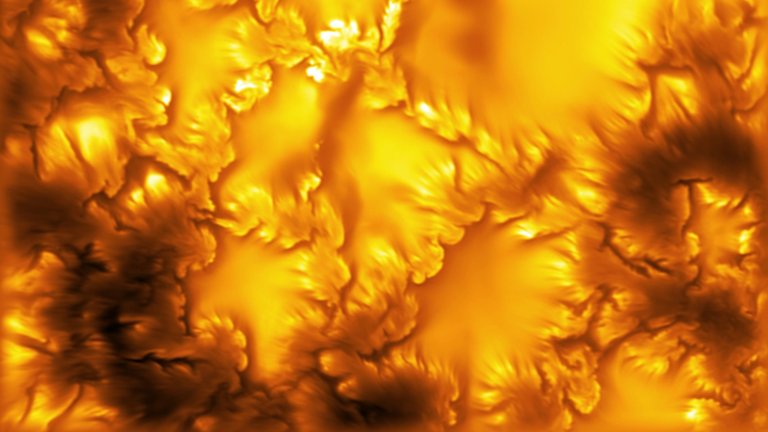
Earlier this month, NASA announced scientists had finally figured out why sunspots disappear, which has mystified scientists for at least 200 years. It has to do with the sun’s insides, which are churning around much like ocean currents on the Earth.
For most of 2008 and part of 2009, the solar disk was blemish-free, which hadn’t happened since 1913, and before that, 1810. It was during the last solar minimum, a period of decreased activity in each 11-year solar cycle. But things were a little quieter than usual. What’s more, the sun’s magnetic field weakened, which allowed cosmic rays to run rampant in the solar system, and Earth’s upper atmosphere cooled off and collapsed.
The culprit was plasma currents within the sun that interfered with the production of sunspots, scientists said in a paper published March 3. These so-called meridional flows act as a great conveyor belt, sweeping along the sun’s surface, plunging deep inside at the poles and emerging again near the equator.
Sunspots are highly magnetized areas of plasma on the sun’s surface, and like anything else, they have a lifespan. When they start to die and de-magnetize, the conveyor belt sweeps them away and drags the plasma into the heart of the sun, where the sun’s magnetic “dynamo” (the name for the mechanism that creates the sun’s magnetic field) recharges them. Then they reappear.
But in 2008, the sunspot reincarnation wasn’t happening. Scientists think it was because back in the late 1990s, the plasma currents had been moving too fast for the dynamo to do its job, and the sunspots couldn’t be recharged. Even after the currents sped up again in the early 2000s, there weren’t enough sunspots to recharge. The result was the deepest solar minimum in a century, and it led to a late start for Solar Cycle 24, which began in early 2010.
New models help explain how all this happened, said study co-author Dibyendu Nandi, an assistant professor at the Indian Institute of Science Education and Research in Kolkata, India.
“It opens up possibility of predicting extreme solar behavior like deep minima, such as what we witnessed, based on internal flows,” he said.
This is very interesting! Thanks so much for the great info.
Jessica Lee Guida
Digital Marketing Strategist
lotus823 - Integrated PR/SEM Agency
Follow Me: @lotus823_Jess
So, according to the caption to image 3, apparently radioactive decay is not constant. Hmm, if the radioactive decay of various radioactive substances can change, how can we assume that the decay rate for Carbon-14, Potassium-40, Uranium-238, and so on are constant? If decay rates are now known to change, doesn't that throw a lot of doubt on radioisotope dating methods?