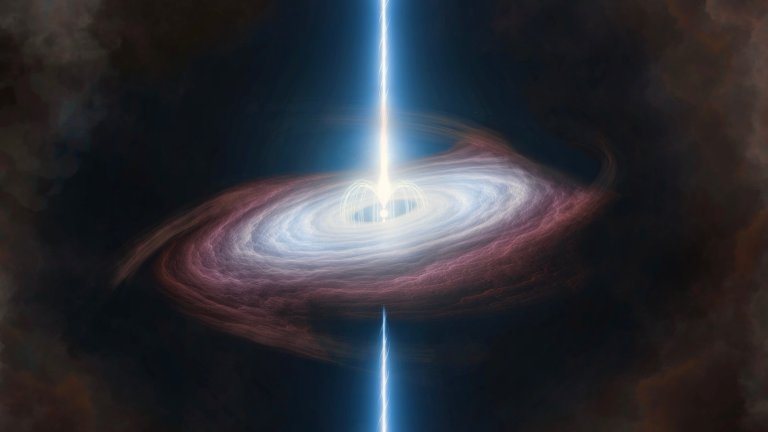
Can you trust nothing in life? A new physics paper suggests that the speed of light in a vacuum may not be constant, and that a vacuum isn't actually entirely empty of stuff.
The paper, by a team of French physicists, finds that the speed of a photon in a vacuum fluctuates by 50 quintillionths of a second per square meter, the Christian Science Monitor reported. In addition, it posits that vacuums may actually have extremely short-lived particles in them that keep appearing and disappearing.
These ideas may be testable, the physicists wrote. Ultra-fast lasers should be able to capture the changes in the speed of light they're proposing.
At the same time, in the same journal, two German physicists studied the properties of a vacuum and proposed an estimate for the total of charged elementary particles in nature—on the order of 100.
Both papers appeared in the March issue of the European Physical Journal D.
140 years of Popular Science at your fingertips.
Each issue has been completely reimagined for your iPad. See our amazing new vision for magazines that goes far beyond the printed page
Stay up to date on the latest news of the future of science and technology from your iPhone or Android phone with full articles, images and offline viewing
Featuring every article from the magazine and website, plus links from around the Web. Also see our PopSci DIY feed
For our annual How It Works issue, we break down everything from the massive Falcon Heavy rocket to a tiny DNA sequencer that connects to a USB port. We also take a look at an ambitious plan for faster-than-light travel and dive into the billion-dollar science of dog food.
Plus the latest Legos, Cadillac's plug-in hybrid, a tractor built for the apocalypse, and more.

Online Content Director: Suzanne LaBarre | Email
Senior Editor: Paul Adams | Email
Associate Editor: Dan Nosowitz | Email
Assistant Editor: Colin Lecher | Email
Assistant Editor:Rose Pastore | Email
Contributing Writers:
Rebecca Boyle | Email
Kelsey D. Atherton | Email
Francie Diep | Email
Shaunacy Ferro | Email
"...Can you trust nothing in life? A new physics paper suggests that the speed of light in a vacuum may not be constant, and that a vacuum isn't actually entirely empty of stuff..."
And prior to the initial moments of the big bang, there was a time where there was no time and no space.
And an interesting side article:
What existed before the Big Bang?
http://www.hawking.org.uk/the-beginning-of-time.html
http://www.dailygalaxy.com/my_weblog/2011/10/what-existed-before-the-big-bang.html
http://scienceblogs.com/startswithabang/2012/10/15/what-happened-before-the-big-bang/
http://scienceline.org/2006/08/ask-snyder-bang/
http://www.universetoday.com/13630/what-was-before-the-big-bang-an-identical-reversed-universe/
"Son, why isn't your light moving at the right speed?"
"Well, there were these particles that appeared in my vacuum!"
"What particles?"
"Well, uh... they were just here a second ago!"
"Son, I am disappoint."
The idea that light speed is a constant in all frames of reference has always bothered me. It also always bothered me that we use time as a unit of consistent measurement when we KNOW it isn't consistent.
Now, particles are creating themselves out of nothingness, then disappearing when they realize they've violated the laws of thermodynamics?
How does this not invalidate everything from Einstein on?
Exciting! Just as the recent data from ESA`s PLANCK telling us that new physics might be needed. And whatever the exact physics they continue to find at CERN and other places lets hope it allows in some way faster then light travel by bending space-time, subspace travel, wormholes or whatever it takes.
That we can actually someday visit other planets in decent time frames instead of taking hundreds of years, centuries or even longer.
To go where no man has gone before!
To infinity and beyond!
The one constant we know for a fact is that man will always be in a constant state of confusion.
"According to the description currently favored by physicists, a vacuum is not completely devoid of matter but instead teems with particles and antiparticles that pop into existence and then run into one another and annihilate themselves, all in very short times. The inherent uncertainty embodied in quantum mechanics permits these spontaneous fluctuations—as long as the particles don't live for more than a fleeting instant, the process violates no laws of physics."
http://www.scientificamerican.com/article.cfm?id=how-the-higgs-boson-might-spell-doom-for-the-universe
"Oh, and a vacuum may not really be void of matter."
Not exactly a new or controversial concept in quantum physics. Nor is it the first experimental data supporting virtual particles (Casimir effect). Although this is the first I have heard of it affecting the speed of light in a vacuum.
Now I'm not saying that their work is not exciting or worthwhile. I'm saying if this is news to you, you have missed a half-century of some pretty awesome science.
Isn't this effect of particles appearing and disappearing the "quantum foam" that Stephen Hawking wrote about years ago?
The only thing that's consistent in life is human stupidity.
Quantum entaglement.
The headline says that this is a finding. It isn't a finding, just a theory that has yet to be tested. It will be quite interesting if the prediction agrees with experiments.
but scientists have known this ever since they discovered that gravity can bend light ...
so what else it 'new' ?
"the speed of a photon in a vacuum fluctuates by 50 quintillionths of a second per square meter"
What? Per square meter? WHAT?!?! That right there is the epitome of Christian science.
My first question would be how dark matter interact with 'light'?
THis isn't news. Light has already been compressed in lab experiments. The compressed light was able to reach its target faster than 186,000 mps. Due to the ability for light waves to be compressed, this effect most undoubtedly happens in nature. The speed of light has never been constant. Light reaching us from billions of years ago has almost certainly slowed, and sped up, over its long journey to us.
"Do not try and bend the spoon. That's impossible. Instead... only try to realize the truth. There is no spoon."
Any word on what keeps the fluctuations bounded by "50 quintillionths of a second per square meter"?
Or what the cause of the fluctuations is?
@ D13 ; Ah, you beat me to it. Agreed, compression would almost certainly happen commonly in space.
We've observed FTL in supernovae too if I'm not mistaken?-??-? And then of course there's the black hole. And then the photons in a neutron star/pulsar as well??
PopSci covered that magnetar that was moving at almost the speed of light--if and when that sucker hits something massive it should really be a show, providing it's not a black hole.
Radio, now it moves at C too, but with the current changing direction so much it would seem to need some area effect to make it go ftl. Yeah, yeah. A black hole would do that but that's too easy. I'll read something on it later and see what I can find out.