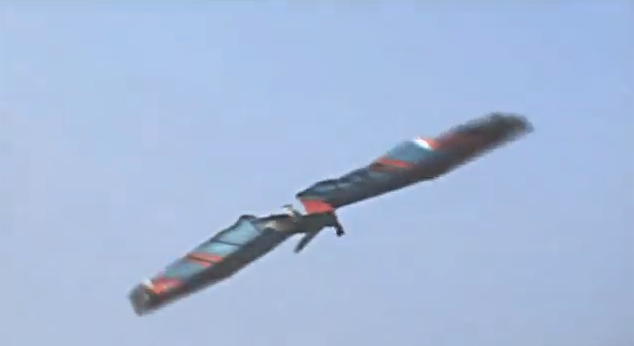
The notion of a person flying like a bird has universal and enduring appeal, so it's not surprising that the "Human Bird Wings" video from "Jarno Smeets" went viral within a few days. However, now that it has been revealed to be an elaborate hoax, eight months in the making, and now that our dreams have been thusly dashed, let’s examine a scientific red flag in the video, one that when pursued bursts the entire fantastical premise: the problem of speed. Watch the video: He really isn’t moving very fast when he lifts up off the ground, so it doesn’t look quite right. Let’s analyze that.
When it comes down to it, the deal is this: What we see in the video must obey fundamental laws of physics to be possible. And knowledge of those fundamental laws will allow us to debunk the whole shebang. In assessing an attempt to simulate the flight of a bird, it's obviously logical to apply the physics of flying birds to our analysis.
In simulating bird flight we can identify four relevant forces acting on the system: The force of gravity acting downward (weight), which is counteracted by an upward lift force, an air drag force which inhibits forward motion, and a forward thrust (or propulsion) force.
Let’s focus on the concept of lift. This leads us to the crucial point: In order to accelerate upward, according to Newton’s Second Law, the lift force must exceed the weight force. (Once in flight in order to maintain altitude the lift force must be equal to the weight force.)
Mathematically:
Fnet = lift - weight = ma
lift > weight
This means that in the case of a bird with a weight of 1 Newton (.225 pounds) it must be able to generate at least that much upward lift force.
In the case of a man weighing 800 Newtons who is attached to another (estimated) 300 Newtons worth of equipment, we would need at least 1100 Newtons of lift.
The question: Is this feasible based on what we see in the video?
The answer: no.
Using the action in the video as data, and then applying some basic principles of physics and aerodynamics, we can see that it just isn’t possible.
To show this, let’s take a look at how birds (and airplanes for that matter) create lift. Basically, when a wing moves through a fluid, the shape and angle of attack of the wing work together to create a pressure difference between the top and bottom of the wing, resulting in an upward lift force. (The angle of attack is the angle of the wing relative to the oncoming airflow.) While the details are much more complicated than the usual popular explanation of Bernoulli’s equation applied to air flow over a curved wing, or an application of Newton’s Third Law between the oncoming air and the wing, both principles are involved and relevant in a complete explanation of the lift force.
In order for a bird to generate lift, it has to propel itself forward through the air such that air flows over its wings. Even though a bird flaps its wings rather than holding them still, as with an airplane, the majority of a bird's lift is created by the forward gliding motion of its wings, not by the flap-flap motion of pushing downwards. The faster the forward motion of the bird, the greater the lift.
One way to estimate the lift force on a wing surface is with the following equation:
L = ½ ρ C A v2
Where L is the lift force, and ρ is the density of the fluid (air, in this case), C is the lift coefficient at a given angle of attack which is usually measured experimentally, A is the surface area of the wing, and v is the velocity of the wing relative to the oncoming air.
Let’s apply this equation to our human bird wings and see what we get. We’ll make the following estimates. Based on a still photo of the wings I estimated their surface area to be 7 square meters. Air density at sea level is approximately 1.25 kg/m3. We can look up studies of bird flight and find that maximum lift coefficients for birds tend to be in the range of 0.8 to 1.2. We’ll be generous and give the wings a lift coefficient of 1.2. Finally we have the crucial effect of velocity on generating lift. On the human bird wings website the fictional Jarno Smeets claims to have flown about 100 meters. I timed the video clip and trying to account for cuts etc. estimate a travel time of 25 seconds which corresponds to a speed of
V = d/t = 100 m/25 s = 4 m/s
Plugging all of this into the above equation results in a lift force of (drum roll, please):
L = 84 N, or a whopping 19 pounds.
Eep.
Just for fun, let’s reverse the calculation and find out how fast he would have to be moving to generate 1100 N of lift. Solving for v we get:
V = 14.5 m/s or 32 miles per hour
Now it must be noted that CGI artist Floris Kaayk (aka Jarno Smeets) went to a lot of time and effort to pull this off. In addition to the weekly blog posts in which he “documented” the development of his “human bird wings” over a period of several months, Kaayk goes to some lengths to show how his pretend mechanical wings mimic the wing motion of birds. He implicitly acknowledges the obvious fact that human arm muscles are highly insufficient for the task and intrigues us with his astonishing control system, which purportedly remotely syncs his arm motion to the motion of a motor using a Wii controller. Finally, although there are some aspects of the video production which are suspicious (as pointed out by some entertainment media experts), he’s a pretty good actor and looks and acts genuinely exhilarated after his "flight."
While our intuition may not always be correct, as it was in this case, when confronted with the increasing proliferation of cleverly edited videos like this one and using some basic physics to pursue the clues, we can go a long way towards determining the ever more relevant question: Is it real or is it a fake?
Five amazing, clean technologies that will set us free, in this month's energy-focused issue. Also: how to build a better bomb detector, the robotic toys that are raising your children, a human catapult, the world's smallest arcade, and much more.


Online Content Director: Suzanne LaBarre | Email
Senior Editor: Paul Adams | Email
Associate Editor: Dan Nosowitz | Email
Assistant Editor: Colin Lecher | Email
Assistant Editor: Rose Pastore | Email
Contributing Writers:
Kelsey D. Atherton | Email
Francie Diep | Email
Shaunacy Ferro | Email
The newton is a unit of force, not weight.
When a unit of measure is named after somebody it is not capitalized.
1 newton is equal to 0.22481 pound-force.
The pound-force unit of measure includes the acceleration of gravity.
Given the parameters you used the wing could lift 84 kg at 4 m/s.
@Chew
The weight is a force. You must be confusing it with mass.
D'oh! You're right, of course. I meant mass. Thanks.
Muphry's Law strikes again.
Well, as Robot would say, "you are late". More importantly, this analysis is quite pointless. The writer almost implies that if "Smeets" had got the numbers right, the writer would have believed his claim! The simple fact is the video looked fake and the signs where there in droves for anyone that wanted to see the truth.
Furthermore, the analysis seems based on level gliding flight (i.e. fixed wing) which is not what was depicted in the video. Estimating horizontal velocity is irrelevant for this case and all calculations based on that are faulty. Just like for a bird, V is the wing velocity which is completely different from the velocity covered over the ground. The writer states this clearly and then calculated V incorrectly based on ground coverage. What is V for a hovering bird???
Given suitable technology, the flight path depicted by this fake could be duplicated exactly by a real flight. I don't believe we have all the needed technology yet ... but perhaps soon.
Ooooo, somebody says I am right! I may allow for one night to allow my ego to become "EMBIGGEN", lol. I am eating ice cream with cookies tonight, oh yea baby!
But tomorrow, it is humble pie, I am the same as everyone else! See ya! Thank you, Far Out Man for the name dropping. Your on my Christmas list now buddy!
.............................
Science sees no further than what it can sense, i.e. facts.
Religion sees beyond the senses, i.e. faith.
Open your mind and see!
1. Check out this video, it's awesome!
2. Hey, by the way, that video ended up being fake.
3. Here's a detailed explanation on how we totally knew that video was fake.
I can't wait for tomorrow's article talking about how they were just testing us when they showed us a bunch calculations for fixed winged flight. Little did we know that those calculations are irrelevant for flapping wings.
And then the article about a new device that can create a 200 psi vacuum!
(we all knew the video was fake)
perhaps a better introduction...
Resident 'Physics Dude' Adam Weiner, with a firm grounding in high school physics, walks through a minimally relevant pop-quiz question to show POPSCI's readers that they would have believed it if Jarno fudged his numbers better.
Ok, the guy was wrong....how about you help him so he could achieve this goal of flying like an eagle?
There is no such thing as True knowledge to human beings, only theories,concepts,and opinions. the absolute truth will never be known to this physical shell.
I cant find the part where it says "We were wrong. We humbly apologize to our loyal readers, And will endeavor in the future never to be upstaged on science matters by Ray William Johnson on =3."
Maybe PopSci should hire Ray to review all videos before they make fools of themselves in the future.
Also note that PopSci was not important enough to mention on =3 along with other big names like wired and Gizmodo. So you have your work cut out for you PopSci.
And I still want that apology.
How quickly we forget. In 1977, the Gossamer Condor won the Kremmer Prize, after demonstrating the first human powered sustained human flight. Comparing the smooth, elegant and huge technology required for the Condor with this video would immediately show it to be fake.
In 1979, the follow-up craft, the Gossamer Albatross, successfully crossed the English Channel under human power. But no normal human could have done it. It required Olympic level athleticism.
You guys should actually do a little research before making incorrect critical comments. Yes I am just a lowly high school physics teacher but armed with some basic physics knowledge and the ability to actually do the research let me set you straight.
Now listen carefully. MOST of the lift force even during flapping flight is generated by the motion of air passing over the wings like with a fixed wing airfoil. The up and down motion of the wings provides more thrust than lift. While bird flight is not fully understood and extremely complex (again I actually read up on this)the equation used in this article is a good approximation and yes the velocity in the equation is relative to the oncoming air not the rate at which the bird flaps its wings.
As far as hovering goes: Hummingbirds are the only birds that do true hovering and they are a separate issue. Other birds either hover by using thermal updrafts or by facing head on into a wind giving them a velocity relative to the air but not the ground. Finally as far as the point of this article. It is twofold. While everyone may not be as clever as you guys, it turns out that a lot of people were not sure what to make of the video. And even if it is obviously a fake some of us actually like to apply the physics to a situation just to have some fun. Because its interesting. I would suggest a little more humility. Here's how we do it in the real science world. If there is something we think is a mistake we politely point it out with an open mind and have the discussion. Sometimes we are wrong.
@AdamWeiner
The fact that you actually took the time to post a reply to the ones out there who are questioning you is tops! Kudos!
As for the topic at hand, I believe that it is only a matter of time before we are "truly" able to achieve flight with our motions. Humanity will only have limitations as to what he/she can do in their minds, and as far as the science community can tell there are no limitations to what we can accomplish as a whole when we put our minds to work on anything!
@adamweiner
thanks for responding. You are right that I should not have mentioned hummingbirds because they fly in a different way. At some point we will be able to create wings that fly in this way too, possibly sooner than "normal" bird wings but that is not what this discussion is about. I suppose the debate boils down to this: Can a seagull fly straight up (lift off) in zero wind?
I think most birds can hover although the energy cost would be extreme for some. I suppose some are just too heavy compared to their lifting capacity. Every time a bird lands or takes off, it is in a state of near hovering regardless of other mechanics that might be involved. Obviously large birds that seldom have to hover are not particularly good at it. As you've indicated, the up and down motion of the wings adds minimal lift just from forcing air downward. The real lift is generated from the angle of attack of the wings in relation to the air mass immediately around it. Taken as a closed system, the bird and the immediate air mass around it can be separated from the environment outside of that system. In such cases, the bird achieves lift only by rapidly moving it's wings backward and forward in that closed system of air. It's forward velocity in relation to the outside environment is not as important in that scenario.
I think it is better to think of a bird's landings, takeoffs and hovering or near hovering in terms of a helicopter rather than a fixed wing aircraft. Again in the closed system of air around the helicopter, the wings generate lift by moving rapidly through that air and it does not matter what speed the helicopter is maintaining in the environment outside of that system (ground speed).
One can also think of swimming. The bird is swimming through the air just as a human swimmer would hold their position in the water with just their arms (no treading). The human gets some lift from forcing water downward but also some lift from creating an airfoil with their hands. The percentages are different because water is denser and our hands make poor airfoils but I think essentially you have a similar effect.
My point ... a bird could have duplicated "Smeet's" flight path and duration exactly and if you believe me, then you must also accept that when real wings are possible, a human will be able to do it also.
@Chew
At the earth's surface 1 N = 100g (not 1,000g - look it up)
@AdamWeiner
I used your equation to see if it would work for a hang glider.
Surface area for a small hang glider is 120 square feet or approximately 11 square meters.
Minimum take off airspeed is around 20 mph or 10 m/s.
Using the same lift coefficient and air density you used in your equations results in a lifting force of 825 N or 185 lbs. Which is a little light for pilot + glider but it is still in the ballpark. (a 120 sq ft glider weights about 50 lbs).
http://www.aerosports.net/intermediate.html
The interesting thing that your equation points out it is that a "bird style" design could take off and fly in similar conditions to a hang glider (running down a hill with a strong headwind). Although it would be prudent to increase the surface area a bit to bring the takeoff speed closer to 20 mph.
@AdamWeiner
2nd (or 3rd) the Kudos for interacting with readers.
I didn't mean to imply (cant speak for others) that there is anything lowly about high school physics. It is, in part , what got me started as an engineer. I apologize if it came off that way on my part.
The back-of-the-envelope proof is valid, if less than I was interested in seeing with a title such as "The physics of True human Flight".
Quite honestly, I think you're unfairly taking the brunt of a bit of indignation with POPSCI. They have a tendency as of late toward carelessness when it comes to content, whether it be a lack of fact checking or a biasing articles, and you're coming in on the tail of this one, still with no real 'Hey, we were wrong, sorry guys!'
I will dream of flying. We do have hang gliders. And we are making more powerful micro engines every day. The dream does seem feasible for the future at least. Oh, to flap our arms and spend our days in control flight, heavenly happy sigh....
.................................
<< Isaiah 40:31 >>
But those who trust in the I-Am will find new strength.
They will soar high on wings like eagles.
They will run and not grow weary.
They will walk and not faint.
.................................
Science sees no further than what it can sense, i.e. facts.
Religion sees beyond the senses, i.e. faith.
Open your mind and see!
I will dream of flying. We do have hang gliders. And we are making more powerful micro engines every day. The dream does seem feasible for the future at least. Oh, to flap our arms and spend our days in control flight, heavenly happy sigh....
.................................
<< Isaiah 40:31 >>
But those who trust in the I-Am will find new strength.
They will soar high on wings like eagles.
They will run and not grow weary.
They will walk and not faint.
.................................
Science sees no further than what it can sense, i.e. facts.
Religion sees beyond the senses, i.e. faith.
Open your mind and see!
@democedes,
Gesundheit. Thank you for the correction. bkulyk spanked me as well.
Exodus 21:7
When a man sells his daughter as a slave, she will not be freed at the end of six years as the men are.
Science flies you to the Moon.
Religion flies you into skyscrapers.
Chew,
Our Dear Lord introduces himself to Moses as the 'I-Am'. Or in other words it was a description and he is beyond any human contemplation or human words.
Religion is a human invention and composes of human words. It was a crazy radical human function of humanity that justified flying into skyscrapers. I am on your side. flying into skyscrapers is an extreme insidious awful act of a few humans.
Yes, science with facts flies to the moon.
But do not close your heart, by confining it to the limitation of man. There is more. God needs no one to make violence to defend him. God will do, what god wants. Those few humans that great violence in the name of God, then they inside themselves have little faith in that God and force their own beliefs on the world.
I TRUST IN GOD! His wisdom naturally will be revealed to me and you and all! God is self evident!
We are all individuals and individually responsible for our own acts!
God is always the color BEAUTIFUL!
.............................
Science sees no further than what it can sense, i.e. facts.
Religion sees beyond the senses, i.e. faith.
Open your mind and see!
i am a mechanical engineer currently studying aerodynamics,
the explanation of why lift is generated for a fixed wing is very complex and depends entirely on wing geometry.
lift generation for flapping wings is even more complex.
both of these subjects cannot be explained easily with a few simplistic equations
*and you mix relative air velocity with ground velocity
Nice analysis. I think we will be able to fly like this one day, flapping and all... but on the Moon, in large pressurized gymnasiums (aviaries?). Same lift forces (or more, if we crank up the air pressure a bit), but 1/6 the weight, makes it all a lot easier.
This analysis contains the same fundamental flaw as that used to prove that bees can't fly. It doesn't take into account wing speed and completely discounts the force generated by compression of the air on the lower surface, which, though secondary to the vacuum lift on the upper surface of the wing can't be discounted (on a flapping wind). This analysis really only applies to an aircraft wing where the force is completely derived from the forward motion.
@JoeStrout
Only problem is figuring out how to land once you're to high up for the moons gravity to pull you back down ha.
This was an obvious fake. You can trick some people but you can't defy physics! Watch the video from 37 seconds to 40S, look at his legs. It is extremely difficult to lift his legs from hanging down to horizontal position without any support.
Once I read your login name, any response to you is pointless.
All this discussion and no one mentioned that bird wings don't just "flap up and down". The tip of a flying bird wing actually traces a figure 8 pattern, which allows the wing surface's angle with respect to the ground to change as the motion is repeated. Simply put, this allows the wing to transition between a moment of lifting and a moment of moving back (creating little or no lift) to the initial position to repeat the 'flap'. This is something like the pitch change involved in a helicopter blade as it changes pitch in relation to its position around the rotor as the helicopter is moving forward. If the amount of lift were always equal for the blade all the way around, it wouldn't work as well for forward flight. The receding blade needs to have less lift.
Also, it is a minor point, but the way a helicopter flies does indeed sometimes depend upon ground speed in the sense that every helicopter has a maximum rated forward speed. To try to exceed that causes loss of lift and increasing instability (the reason Air Wolf's turbo boosted forward speed won't work in reality). But for ground speeds 'within specs' you are right, it doesn't affect things much.
@psciz
thanks for the comment but I'm a bit unclear who you agreed with at the end. I think you are agreeing that a bird's flight cannot be compared with a fixed wing craft attempting to duplicated Smeets' trajectory. I could be wrong of course.
Going back to the helicopter analogy, I'm maintaining that one could fly an RC helicopter exactly along the apparent trajectory of the fake flyer in Smeets video, and in the same amount of time.
Furthermore, I think a bird could do this just as easily. Some birds are not good at hovering but this is not about pure hovering (next to a feeder for example) but rather maximum lift capacity (i.e. many birds can take flight purely by wing effort without assistance from legs, wind etc.).
It then follows that eventually, humans will be able to duplicate the flight exactly too, contrary to Adam's claim and formulation. Of course that will depend on what the maximum lift capacity of the human wings are and how much energy is available to be 'wasted' to enforce the trajectory and timing of this video.