
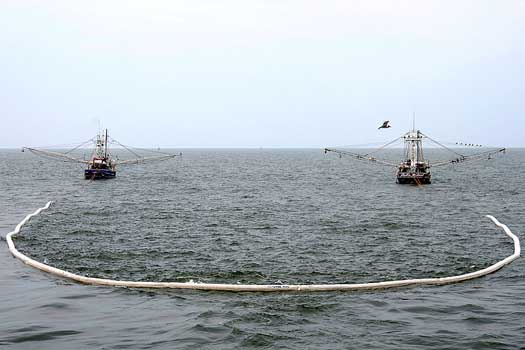
We don't want to jinx it or anything, so hold your breath and cross your fingers while you read this: BP's "static kill" procedure appears to have completely and finally stopped the flow of oil in the Gulf of Mexico. After eight hours of pumping heavy drilling mud into the well pipe overnight, the well pressure is now being dictated by the hydrostatic pressure of the drilling mud -- not by containment caps or other means -- which means a concrete capper should seal the deal.
Before we talk about what this means, a quick spin through the numbers is in order. It's now day 106 since the Deepwater Horizon rig explosion occurred, claiming the lives of 11 rig workers and kicking off what is most currently being estimated as a 62,000-barrel-a-day (barrels, not gallons, making it 12 times faster than BP originally claimed) flow of oil into Gulf waters. All in, 4.9 million barrels, or 205 million gallons, of crude were spilled, costing BP billions in cleanup efforts (they're still on the hook for more) and causing unquantifiable damage to Gulf and Gulf Coast ecosystems.
That's the bad news. The good news is that the worst appears to be behind us. BP is still mulling its options with Coast Guard officials and may either pump in more drilling mud to push the oil deeper into its source rock, or it may begin pumping concrete into the well to cap it off for good. BP is also moving forward with the drilling of the relief well so they can also seal the well from the bottom for added security.So where are all these 5 million barrels of oil? There's good news being reported on that front as well. The New York Times reports this morning that the government is expected to announce that only 26 percent of that oil remains in the water. The other three-quarters have evaporated, dispersed, or been removed by cleanup efforts. How damaging the lingering and dispersed oil is remains to be seen.
Of course, there's still the issue of the 1.8 million gallons of chemical dispersants that were dumped into the water and the various unknown effects they might have on ocean life. But for now, the spill itself appears to (finally) be over with, and that's as good as the news can get at this point.
[Discovery News, NYT, WSJ]

Five amazing, clean technologies that will set us free, in this month's energy-focused issue. Also: how to build a better bomb detector, the robotic toys that are raising your children, a human catapult, the world's smallest arcade, and much more.


Online Content Director: Suzanne LaBarre | Email
Senior Editor: Paul Adams | Email
Associate Editor: Dan Nosowitz | Email
Assistant Editor: Colin Lecher | Email
Assistant Editor: Rose Pastore | Email
Contributing Writers:
Kelsey D. Atherton | Email
Francie Diep | Email
Shaunacy Ferro | Email
"only 26 percent of that oil remains in the water. The other three-quarters have evaporated, dispersed, or been removed by cleanup efforts."
Errrr... what?
*sniff *sniff whats that I smell... ahhh, fishy.
Thats a hell of a lot of oil to just evaporate. But then again, who would know if they were lying? I know people go out in the gulf to scuba dive and fish but its a big place.
It's about time they stopped this.
We were told early on that the best of the best were working on this. I have seen no evidence of this.
Each of the failed efforts had the potential of working, but were poorly planned and poorly executed.
The containment dome failed because apparently the brainiacs never heard of hydrates.
The top kill failed because the junk shot failed. The junk shot failed because there was nothing put in place to catch the junk. A simple chain link screen across each of the openings would have caught the junk and formed a plug. Inject mud/cement, end of story.
Simpler yet, water injection above the BOP could have plugged the riser with hydrates. There are any number of ways to plug a pipe. Just ask any plumber.
Then the diamond saw jammed because the geniuses decided to shear off the riser before sawing it. Before shearing, the riser was held rock steady.
The tophat couldn't seal properly because the seal design was dependent on a clean saw cut.
Kudoes to Cameron for designing a valve stack that even BP could install... even if it did take them 2 months to build it. But wait... aren't these the people who make blowout preventers that fail to prevent blowouts?
I wouldn't trust any of the people to change a flat tire on my car, much less allow them to use power tools.
This entire episode has been a bad joke, and as a Gulf Coast resident, I'm not laughing.
There is oil seeping through the earth now on the mainland, but they are still claiming this a victory and withdrawing their resources. Bad news....bad news bears
@Greystone - Just so you know, capping the pipe and plugging the well are two different things. They achieve the same purpose, but one is more permanent (and difficult) than the other. I doubt your plumber would know anything about plugging a pipe which has thousands of pounds of pressure on it in an deep sea environment.
Also, Cameron is a good company with good products. I work for a valve company and we know what is relying on our valves, they get tested 100% before they leave our facility. Maintaining and periodically testing the BOP is the responsibility of the company that owns and operates the rig, not the manufacturer.
should of just listened to Russia and nuked it
yay!!!!!!!! finally!!!!!!!!!!!!!! after 106 days they finally fix the oil spill!!! About time don't you think?
i vaguely recall hearing a story about how it was raining oil inland in one of the gulf states. so saying that the oil evaporating is a good thing probably came from the bp website. Cliche i know, but "what goes up must come down"
Evaporation was expected by BP. Think about what a barrel of oil yeilds, a fair portion of oil is volatile chemicals; which of course means that much of it will evaporate into our atmosphere. BP was counting on this. Now the rest of the oil will either create tarballs...and float around for years until it arrives on some beach, or bind with the environment probably in unhealthy ways. Bottom line, there has to be a better way than fossil fuels. I am prepared to accept lesser levels of existance in order to maintain the environment for future generations. God gave us this planet and everything in it to use NOT ABUSE!
WHAT A BARREL OF CRUDE OIL MAKES
Product Gallons per barrel
gasoline 19.5
distillate fuel oil
(Includes both home heating oil and diesel fuel) 9.2
kerosene-type jet fuel 4.1
residual fuel oil
(Heavy oils used as fuels in industry, marine transportation and for electric power generation) 2.3
liquefied refinery gasses 1.9
still gas 1.9
coke 1.8
asphalt and road oil 1.3
petrochemical feedstocks 1.2
lubricants 0.5
kerosene 0.2
other 0.3
Figures are based on 1995 average yields for U.S. refineries. One barrel contains 42 gallons of crude oil. The total volume of products made is 2.2 gallons greater than the original 42 gallons of crude oil. This represents "processing gain."
Please stick to the science of the accident! The first rule is to observe and record the facts as best as you can! Look for facts that are repeatable, establish the facts of the observation! The first fact should be the volume of oil that came through the pipe into the open sea! There was a pipe with a diameter X that could only allow X amount of oil to be delivered through the mouth of the pipe over a known period of time! With the facts math takes over! So students, let's establish first how much oil really escaped into the open sea, then how much oil was skimmed up by the fleet of working skimmers! Minus that oil skimmed from the possible oil delivered by the pipe, minus oil recovered through the pipe into waiting oil tanker ships, minus oil recovered with booms and other means, will equal the amount of oil that could have been eaten by microbes, and fires that were set to destroy some of the surface oil, will give us a better ideal of how much oil is missing! Maybe! Most discussions of the accident lacks any facts that would allow a better understanding of the accident, nor how to prevent it from happening again! The accident was caused by the contractor's crew concerned about personal comfort and retarding the safety systems so that the crew would not be bothered by a 3AM emergency alarm, alarms for safety of the crew and the vessel they were sleeping on! Alarms that could have saved lives and perhaps the destruction of the oil rig and the oil pipe line!