Monoliths may not have transformed Jupiter into a star and made Europa a new Earth, but the late science fiction author Arthur C. Clarke might still be pleased, wherever he is, with NASA's prediction for 2010. Spaceflight Now reports that this year should prove whether fossilized life truly exists in three Martian meteorites, one way or the other.
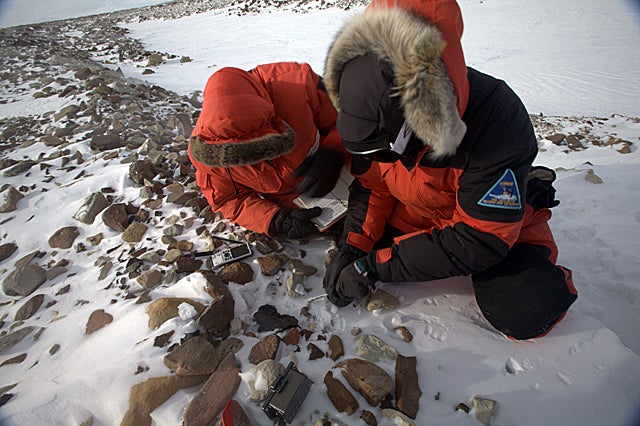
Scientists have been reexamining the controversial Allen Hills meteorite since it sparked reaction from both NASA and the White House in 1996. But now better instruments have turned up possible Martian fossils inside two more meteorites, including a chunk of space rock that has sat inside the British Museum of Natural History in London for almost 100 years.
The scientific teams are "very, very close to proving there is or has been life [on Mars]," said David McKay, chief of astrobiology at the NASA Johnson Space Center in Houston, in a Spaceflight Now interview.
Such life would have likely come from a planet-wide underground network of microorganisms that first emerged 3.6 billion years ago on Mars, scientists say. That development would have paralleled the simple life forms emerging on Earth at around the same time.
New tools for the investigation include a nifty Ion Microprobe that can fire streams of ions onto micro-fossil samples. The ions transform the sample into plasma that can be analyzed via spectrometer for each chemical or mineral part.
People on Earth have already begun wrapping their heads around the possibility of extraterrestrial life. It looks like we might not have to travel all the way to Avatar's Pandora after all.
Five amazing, clean technologies that will set us free, in this month's energy-focused issue. Also: how to build a better bomb detector, the robotic toys that are raising your children, a human catapult, the world's smallest arcade, and much more.


Online Content Director: Suzanne LaBarre | Email
Senior Editor: Paul Adams | Email
Associate Editor: Dan Nosowitz | Email
Assistant Editor: Colin Lecher | Email
Assistant Editor: Rose Pastore | Email
Contributing Writers:
Rebecca Boyle | Email
Kelsey D. Atherton | Email
Francie Diep | Email
Shaunacy Ferro | Email
Mmmm. Reminds me of 'Deception Point' by Dan Brown. Only in Antarctica and with small rocks , not one big one.
--GTO--
The movement in the images of objects moving in the Phoenix Microscopic imager at the Phoenix Lander site as shown at this link
www.youtube.com/watch?v=zhfSjJeQf58
Is not caused by the wind, is not the wind, is not the wind...
The maximum wind speed at the Phoenix Lander site recorded was 5 m/s, 11 mph, by a dust devil, there is not much energy in the wind at that low of speed in that low of density 1/120th of earths. Even if a dust devil moved over the rover it would be gone in a flash and not be around for over several minutes to several hours the time between the first frame to the last frame in the images. The Martian dust fines are several thousand times smaller than the objects in the image's. The objects in the image are between 0.1 to 0.2 mm in size, 0.004 to 0.008 inches, the Martian dust is 0.5 to 30 um, that's 0.5 x 10-^6 m to
30 x 10-^6 m in size. So that moving effect is not caused by the wind...
It is funny how people visually see something that is moving and find subtle things to call it to explain it away I too do this and that's OK because it is a part of deductive reasoning, that's why it is called a UMO in the movie, unidentified moving object because it is similar to anyone supporting their claim if they saw a UFO and caught it on camera, it too is always explained away. The samples in the microscopic imager were dug up, not directly on the surface. Here on earth we have subterranean life that live several miles under the surface. Here on earth we have extremophiles called tardigrades, water bears, that can hibernate for decades and survive the vacuum of space and 1,000 times more radiation than humans that can thrive at the Mars Phoenix Lander site. In fact the maggot like objects moving around in one time lapse movie kind of looks like them.
"Tardigrades are polyextremophiles and are able to survive in extreme environments that would kill almost any other animal. Some can survive temperatures of -273°C, close to absolute zero, temperatures as high as 151 °C (303 °F), 1,000 times more radiation than other animals such as humans, almost a decade without water, and even the vacuum of space. In September 2007, tardigrades were taken into low Earth orbit on the FOTON-M3 mission and for 10 days were exposed to the vacuum of space. After they were returned to Earth, it was discovered that many of them survived and laid eggs that hatched normally, making these the only animals shown to be able to survive the vacuum of space. The biggest adults may reach a body length of 1.5 mm, the smallest below 0.1 mm. Freshly hatched larvae may be smaller than 0.05 mm."
www.en.wikipedia.org/wiki/Tardigrade
The phoenix science team had established that all the necessary nutrients to sustain life was at the Phoenix Lander site. They found water boiling away underneath the Lander, water ice sublimating and the soil was a base not acidic, etc, etc, etc...
Life on or in a rock on Earth, no matter where the rock came from, will not conclusively prove ET life.
"We found some rocks from Mars in Antartica!"
"How do you know they are from Mars?"
"They have the characteristics of rocks from Mars."
"Is there any reason not to think that they came from Mars?"
"Nope."
"Why are you super-anlyzing that rock?"
"We think we found life on Mars."
"You are on Earth, dummy."
"No, no - the rock, the Mars rock, has signs of life . . . there must be life on Mars!"
"How do you know they are from Mars?"
"They have the characteristics of rocks from Mars."
"Is there any reason not to think that they came from Mars, like say, the evidence of life?"
"Yup."
"Where are the rocks from?"
"Antartica."
"Is there life on Antartica?"
"Yes."
"Problem solved."
Islam and Sharia Law are taking over the lands in modern Europe as you read this. Make the stand today and educate yourself on this dire matter!
How the hell do they know for sure that these meteorites came from Mars? I mean its not like they can know for sure right? And if they do find life then it could just be life from Earth itself.
Earth has microbes that live underground in rocks. These "Mars rocks" have been on the Earth for millions of years. How long does it take an Earth microbe to migrate into a new rock?
Now if the Ion Microscope works well, we should definitely send it to Mars. But until they look inside a Mars rock that has never touched the Earth, I won't believe they have found Martian microbes.
@rlb2: Tardigrades are so cool!
Oakspar...
Thanks for the dialog. It said what needed to be said, in an understandable and slightly humourous fashion.
If water bears (tardigrades)would be able to survive on mars... why not plant them their as our first attempt at terraforming? I recognize that in the long history of introduced species in earth ecosystems, such an endeavor never truly ends well for the ecosystem as a whole. However, assuming that there is not life on Mars, why not plant a little bit, give it a few billion years, then go back and meet the neighbors who have evolved? And assuming that there IS life on Mars, this would be a test to see if it is biochemically compatible with earth life. Plant tardigrades, then when you go back and look for life, you can expect to find something, and maybe in the process, find something else feeding on the little beasties!
This kind of founding always make me think, how much of the information are we given? Is this just a preview of a movie which is coming soon, that we are being prepared for? I don't know....Just a thought
www.sirketarama.com
I have been interested in tardigrades and other extremophiles for over 12 years but the credit should go to the field scientist who done the research of these amazing little animals. Some scientist hypothesize that tardigrades were earth Panspermia, meaning them and other extremophiles seeded the earth from the impact of an asteroid or comet. When they talk about the Mars rocks they are talking about some NASA scientist who put their reputation on the line by suggesting such an outlandish thing, it is good to know that the world isn't done hearing about the work they have done.
"Extraordinary claims require extraordinary proof," is something that Dr. Sagan said so many years ago and that explanation for accepting a theory as true goes all the way back thousands of years. Dr. Sagan didn't invent that statement, it is the basic tenant of the scientific community to approve a theory close to being a fact verses an hypothesis. However that being said false models from the past have kept scientific information from being extraordinary to becoming a ridiculous waste of time.
Case in point:
Our sun is the center of the universe.
Wrong....
All moons in our solar system is similar to our own...
Wrong...
Viking results and accepted theory which modeled the entire Martian globe after its finding was that Mars is a cold dry acidic world without water, or water ice and no life bearing organisms....
Wrong....
All these wrong models were accepted by the scientific community and hundreds if not thousands of papers were published in accepting these false models as fact without extraordinary proof........
People actually made money off these un-extraordinary papers, magazines made money off of these un-extraordinary false models....................
Yet when people get very close to reporting the truth without extraordinary proof they won't print this information unless they are supplied from the same scientific community that has been supporting these extraordinary false models........
Correction -- Our sun is the center of the universe.
Should be -- Our earth is the center of the universe..
rlb2...
Neither is the center of our universe. The sun is at the "center" of our solar system, which is on an arm of the milky way, which is in the universe as a whole, but we have no idea where the edges are (or even IF there are edges), so we cannot determine whether we are middle-ish or not.